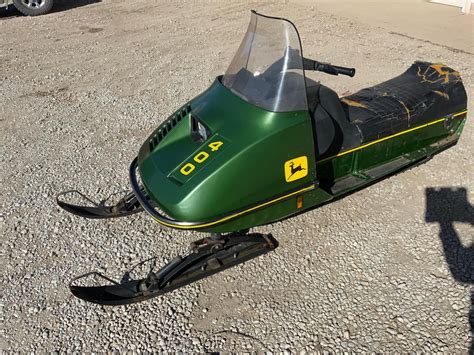
Finding parts for vintage snowmobiles, especially those from manufacturers no longer actively involved in the snowmobile industry, can be a challenge. This article provides a comprehensive guide to identifying and sourcing parts for your John Deere snowmobile.
The History of John Deere Snowmobiles
John Deere entered the snowmobile market with the idea of utilizing their factory during the off-season, building snowmobiles in the same factory as their lawn and garden equipment. However, they soon realized the snowmobile market was highly variable, with sales dependent on snowfall, and the technology was rapidly evolving.
The Winnipeg to St. Paul International 500 & Deere’s Start in 1972
The beginning of the International 500, or Winnipeg to St. Paul race was actually a return of the dog sled route between the two cities, and it was believed that racing the route again on snow machines would prove to the public that the new machines were reliable and people would buy them. It was also the start of the St. Paul snow festival celebrating the winter season.
The race grew quickly, and inside the companies that made snowmobiles, the men that sold them told the men that designed them that this race is important, and the men that designed them agreed. So the men called a meeting with the men that went in circles and the men that test drove, and the man with the big desk said to all the men, “We must win this race to sell sleds on Monday and delight our shareholders”. So, game on for snowmobile factory cross country racing.
Read also: John Deere Sprintfire Specs
The men with the big desk’s at that time were Mr. Ness at Arctic, Mr. Dolan at Polaris, and Mr Hewitt at Deere. Deere drivers were suited with extra pockets for tools and parts as well as their trunk space on the sleds, and at least 15 pounds of repair parts on board!
Deere’s first effort was a learning experience, and the small team fell out one by one to various failures. John Orvis did the best for Deere, but it was apparent to those with keen awareness that Deere had key people filling legal tablets with notes and drawings for the next battle, because the war had really just begun.
1974 I-500
The race was inverted, started in St. Paul, and ran north to Winnipeg, with the starting line on lake Phalin in St. Paul. The rules for race sleds really changed with the cc limit going from 400 cc to 300 cc. The sleds had to be stock production models and would be inspected against stock specifications at the end of the race. The sleds could no longer have tuned pipes and had to meet noise DBA minimums at check in for the pre-race inspection.
A few of the very best prepared independent racers from 1973 on Starfires and EXT’s found a new home inside Deere race engineering. Humiliation builds champions if the commitment is true, and Deere was committed to winning the 500.
Read also: Classic Snowmobile Review
Deere rightfully predicted that manufacturer consolidation would come from 200 down to 6 by 1977! Market share in a declining industry would be a real battle.
1975 I-500
The finish of the 1975 I-500 spawned the start of the most dominating cross country effort in snowmobile history, Enduro Team Deere. The efforts of Knutson’s 340/S mod oval racer and the water cooled Deere prototypes at the Heartland Grand Prix were just small examples of the strategy that was unfolding behind the scenes at Deere.
1976
The 340/S was a sleek and graceful lady more than willing to reward you if handled properly. Her younger sister, the Liquidator, was a 100 MPH high maintenance bitch that would give you the ride of your life, and break your heart without warning. An intoxicating addiction, even with the briefest handful of her throttle, the kind of sled legends are built around, and Championships.
Read also: G-Force One: First Impressions
The sled was built to withstand high speed crashes (you could stand on the hood), rocks, trees, junk in the ditches, and be able to run down bare asphalt for 35 miles. It was 500 pounds of purpose built, long haul, high speed endurance race sled set to carry a wicked fast reputation. The competition stood in awe as nothing like this sled had ever been built. Many were critical of it’s weight, not knowing the potential of the engine.
The enduro driver and circle driver factory rosters changed, and with the exception of the I-500, the factory fielded a cross-country team and an oval team. The Liquidator’s tremendous potential was also it’s ugly side, as the mono block 340 cc piston and ring combination was erratic, resulting in unpredictable scoring!
1978
1978 was the pinnacle of the evolution of cross country racing. The purses were large and the drivers very competitive. The new HP restrictions were in place, and the ICCSF was growing stronger.
Deere supported the ETD drivers independently, with the new Cross County Liquifire getting a Yokohama track and radiator/bulkhead exchanger cooling combination, a Liquidator type seat, and all refinements from the ’77 campaign.
The Deere was able to take extreme punishment with good speed and reliability. Driver skills were also improved.
The 1978 I-500 would draw a large field of entry’s, but in final analysis, only 30 drivers would position themselves with the capability, preparation, and mental discipline to race 560 miles and compete for the win.
Where to Find Parts
Historical Context
JD sold what was left of their snowmobile business to Polaris. Polaris sold what Deere snowmobile parts they had left to Parts Unlimited in the late 80"s.
- Ebay: Ebay is about your best source for NOS and used parts.
- Dennis Kirk: Dennis Kirk has some repro parts still listed. Dennis Kirk snowmobile catalog has lots of parts for obsolete brands.
- Junkyards: Here in WI we got a dedicated snowmobile junkyard.
- Dealerships: You mention you work at a dealership that may still have some New Old Stock snowmobile parts. I purchase remaining snowmobile related items in complete lots such as NOS snowmobile parts, service tools, parts & technical manuals etc. from dealerships.
Parts Catalog Manuals
Are you looking for a comprehensive and reliable parts catalog manual for your John Deere Sportfire snowmobile? Look no further! Our John Deere Sportfire - Snowmobile Parts Catalog Manual is exactly what you need. This manual contains detailed illustrations, parts name, and parts number, making it easy to identify and order the correct part for your machine. It is also very helpful for assembly or disassembly tasks or to learn the machine structure.
Key Features:
- Detailed illustrations
- Parts names and numbers
- Compatibility with Windows and Mac
- Printable unlimited copies
- Viewable on mobile devices
Important Note: Unsafe use of this machine may cause serious injury or death, so operators and maintenance personnel must read this manual before operating or maintaining this machine.
Where to Buy: You will be able to the manual after payment.
Additional Support:
- Type in the make, model, and year of your equipment.
- You can't find what you're looking for, hit us up on our live chat.
Payment Options: We accept major credit/debit cards, PayPal, Google Pay, and Apple Pay.
Understanding Manuals: Our PDF manuals do assume some basic understanding to get the most out of them.
Accessing Manuals: Absolutely. to your smartphone or tablet.
Can't find your manual? No problem! We're here for you.
Restoration and Community
I am now retired to home farm in MI but I am very involved in restoration of JD sleds.
If you are a regular visitor you may have noticed that the forums are no longer working due to a back-end server update.
I am starting the process of putting together our 2020 Calendar! Photos in the snow are best but not required. It is great if you are in the photo too.
Запчасти для спецтехники Delta Parts – найдется все!
tags: #deere #snowmobile #parts