Field hockey is a fast-paced, strategic game with distinct positions, each with unique responsibilities. Understanding these positions is essential for maximizing your performance on the field.
Each team has 11 players - 1 goalie and 10 field players. The field players can be forwards, midfielders, or defenders. Each position requires its own set of skills and responsibilities.
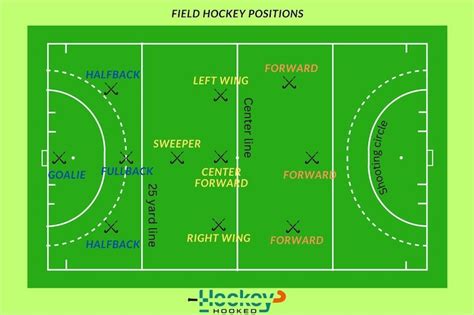
Here's a breakdown of the different positions on the turf, their responsibilities, and their skills.
1. Goalie
Goalies are arguably the most brave and important players on the field. A goalie is positioned in front of a goal that is surrounded by a 16-yard scoring circle with a penalty marker directly in front of the goal.
Unlike field players, goalies are allowed to use any part of their body like their hands and feet as well as their hockey stick to stop the ball. Goalies only have one job and that is to protect the goal. Even so, their job is the most important and they have to stop the ball at all costs.
Read also: Challenges and Triumphs for Babson Field Hockey
Goalies use a specific stick different from field players that is longer, wider, and thicker to withstand the powerful shots coming their way! A goalie is also in charge of communicating with their teammates about defensive strategies. Goalies should focus on communicating with the fullbacks to help protect the goal.
Goalies have to be extremely composed and mentally strong because it can be super unnerving when the opposing team is attacking. The goalie is also the last line of defense which makes it all the more pressurizing. Apart from that, goalies must also have excellent reflexes and good hand-eye coordination in order to stop those quick shots by the opposing team.
Tier 1 goalkeepers command control of the defense and coordinate the team to maintain a strong line of defense. They are unfazed in high-pressure situations and can make smart, split-second decisions. Their agility and athleticism allow them to make strong, consistent saves.
2. Forwards
You can find forwards in between midfield and the opponent’s goalie. They are typically the people who score the most goals in a game. Forwards are also known to be called strikers. Their main job on the turf is to work together to head downfield and score.
Forwards are also known as the offensive line of the team, much like the strikers in football. They’re the ones with the responsibility of taking accurate shots and score goals for the team. More often than not, forwards are the fastest sprinters on the team. Those who play as forwards would usually have outstanding stick skills and lightning quick reflexes.
Read also: Achievements of Duke Field Hockey
They’d have to be able to deflect shots quickly and create opportunities inside the shooting circle in order to score.
Great forwards are unselfish, move quickly, and create spacing and ball movement to help their teammates.
Tier 1 athletes are the best forwards in the college game. These athletes can combine pace, deception and speed to drive the ball to the goal and score. They are extremely versatile with the ability to adapt their skills in various situations. The most important role of a forward is to score goals, which they do consistently from all angles in high-pressure situations.
Top Strikers Do THIS in the Circle in Field Hockey
3. Midfielders
Midfielders (also called halfbacks) are the playmakers of the team, if you love to run this is the position for you. The game begins with a center pass in the middle of the field and most commonly a midfielder will make this to their teammates. These players have strong defense and offense abilities because they play both sides of the ball. From getting a pass off the defenders to scoring, midfielders are in the mix of it all.
Midfielders are also known as the “links” and are the most flexible players. Well, I don’t mean flexible in the gymnastics kind of way but more of their position. They’d have to be extremely versatile as they have to alternate between playing offence and defence. They have a lot of responsibility as they have to support both the forwards and the defenders as well as control the neutral zone.
Read also: Choosing the Right Hockey Stick Size
Midfielders are also the fittest of the bunch, seeing how they’d have to run the field in the space between the offence and defence as well as facilitate passes at the same time. They’re the ones who have to control the game and ensure possession of the ball is kept in the grasp of their team.
Midfielders, also known as halfbacks, must be able to play both defense and offense as they are considered to be multi-taskers on the turf. It is important that midfielders have a high stamina because of their constant movement up and down the field. Midfielders must be ready to defend quickly if an offensive attack fails, while remaining vigilant to where the ball is.
Tier 1 midfielders can effectively support the attack team on offense, as well as fall back to assist the defense team to protect the goal. These athletes have a great deal of stamina, which allows them to cover a lot of ground during the game.
4. Defenders
Defenders have to be proactive, always keeping an eye on the ball and the goal to position themselves in the middle of the two. Defenders use skills like tackling, pressing, and marking to steal the ball from the other team.
Fullbacks are primarily defensive players. Their primary role is to defend an opposing forward and keep the ball away from reaching the goalie. A successful defensive stop will result in getting the ball back to the other side so the mid-fielders and forwards can score. A fullback should know where their opponent is constantly and support the mid-fielder when switching into the attack.
Being a defender is one of the most important roles on the field as they’d have to be able to confront attacking players from the opposing team, protect the goal and clear the ball.
These players have to be able to think quick on their feet and block incoming shots as well as defend aggressively. They’d have to limit the chances of the opponents scoring and shift the game play away from their defensive zone. Although defenders have one of the most important jobs, they’re probably the least lauded of them all.
Tier 1 defenders take control on the field and consistently win one-on-one battles with the attackers. Their upper body strength and ability to time strong tackles make them very successful defenders. When presented with a scoring threat, they can quickly prevent scoring opportunities and regain and maintain possession of the ball in high-pressure situations.
5. Sweeper
Sometimes coaches will have a single fullback play close to their own goal. They are called a sweeper and are considered an extra defense since they will stay back behind the other fullbacks near the goalie. Their job is the same as a fullback, to defend an opposing forward and keep the ball away from the goal box.
The sweeper is a defensive player positioned behind the fullbacks who provide additional support to the defence. Their primary role is to sweep or clear any loose balls or rebounds that penetrate the defensive line. The sweeper also acts as a last line of defence, covering gaps and supporting the goalkeeper.
Tier 1 sweepers are a reliable last line of defense who own their space on the field. They are strong defenders who consistently prevent attackers on the opposition team from creating scoring opportunities. They can quickly clear the ball; intercept passes and regain possession of the ball. These athletes have the innate ability to anticipate the opposition’s movements and time their tackles well.
College Recruiting Considerations
Securing a roster spot for collegiate field hockey isn’t easy. College coaches look for position-specific skills, as well as a list of academic and personal criteria that every athlete needs to meet, regardless of position.
There are 281 NCAA field hockey teams with an average roster size of 22 athletes. Student-athletes who want to play at the college level must keep their recruiting profile up-to-date, compete in tournaments where college coaches are present, communicate clearly and frequently with college coaches and make sure they meet NCAA eligibility requirements. With few scholarships available, remaining committed to the recruiting process and building strong relationships with college coaches is crucial.
While college coaches want to fill their roster with athletic field hockey players, there’s more to catching a coach’s attention than athleticism.
- Fundamentals: College coaches seek athletes who have mastered the fundamentals of ball control and accurate passing.
- Communication: Field hockey requires a great deal of communication on the field. College coaches want leaders with strong communication skills.
- Sportsmanship: Teamwork is critical to the success of a field hockey team.
- Field Hockey IQ: Student-athletes need to have good vision and the ability to make quick decisions.
- Confidence: Strong athletes are not just talented; they are also mentally tough and confident in themselves.
- Athleticism: Field hockey is demanding on the body.
- Consistency: The more consistent an athlete is across game performances, the more reliable they are in the eyes of a college coach.
All five field hockey positions are unique, and college coaches have different expectations of each position. While all field hockey players need to possess the qualities above, college coaches at each division are looking for different experience levels and skills in recruits.
Tier Levels for College Athletes
Tier 1 athletes have the skills and experience to play at NCAA Division 1 programs.
Tier 2 athletes are slightly less experienced and skilled, making them a better fit for lower-end Division 1 programs and top-end Division 2 programs.
Tier 3 athletes are generally suited for Division 3 programs.
Goalkeeper Tiers
- Tier 1: Commands control, unfazed in high-pressure, agile, and athletic.
- Tier 2: Great communicators, calm under pressure, make quick decisions.
- Tier 3: Decent communication, struggle to organize defense, nerves impact decisions.
Defender Tiers
- Tier 1: Takes control, consistently wins one-on-one battles, prevents scoring.
- Tier 2: Strong individually and as a unit, good communicators.
- Tier 3: Understand role but lack confidence, slower reactions, mistakes in battles.
Midfielder Tiers
- Tier 1: Effective support on offense and defense, great stamina.
- Tier 2: Stamina to cover, good support, passing, scoring opportunities.
- Tier 3: Lack stamina, prone to mistakes.
Sweeper Tiers
- Tier 1: Reliable last line, prevents scoring, clears ball, anticipates.
- Tier 2: Solid security, prevents scoring, intercepts passes, clears ball.
- Tier 3: Cover goalkeeper well, but less successful at preventing scoring.
Forward Tiers
- Tier 1: Combines pace, deception, and speed, versatile, scores from all angles.
- Tier 2: Good communicators, create scoring opportunities.
- Tier 3: Trouble adapting, understand scoring role, can make goals from some angles.
Each NCAA division is unique in its own way. To understand what division level is the right fit, student-athletes need to decide what they are looking for in an institution and athletic program.
Once they have a good understanding of what they are looking for, student-athletes will need to evaluate at what level they are best suited to play field hockey. Athletes can research current team rosters to see how they measure up, as well as work with their club and/or high school coach to evaluate their talent.
Joining a club field hockey team is a great way to develop as an athlete. Club teams practice and compete year-round, so student-athletes can consistently focus on improving as field hockey players throughout the year. Another benefit of joining a club team is the increased visibility and access to college coaches that high school field hockey does not offer. Club field hockey teams compete in tournaments attended by college coaches across the country.
Choosing Your Position
Selecting the right position in field hockey is a crucial step in becoming a stronger, more effective player. Whether you're new to the game or have some experience, identifying the role that best aligns with your skills and personality can greatly impact your performance and enjoyment of the sport.
Playing in a position that suits your strengths helps you perform better, boosts your confidence, and enhances your overall enjoyment of the game.
- Assess Your Skills and Strengths: Identify what you excel at on the field. Are you fast and agile? Do you have strong tackling skills? Are you a strategic playmaker? Understanding your strengths helps determine where you’ll be most effective.
- Consider Your Personality: Your temperament plays a key role. If you stay calm under pressure, goalkeeper may be a great fit. If you love leading an attack, forward might be ideal.
- Factor in Your Team’s Needs: Consider where your team could use support. If they need more defensive strength, you might shine as a defender.
- Experiment with Different Positions: Try out various roles during practice.
Your height, speed, and coordination all play a role. Coaches may assign you a position when you're new to the game based on your skills. You're not locked into one position forever. Your coach may assign positions based on what the team requires.
Choosing the right field hockey position is about more than just your abilities-it’s about aligning your strengths, personality, and playing style with the demands of the role.
Frequently Asked Questions
Q: Can I play multiple positions in field hockey?
Yes! Many players switch positions depending on the game’s needs.
Q: Is there a position for everyone in field hockey?
Absolutely!
Q: How can I become a better forward or midfielder?
Work on your speed, ball control, and passing.
Remember that while the basics may seem easy for hockey beginners, the journey to mastery lies in honing the specialised techniques inherent to each position. This is where specialised hockey lessons that focus on how hockey positions should work together, can up your skills and get you ready for higher levels of competition.