The disappearance of individuals during ski trips or in ski resort areas has often presented complex and chilling cases. Some of these cases have remained unsolved for years, shrouded in mystery and speculation. However, advancements in investigative techniques, such as genetic genealogy, have recently led to breakthroughs in some of the most perplexing cold cases.
The Murders of Bobbie Oberholtzer and Annette Schnee
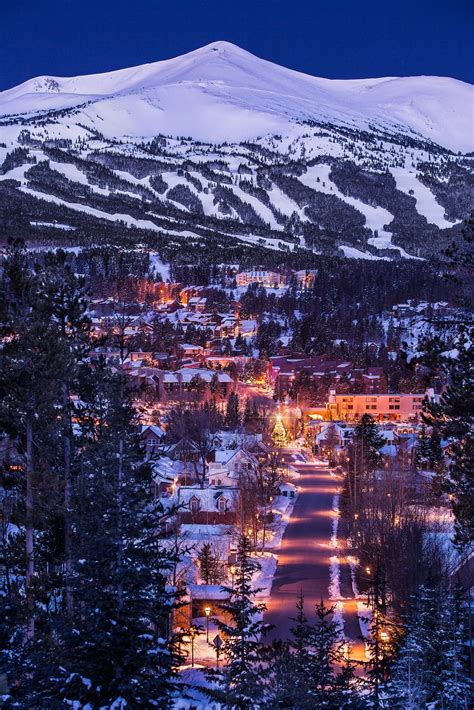
Twenty-nine-year-old Bobbie Oberholtzer and twenty-one-year-old Annette Schnee both disappeared on January 6, 1982. They were last seen (separately) in Breckenridge, Colorado, a small ski resort in the Rocky Mountains with a population of 1,200.
- Bobbie Oberholtzer: On January 7, Bobbie's body was found off of Highway 9 near a scenic overlook near the summit of Hoosier Pass, five miles south of Breckenridge. She had been shot twice. Only two pieces of evidence were found: a set of house keys and an orange sock. Police were mystified; the keys belonged to her, but the sock did not.
- Annette Schnee: Six months later and thirteen miles away, Annette's body was found, this time in Sacramento Creek near a Highway 9 side road. She had also been shot to death.
The murdered women were both area residents. They had both disappeared on the same day, January 6, and had been shot with a medium-caliber revolver. By all accounts, they had never met. Their bodies were found thirteen miles and six months apart. However, police are certain that they were murdered on the same night by the same man.
Initial Investigation and Suspects
The chief suspect was Bobbie's husband, Jeff. Since the murders, he has staunchly maintained his innocence. Bobbie and Jeff were both from Racine, Wisconsin. They married on July 1, 1977, four-and-a-half years before her murder. He ran an appliance repair business, while she worked as a receptionist in Breckenridge. They lived in Alma, fourteen miles away.
According to him, the day of her death, January 6, began normally. She left home at 7:15am and hitchhiked to work. Hitchhiking was quite common in the area and residents often stopped for people that they knew. At 6:20pm, she called home to tell him that she was at the village pub having drinks and celebrating her promotion with friends after work. He asked her if she wanted him to pick her up, but she said that she had a ride and would be home shortly. That night happened to be one of the coldest of that winter, with temperatures reaching thirty degrees below zero. At around midnight, Jeff woke up from a nap and realized that Bobbie still was not home.
Read also: Girl's Hockey Guidelines
When the bars closed at 2am and she still had not returned, he knew something was wrong. He drove in to Breckenridge to look for her. Her friends told him that she had left the bar at around 7:30pm. They assumed that she had caught another ride home. Jeff told the Breckenridge police that she was missing. However, at the time, it was too early to file an official report. The next morning, a farmer who lived thirty miles outside Breckenridge found Bobbie's driver's license on his property.
Jeff went with two friends to pick up the license. On the way, they made a disturbing discovery. While driving past a field, he noticed a blue spot in the snow. It was her backpack, which she had with her when she left for work. Also found was one of her gloves, spattered with blood, and several bloody tissues. Jeff's friends helped him organize a search. Two hours later, the search party came across Bobbie's lifeless body. She was found more than fifteen miles from where her backpack was discovered.
Police found three puzzling clues. Only her footprints were at the crime scene. A plastic cord was tied around one of her wrists. The single orange sock was found nearby. They had no idea who it belonged to. The same day Bobbie's body was found, Annette was reported missing. She was a chambermaid and a cocktail waitress who worked in Frisco and lived in Blue River. Like Bobbie, she often hitchhiked to work.
When investigators first asked Jeff if he knew Annette, he denied it. Several days later, after seeing her picture in the newspaper, he contacted them and said that he did know her and had given her his business card. He claimed that he had once picked her up when she was hitchhiking. He said that he never saw or heard from her after that. On July 3, 1982, six months after she had disappeared, her body was found. Police were stunned when they discovered she was wearing the matching orange sock. Jeff's business card was found in her wallet. Her backpack was later found close to where Bobbie's body was found.
The Events of January 6, 1982
What happened on January 6, 1982? That afternoon, Annette left her chambermaid job in Frisco early because she was not feeling well. She was last seen leaving a pharmacy in Breckenridge at 4pm while in deep conversation with an unknown, dark-haired woman. She was supposed to work at a bar called The Flip Side at 8pm that night. Police believe that around 5pm, she set out to hitchhike home and get ready for work.
Read also: Figure Skating: Black Skates
The killer picked her up and drove twenty miles south of Breckenridge, taking her down a small, dead-end road. She was then either made to disrobe or was undressed by him. She was sexually assaulted and then allowed to get dressed. While she was doing so, she apparently found one long sock and put it on, but could not find the second one. She then put a bootie on her other foot and put her boots on.
Police believe the killer then drove back to Breckenridge and found a second victim: Bobbie. He drove her ten miles south of Breckenridge to the parking lot of a scenic overlook, where he apparently attempted to rape her. Police believe that she fought with him and subsequently escaped from his vehicle. While escaping, the other orange bootie came out with her. She then ran down the highway toward her home. It is believed that he tried to stop her and talk to her. When he pulled out a gun, she ran into the snow. He then shot her twice as she turned away from him.
Jeff does not believe that Bobbie would have gotten into a vehicle with strangers. He points out that they had talked earlier about him giving her a ride, and that she could have called back if she needed one. Approximately two months after Bobbie's murder, Jeff submitted to a polygraph test and passed. From day one, he has insisted that he had an alibi. According to him, during the time the murders were committed, he was with an acquaintance who had dropped by for a visit.
For nearly nine years, no one could find this man. Finally, in December 1990, he surfaced. When police interviewed him, he stated that he had been in Jeff's house that night. However, the times he gave to police did not match up with the times Jeff gave them. Jeff is upset that he remains the main suspect in this case.
Other Suspects and Leads
Police considered Jeff a suspect in both murders. They felt that it was more than a coincidence that he had known both victims and discovered Bobbie's backpack in a remote field. Two months after the murders, he was given a polygraph test, which he passed. He claimed to have had an alibi for the night; an acquaintance had stopped over for a visit. Police could not find him for several years.
Read also: Your Big Sky Vacation
Jeff believes that Bobbie was killed by someone she knew. Police looked into several different suspects in this case. One was cab driver Thomas Edward Luther, who beat and raped a hitchhiker after picking her up in Breckenridge in February 1982. While in jail, he allegedly bragged about being responsible for the murders. According to his girlfriend, he did not come home on the night of the murders. He also lied to investigators and said he was at work at the time.
Another suspect was alleged serial killer Henry Lee Lucas. Yet another suspect, Tracy Petrocelli, murdered his fiancée in 1981 and went on a multi-state crime spree. Police would like to question the unidentified dark-haired woman last seen with Annette on January 6. She was described as a white female, 5'4" tall, and slender build. She is not considered a suspect.
The weapon used in the murders was a .38/.357 handgun using a Remington/Peters copper jacketed hollow point bullet. It was also profiled on Sensing Murder, The Oprah Winfrey Show, A Current Affair, On the Case with Paula Zahn, and 48 Hours during the investigation. The former followed the perceptions of psychics Pam Coronado and Laurie Campbell.
Breakthrough and Resolution
Initially, police believed that the blood found on the tissues and Bobbie's gloves belonged to her. However, in the early 1990s, DNA testing determined that it came from a male. The testing also determined that it did not belong to Jeff. As a result of this and other evidence, including several alibi witnesses, he was eventually cleared as a suspect in the murders.
On February 24, 2021, seventy-year-old Alan Lee Phillips was arrested and charged with the murders. He was also charged with kidnapping and assault with a deadly weapon. Investigators, aided by United Data Connect, used genetic genealogy to link the DNA evidence to him. This process involves taking a DNA sample from an unknown suspect and placing it in a public DNA database.
Investigators suspect that Phillips may have been involved in other crimes throughout Colorado. Interestingly, it was discovered that on the same night as the murders, he was rescued from nearby Guanella Pass after his truck got stuck in the snow there. Scratches were noticed on his face, but he claimed that they occurred after he tripped in the snow.
In September 2022, Phillips went on trial. On September 15, a jury convicted him of all eight charges, including first-degree murder after deliberation and first-degree murder involving felony kidnapping and robbery. On November 7, he was sentenced to life in prison without the possibility of parole.
| Victim | Date of Disappearance | Location Last Seen | Date Body Found | Cause of Death |
|---|---|---|---|---|
| Bobbie Oberholtzer | January 6, 1982 | Breckenridge, CO | January 7, 1982 | Shot twice |
| Annette Schnee | January 6, 1982 | Breckenridge, CO | July 3, 1982 | Shot to death |
The Lil' Miss Murder: Lisa Marie Kimmell
The Lil' Miss murder is the name given to the murder case of Lisa Marie Kimmell (July 18, 1969 â April 2, 1988), a young American woman who disappeared while traveling from Denver, Colorado, to her family's home in Billings, Montana.
Kimmell remained a missing person for eight days before her body was discovered floating in the North Platte River near Casper, Wyoming. Evidence from a nearby bridge revealed she had been bludgeoned and stabbed to death there, before being thrown into the water.
Kimmell's murder remained a cold case for 14 years, until DNA profiling linked Dale Wayne Eaton to her kidnapping, rape, and murder. In 2002, Kimmell's missing car was recovered from Eaton's property, where he had buried it after her abduction and murder.
Eaton was convicted of first degree murder and sentenced to death in 2004. At the time of her disappearance, Kimmell's case was profiled nationally on the series Unsolved Mysteries, and her murder has been subject to various true-crime documentary segments.
Eight days after her disappearance, on April 2, Kimmell's body was found floating in the North Platte River near Casper, Wyoming, by a local fisherman. An autopsy determined that she had been bound, beaten and raped, for at least six days. Evidence showed that she was then taken to the Old Government Bridge (42°38â²18â³N 106°37â²03â³W), where she was hit on the head with a blunt object, stabbed six times in the chest and abdomen, before being thrown into the river.
Kimmell's case was profiled on the television program Unsolved Mysteries within weeks, and A&E's Cold Case Files in the years since, with each case concentrating on locating witnesses who might have seen her black 1988 Honda CR-X automobile with a Montana plate bearing a personalized "LIL MISS" license plate.
In the summer of 2002, investigators researching cold cases came across Kimmell's rape kit, and a DNA profile was developed from the seminal evidence. The CODIS database matched the DNA to Dale Wayne Eaton, 57, of Moneta, Wyoming, who was then serving time at Englewood federal prison in Littleton, Colorado on an unrelated weapons charge.
Eaton's DNA profile was placed in the CODIS database in 1997 after he was arrested on a separate charge: he had stopped to offer assistance to the Breeden family, whose car had broken down, but then he kidnapped the family at gunpoint. After his arrest for this kidnapping, Eaton escaped, but was later recaptured in Shoshone National Forest. At that time he possessed a weapon, elevating his crime to the federal level.
Eaton's next door neighbors reported to investigators that they had seen him digging a large hole on his property in Moneta, Wyoming, approximately 75 miles (121 km) from Casper. The site was excavated in the summer of 2002, and Kimmell's Honda CRX was unearthed, still bearing her distinctive "LIL MISS" license plate.
A fellow inmate, Joseph Francis Dax, testified Eaton confessed to him as follows: Kimmell offered to give Eaton a ride, and Eaton accepted. He made sexual advances during the ride which Kimmel did not appreciate, so she pulled over to let him out of the car.
Eaton was found guilty of all charges and sentenced to death on March 20, 2004. He appealed this conviction and lost. Scheduled to be put to death in February 2010, he sought and received a stay of execution in December 2009. It was overturned in 2014.
Law enforcement has suspected that Kimmell's murder may have been part of a pattern of serial killings, known as the Great Basin Murders, which took place between 1983 and 1996 in Wyoming. Most of the victims were young women who initially disappeared, only to be later found murdered.
Bechtel's white Toyota station wagon was found parked off a dirt road in the Shoshone Forest. Both Kimmell's and Bechtel's cases were profiled on Unsolved Mysteries and Nightmare Next Door.
Kimmell's mother, Sheila, published a book, The Murder of Lil' Miss, about her daughter's life and murder, in 2005. True crime author Robert Scott wrote a book called Rivers of Blood (2009) that detail Eaton's life and crimes, including the disappearance and murder of Lisa Kimmell.

(SOLVED) THE MURDERS OF BOBBY JO OBERHOLTZER AND ANNETTE SCHNEE
The Disappearance of Michelle Vanek
Michelle Vanek, a 35-year-old mother of four from Lakewood, Colorado, disappeared on September 24, 2005, while hiking Mt. of the Holy Cross, one of Coloradoâs most iconic fourteeners. Vanek and a family friend, Eric Sawyer, embarked on what was intended to be an 11-mile hike up the North Ridge trail. However, they mistakenly took the more challenging 15-mile Halo Ridge Route.
By early afternoon, about a half-mile and 500 feet below the summit, Vanek decided she was too tired to continue due to low water, food, and the onset of altitude sickness. She encouraged Sawyer to proceed to the peak while she waited for him. He agreed to tag the summit and meet her on the northeast ridge for their descent. However, upon his return, Vanek was nowhere to be found.
The ensuing search for Michelle Vanek became the largest search for a missing hiker in Colorado history, involving as many as 850 searchers, dog teams, helicopters, and planes. Despite the extensive efforts, no significant clues were found, and the search was eventually called off after several days due to heavy snowfall.
The lack of resolution led to widespread speculation and theories, ranging from abduction by aliens to accusations against Eric Sawyer. For Ben Vanek, Michelleâs husband, the endless speculation only compounded his grief and uncertainty.
Renewed Interest and New Clues
Despite the initial lack of success, the case saw renewed interest in 2022 when a local ski coach and his son discovered a Sorel Asystec hiking boot propped up on a rock in the Lake Patricia area, off the northeast side of Holy Cross. The discovery prompted a renewed search effort, though no other items were found at the time.
In the fall of 2023, Scott Beebe, a longtime member of Vail Mountain Rescue and a Lutheran pastor, had a dream in which Michelle Vanek appeared to him. This vision prompted a team of six women from Vail Mountain Rescue to launch a new investigation into the case.
The Women's Team Investigation
The womenâs team, led by Erika German and Emily Brown, meticulously reviewed the original case files, digitized hand-drawn maps, and analyzed previous search paths using modern mapping software. This allowed them to identify gaps in the initial search strategy, particularly in a series of couloirs on the north and northeast side of the mountain.
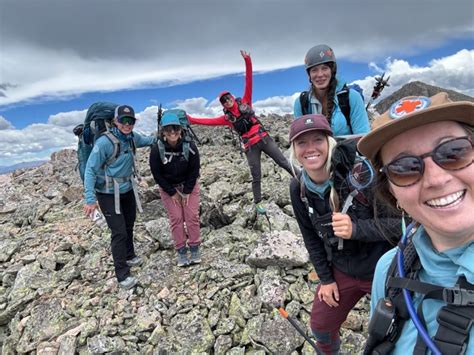
In August 2024, the team conducted a helicopter mission to Holy Cross Ridge but were forced to land three miles away due to high winds. The team members then hiked to the point where Sawyer had last seen Vanek, attempting to retrace her possible steps and understand the choices she might have made.
German and Zach Smith, another member of Vail Mountain Rescue, continued to search the area. On September 13, 2024, they discovered a piece of fabric matching the description of the red shirt Vanek had been wearing, along with a battered ski pole, in a difficult-to-access couloir.