An ice hockey stick is an essential piece of equipment used to shoot, pass, and carry the puck across the ice. Typically, ice hockey sticks are approximately 150-200 cm long and consist of a long, slender shaft with a flat extension at one end called the blade. The blade is the part of the stick used to contact the puck and is typically 25 to 40 cm long. Stick dimensions can vary widely, as they are usually built to suit a particular player's size and preference. The blade is positioned at roughly a 135° angle from the axis of the shaft, giving the stick a partly 'L-shaped' appearance. The blade is slightly curved to aid control of the puck, especially in shooting.
The goaltender has a slightly modified stick. The lower part of the stick is wider, the angle is smaller, and the blade is slightly curved towards the direction of the play.
The origins of ice hockey are the subject of much debate amongst sports historians, but it’s generally agreed that the hockey stick developed from a number of ‘stick and ball’ games from the UK. These include ‘shinty’ from Scotland, ‘hurling’ from Ireland and ‘bandy’ from England, a very early form of ice hockey played with a ball instead of a puck.
Starting in the 18th century, there are numerous references to the Mi'kmaq people of Nova Scotia playing ice hockey, and starting in the 19th century, there are claims that they invented the ice hockey stick. In the mid-19th century, the Starr Manufacturing Company began to sell Mic-Mac hockey sticks nationally and internationally. Through the first decade of the 20th century, it was the best-selling hockey stick in Canada.
The first organised game of ice hockey took place at the Victoria Skating Rink in Montreal, Canada, in 1875. It was played between two teams of nine (today it is six-a-side) and early sticks were hand-whittled from maple or willow.
Read also: Features of Custom Hockey Gloves
Let's explore the evolution of hockey stick materials and construction, from traditional wooden sticks to advanced composite designs.
Evolution of Hockey Stick Materials
Hockey sticks were mostly made from the maple or willow trees, which was also a common choice for golf club shafts and wooden tools. Ash gradually became the preferred medium, and by the 1920s an ash hockey stick crafted from a single piece of wood was the type most commonly used.
There were only a handful of major developments in hockey stick technology between the 1920s and the 2000s. Foremost among these was creation of the laminated stick in the 1940s, where layers of wood were glued together and sandwiched to create a more flexible and durable design. In the 1960s, companies began adding another lamination of fiberglass or other such synthetic compound as a coating, which further added to the durability and usability of the stick.
In the 1970s, cricket and baseball bat manufacturers began experimenting with lightweight steel alloys as a replacement for the traditional willow or ash bat. Hockey stick designers followed suit in the early 1980s, introducing first a single piece all-aluminum stick. This design was not popular, as the stiff aluminum did not have the proper "feel", and so a design featuring an aluminum shaft and a removable, replaceable wooden blade was tried.
In recent years, the aluminum stick, as well as its wooden counterpart, have largely been replaced by more advanced composite designs. Over the last two decades, there have been tremendous advances in the material technology used to create hockey sticks. Carbon fiber has become by far the most common building material for sticks used in the NHL. Carbon fiber sticks were originally sold as shafts alone, much like their aluminum counterparts but nowadays, most hockey sticks are "one piece" sticks. The first company to successfully develop, produce and market "one piece" carbon fiber composite sticks was Composite Busch SA [10] out of Switzerland in 1992. Carbon fiber sticks are ideal due to their light weight and favorable mechanical characteristics.
Read also: The story of Craig Needham
Ash became the wood of choice in the 1920s, and there was then very little development in stick technology until the late 1990s - with the advent of strong, flexible and lightweight materials such as carbon fibre.
How hockey sticks are made
Types of Hockey Sticks
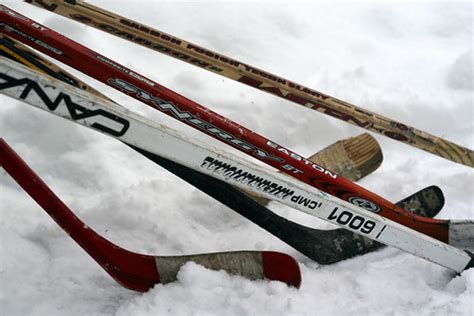
There are two main types of stick - wooden hockey sticks and composite hockey sticks - and which one you opt for is all down to personal preference.
Wooden Hockey Sticks
Wooden hockey sticks have been used since the birth of the sport. They are cheaper than their composite cousins, and players who choose wood often say that they feel much more of a connection to the stick when receiving passes or shooting for goal. A downside of the wooden variety is in how hockey sticks are made, especially when it comes to the top amateur and professional ranks. Every piece of wood is different so it’s very hard to get consistency. It would be like a tennis player playing with rackets that have different string tensions.
Wooden sticks are usually constructed by laminating multiple types of wood into a high quality plywood, then coating the stick and blade with thin plastic or fiberglass. Some manufacturers use fiberglass as a laminate between wood layers. The main advantage that wooden sticks enjoy today is their low cost. This makes them a popular choice for street hockey.
Their main disadvantage that wooden sticks suffer from is their relative inconsistency. Wood has a tendency to warp, and over time its flex and stiffness properties will change.
Read also: Inside Aaron Ness's Career
Aluminum Hockey Sticks
Aluminum sticks were the first non-wood sticks to appear. Most aluminum sticks consist of a shaft made of an aluminum alloy and a wooden blade or composite blade, which is held in the shaft by glue and the compression of the shaft itself. The main advantage aluminum sticks enjoy is their unparalleled durability. It is fairly rare for an aluminum shaft to be broken or damaged, even at the professional level, and since the blades can be easily replaced, a shaft will typically last for a relatively long period of time. Aluminum sticks will not suffer wear or warping like a wooden stick, and they can be manufactured with high consistency.
Composite Hockey Sticks
Composite hockey sticks on the other hand are made of a variety of materials, including fibreglass, Kevlar, and carbon fibre. The shaft of the stick is usually made of carbon fibre, while the blade is made of fibreglass or another material. Carbon fibre is used as it can withstand a significant amount of force without breaking, while it’s also very lightweight. The materials are layered together and then moulded into the desired shape. While composite hockey sticks are lightweight, strong and durable, they do tend to be more expensive than other types of hockey sticks.
Fiberglass was the first composite stick material, initially used with wood. Composite sticks generally weigh less than their aluminum forebears, and they can be manufactured with more consistent (and varied) physical properties than their wooden counterparts.
At the higher echelons of the sport, composite hockey sticks are used by virtually all professional players. Much of the reason for choosing this type of stick comes down to the answer to the question ‘how are composite hockey sticks made?’ Although they’re more expensive than wood, composite sticks are lighter, more durable and can even be custom made to very exact specifications.
Construction of Composite Hockey Sticks
Now let’s find out how hockey sticks are made.
First, sheets of carbon fibre are laid across each other to make an incredibly strong yet light material. This is squeezed through a heated roller that melts the layers together into one sheet of composite fabric. The strips are then cut to size, and between 15 and 20 layers are wrapped around a hollow core.
The carbon fibre-wrapped shafts are now placed in compression tubes, and heated to around 150°C which fuses the layers together until they are virtually unbreakable. The core is removed, and when they’ve cooled sufficiently, a machine tests the flexibility to ensure they can cope with the pressure of a world class ice-hockey player shooting for goal.
As the shafts undergo stress tests, the outer surface of the blades are precisely machine-cut from the same layered carbon fibre that is used to create the shafts.
The inner core of the blade is made from a rubber bladder, surrounded by two pieces of foam. The foam cushions the immense forces that players use to hit the pucks.
To protect the core, 35 layers of carbon fibre are wrapped around it. Similar to the shafts, the blades are heated and pressed inside moulds to bind the layers together with eight tons of downward force. It’s this constant wrapping, heating and binding that gives the stick its strength and explains how hockey sticks are made.
At the same time, the inner bladder inflates, compressing the carbon fibre from the inside.
When the blades are released from the moulds and have cooled down, the shafts are slotted into the blades using ultra-strong glue.
When the adhesive is set, the ice hockey sticks go through a rigorous quality control process.
For one manufacturer, random sticks are selected that have to hit 200 pucks at a speed of 75mph without shattering.
Providing they pass quality control, the sticks are now painted, the manufacturer’s logos are applied and each stick is coated in a protective layer of resin, which gives the players a firmer grip. Finally, a plastic plug is inserted into the open end at the top of the shaft.
Amazingly, the process of how hockey sticks are made takes just two hours from start to finish, a lot faster than some sports (such as the 23 days pool balls take to make!)
Key Features and Design Elements
A critical part of hockey stick performance stems from key design elements and how they are engineered. There are three main areas of the stick that involve detailed design considerations-the blade, shaft, and grip.
Blade
Much like the shaft's flex, a blade's shape is a very important characteristic of a stick's performance. Blade curves vary from small hooks to large sweeps depending on player position and preference. The curve refers to the basic amount the blade curves from toe to heel, as well as the part of the blade where that curve is located. A "toe curve" means that the curve is concentrated near the toe of the blade, and it is usually preferred by forwards, who seek better puckhandling and more accurate wrist shots.
Face angle is the angle between the ice surface and the front surface of the blade (this characteristic is comparable to the difference between the different irons in golf). The toe shape refers to the basic shape of the end of the blade, and it is typically either round or square. Depth, angle, and shape influence lift on shots and handling. The lie angle where the blade meets the shaft impacts how the puck contacts the blade. Materials and layering techniques for blades focus on balanced stiffness, vibration dampening, strength, and impact resistance.
The curve of a blade is limited at most levels of competitive hockey, generally to an amount between 1⁄2 and 3⁄4 inch (13 and 19 mm). The genesis for this rule was the "banana blade" of the 1960s. At the height of this era, players would often simply cross the blue line and let fly with a slap shot, hoping that the bizarre behavior of the puck would beat the goaltender. In the modern game, the emphasis on shooting accuracy has largely eliminated any preference for extreme blade curves.
Hockey stick curves have gained in popularity since their inception. Curves range from strongly angled toe curves to slightly angled heel curves, affecting the feel of a hockey puck. Each hockey stick brand will identify the curves with a specific title. In addition, brands share curves to offer players similarities while using different sticks. The curve of the blade has a direct effect on your ability to shoot, pass and stickhandle.
All Hockey stick curves have some degree of loft to them. This is similar to how golf wedges look, but to a much lesser extent. Hockey stick blades with a closed face will help keep shots low and powerful, with more straight-line velocity. Slightly open faces are slightly more open than the closed option, so it will still provide great power on heavy shots, while also give players an easier time lifting the puck on shots. Open faced blade types are, as the name states, the most open of the three.
- Toe Curves: Blades that have most of their curve at the toe area of the blade.
- Mid Curves: Fall between toe curves and heel curves and in use are a balance of the two.
- Heel Curves: Blades that have more of a curve near the base (or Heel) of the blade. This means that the curve of the blade will start here with the middle and toe of the blade straightening out a little bit. Heel curves are predominantly used by defensemen as they help improve slap shot power and accuracy.
There is no ‘standard' blade length (e.g., 8" for a short blade and 9" for a long blade). The maximum allowed under NHL rules is 12.5 inches from the heel to the end of the blade. Blade length can vary greatly depending on the manufacturer-a ‘short' or ‘long' blade is a relative term and can vary between companies.
Shorter Blades:
- Give the player better puck control.
- Promise a quicker release on snapshots due to the puck having less distance to travel to the release point.
- Create less velocity on shots due to the puck having less time to build up velocity.
Longer Blades:
- Are great for a combination of shot power and puck control.
- Help to maximize shot power because the puck has more contact time against the blade to build up velocity.
- Deliver a slightly slower release on shots as the puck has longer to travel to release.
- Help to make pass reception easier since there is more area on the blade to catch passes.
Shaft
Tapered round profiles with squared edges allow maximum energy transfer while providing areas for gripping. Strategic stiff and flexible areas fine-tune the shaft to player preferences. Shafts utilize layered aerospace-grade composites of carbon fiber, fiberglass, Kevlar, and ultra-high molecular weight polyethylene fibers bonded with epoxy resins.
The lie of a stick refers to the angle between the shaft and the blade. A lie value of 5 corresponds to a 135° angle, and each additional lie value corresponds to a 2° smaller angle. With the bottom of the blade flat on the ice, a higher lie value corresponds to a more upright shaft. Typical values range from 5 to 7; most sticks now are near 5.5. Players usually seek a lie that will put the blade flat on the ice while they are in their typical skating stance.
Flex
Hockey stick shafts, much like golf club shafts, are highly flexible, and this flexibility is a key component in their performance. With most composite and aluminum sticks, their stiffness characteristic is correlated numerically. This number, which ranges from 40 through 160, is printed on the stick and corresponds to the amount of force (in pounds-force) that it takes to deflect or bend the shaft one inch. For example, if 100 pounds-force (440 N) is required to bend the shaft 1 inch (2.5 cm), it would be labelled "100 stiff".
Stick stiffness is viewed as a very important characteristic by most players. Commonly, defencemen seek stiffer shafts, as their greater stiffness imparts more force on slap shots and improves stick-checking.
Engineering Considerations
Designing elite hockey sticks involves navigating complex tradeoffs around flex, stiffness, durability, weight, and performance. The flex profile influences the kickpoint for shooting and energy transfer for puck control. Stiffness affects stability during shots and passes. Engineers balance bend and rigidity through strategic material layering and shaft geometry to match player style and preferences.
The hockey stick undergoes significant impact forces. Engineers focus on enhancing toughness, crack resistance and shielding the blade's foam core. Lower stick weight improves handling and swing speed but can reduce stability and energy transfer. Advanced ultra-high modulus carbon fibers allow thin, lightweight constructions without compromising stiffness and strength.
Stick stiffness, balance and mass distribution influence energy loading for shooting. The right flex rating and kickpoint match the stick to a player's shooting technique and strength. Some composites dampen vibrations from impact shocks better than carbon fiber. Fiberglass meshes well with carbon layers for fracture toughness, while Kevlar augments impact resistance. Weather-resistant epoxy resins prevent moisture degradation.
Engineers characterize materials through lab testing and simulations. Quantifying the mechanical properties empowers performance-driven designs optimized for power, precision, longevity, and feel.

The Future of Hockey Stick Materials
Tomorrow’s hockey sticks will blend sustainability, smart design, and enhanced materials. Manufacturers are exploring bio-based resins, recycled carbon fibers, and embedded sensors that track flex and shot velocity. From classic wooden models to state-of-the-art carbon fiber sticks, the material you choose directly affects your feel, power, and control on the ice.
While carbon fiber garners much of the attention in composite hockey sticks, fiberglass reinforced plastic (FRP) composites present intriguing possibilities. Though less stiff than carbon fiber, fiberglass matches or exceeds its strength and fracture toughness-critical for durability. Fiberglass also better dampens harmful vibrations that cause "stingers" in the player's hands. Reinforcing fiberglass strands with thermoplastic resins like polypropylene or ABS plastic creates rigid FRP composites. The plastic matrix transfers load forces between the strong glass fibers.
Fiberglass and plastic resins cost a fraction of carbon fibers, keeping material costs down. Increased durability also reduces replacement costs. Automated production systems like heated press molding and pultrusion processes enable high-volume, low-cost output of FRP sticks molded to precise specifications.