Adjusting your own ski bindings can be a daunting prospect, but with the right knowledge, you can ensure a safe and enjoyable skiing experience. Ski bindings are designed to release your boot in the event of a crash, reducing the risk of injury. They need to strike a balance between hold and release. This article will guide you through exactly what you'll need to know and do to adjust your ski bindings correctly and safely.
Can I Adjust My Own Ski Bindings?
Yes! The proper binding of your ski boots to your skis is fundamental to allow you to ski safely and ski with the best technique that you can.
Quick and Easy - Ski Binding Setup and DIN Setting
What Do You Need Before Adjusting Your Bindings?
The most popular ski binding types are all designed to be adjusted on the slopes as needed, so you don’t need any additional equipment besides a screwdriver (usually a crosshead). However, the most important point to note is that your ski boots and ski bindings must be compatible with one another.
Major Variations of Ski Bindings
There are many different types of ski bindings, but the three most common binding types are:
- Traditional piste bindings are usually drill mounted (as shown here, without an adjustable toe piece to set your forward pressure), or rail mounted (with an adjustable toe and heel piece to set your forward pressure) to your skis. You’ll find these types of bindings on most off-the-shelf alpine skis. Drill mounted bindings only have an adjustable heel piece, and so they only offer a small amount of forward pressure adjustment, and must be re-mounted using specialist drilling equipment to fit different boot sizes.
- Touring bindings are usually drill mounted (with limited or no toe or heel adjustment to set your forward pressure without using specialist equipment). The key feature of touring bindings is free-heel action, which allows your heel to lift up, designed for traversing or ascending the hill.
- Freetour bindings are usually drill mounted. These “hybrid” bindings combine the safety and security of a traditional piste binding when they are in the downhill mode, with the ability to use free-heel action for touring.
As most skiers want to work on technique on piste, in this article we will concentrate on the more traditional piste style of bindings.
Read also: Battle Bindings: Performance and Value
Brands of Ski Bindings
Even within the category of traditional piste bindings, there are many binding variations depending on which manufacturer makes your ski bindings:
- Marker
- Salomon (sometimes branded as Atomic, Armada, or Scott)
- Tyrolia (sometimes branded as Head or Fischer)
- Look (sometimes branded as Rossignol)
Steps to Adjusting Ski Bindings
When setting up bindings and boots with the brands above, there are four major steps to work through when adjusting your ski bindings.
1. Adjust Forward Pressure
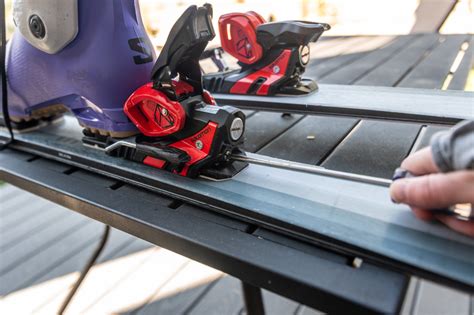
The forward pressure (the pressure applied to the ski boot by the toe and heel of the binding) needs to be exact in order to make for safe skiing. Too little forward pressure and the binding will pre-release, too much pressure and the binding will not release. To adjust this demo binding both the toe and heel can be moved to ensure correct pressure and the boot remains centred on the ski.
To adjust your forward pressure, use the levers on the toe and heel piece to slide the piece along the rail until the marker aligns with the shell size of your boot.
Note: The boot we are using has a shell length of 315mm. This is neither the mondopoint size or shoe size, but rather is the mm length of the boot shell. This mm length is engraved on the side of the heel on every ski boot.
Read also: All About Twin Tips
The toe position has been moved to accommodate shell size 314mm-321mm (as shown here). The heel has been moved to accommodate shell size 317mm as this is the closest to 315mm.
2. Check Toe Height
Toe height is sometimes set automatically but in many cases, the toe height needs checking every few trips as the boots wear from walking. If the toe height is too low the boot may not release in a fall and set too high the boot can move around and pre-release from the binding. It is also worth checking the bottom of your ski boots for damage, small stones wedged under the toe can slow release in a fall by adding extra friction.
A quick and easy way to set the toe height to the correct amount is to fold a sheet of paper in half and place it under the boot forefoot before closing the heel in place.
NOTE: Many new styles of boot use Gripwalk soles. These are thicker and more shaped than older styles of boots and in some cases, these new boot soles will not fit older bindings! Look out for terms like Grip Walk, MNC (multi norm certified) and Sole ID on your bindings.
3. Setting Your DIN Release
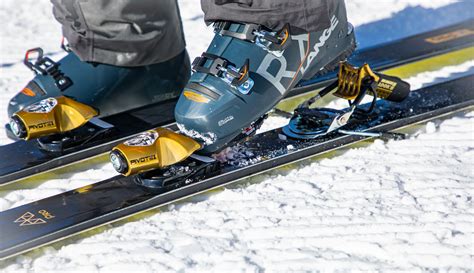
The penultimate step to adjusting your ski bindings is setting your DIN release. The best way to find out your DIN release number is to go get your bindings adjusted in your local ski shop by a professional. This is important because having an incorrect DIN release setting can cause you to either prematurely eject from your bindings if the number is too low, or not release at all if it is too high.
Read also: Safely Remove Bindings
There are many online tools to work out your release setting, but you should be wary of using these. When you've got your DIN setting number, it's time to make your adjustments.
What is the DIN Setting of Ski Bindings?
The DIN setting is the release force setting of a ski binding. It is the value that determines the amount of force effect needed for a binding to release in order to keep the skier from being injured.
There are two officially approved methods to determine this DIN value:
- The tibia method is mainly applied by professionals in Germany. With this method, the expert measures the width of the tibial plateau at you knee.
- Most frequently used all over the world, however, is the bodyweight method. It was developed in the USA and Switzerland, and is based on scientific analyses of skiing accidents.
According to bodyweight, boot sole length, skiing ability, and age, the weight method uses a table to determine the DIN setting. The higher the DIN setting, the later the binding releases, and the higher the risk of injury!
How Do I Calculate the DIN Setting?
To find the right DIN setting for a person using the bodyweight method, you first need the weight, sole length, ability level, and age of the person whose ski binding you want to adjust. Then you have to read the table correctly. Follow these five steps:
- First you want to find the line with your bodyweight inside of the DIN setting table.
- Then you look right to find the base DIN setting according to your sole length.
- Now is where the ability level comes in. We distinguish three different types of skiers:
- Type 1: Beginners and cautious skiers who ski mainly on even to relatively even slopes with slow to medium speed.
- Type 2: Intermediate skiers who ski mainly on relatively even to relatively steep slopes with higher speed.
- Type 3: Very experienced skiers who ski mainly on relatively steep to steep slopes with high speed and pressure on the edges and in an aggressive manner.
- Now you can determine your DIN setting according to the skiing ability:
- Type 1: The base DIN setting is the correct setting.
- Type 2: The DIN setting one line below the base setting is correct.
- Type 3: The DIN setting two lines below the base setting is correct.
- As a last step you can adjust the setting according to age: skiers under 10 or over 50 years old should move one line up to find the right DIN setting.
DIN Setting Table
Here is a sample DIN setting table:
| Weight in kg | DIN Setting in relation to the sole length (in mm) of your ski boot | |||||
|---|---|---|---|---|---|---|
| -250 | 251 - 270 | 271 - 290 | 291 - 310 | 311 - 330 | 330+ | |
| 10 - 13 | 0,75 | 0,75 | ||||
| 14 - 17 | 1,00 | 1,00 | 0,75 | |||
| 18 - 21 | 1,50 | 1,25 | 1,00 | |||
| 22 - 25 | 1,75 | 1,50 | 1,50 | 1,25 | ||
| 26 - 30 | 2,25 | 2,00 | 1,75 | 1,50 | 1,50 | |
| 31 - 35 | 2,75 | 2,50 | 2,25 | 2,00 | 1,75 | 1,75 |
| 36 - 41 | 3,50 | 3,00 | 2,75 | 2,50 | 2,25 | 2,00 |
| 42 - 48 | 3,50 | 3,00 | 3,00 | 2,75 | 2,50 | |
| 49 - 57 | 4,50 | 4,00 | 3,50 | 3,50 | 3,00 | |
| 58 - 66 | 5,50 | 5,00 | 4,50 | 4,00 | 3,50 | |
| 67 - 78 | 6,50 | 6,00 | 5,50 | 5,00 | 4,50 | |
| 79 - 94 | 7,50 | 7,00 | 6,50 | 6,00 | 5,50 | |
| 95+ | 8,50 | 8,00 | 7,00 | 6,50 | ||
| 10,00 | 9,50 | 8,50 | 8,00 | |||
| 11,50 | 11,00 | 10,00 | 9,50 |
4. Adjust Binding Position
Some skiers like to adjust the position of their bindings on their skis relative to the center point of the ski, to dial-in the performance of the ski for certain scenarios. When using a Slalom ski, people often like to move the binding forward to make it easier to turn faster or with a shorter radius.
On all skis apart from twintip freestyle skis, the ski centre is a line, arrow or other marking to indicate where the centre of the ski boot should sit (as shown here). It is important not to confuse this centre line with the ski centre as marked on freestyle skis. Freestyle skis use the balance centre point of the ski, which is much further forward than the centre by length. On a traditional ski, the centre balance point is usually under the toe.
Additional Tips
A few basic tips on how your ski bindings should fit. Skiboard bindings and boot fit require proper fit so they perform correctly. What you don't want is your bindings coming off while riding because they were not properly adjusted. If you are a do-it-yourselfer, then read this. Otherwise, we always recommend taking boots, skiboards and bindings to a certified ski tech (at all resorts).
- When you get to the lift, before you snap your boots into your bindings, very important to remove any snow from the bottom of your boots.
- It is essential that the proper DIN setting is set on your bindings so bindings will release when they should and not release prematurely.
Thanks for reading this guide to adjusting your ski bindings. We hope the tips and 4 steps have left you empowered with knowledge about your binding, and how it can be adjusted! If your binding type has not been covered (there's so many out there!), or if you require assistance to make sure you've got it right, don't hesitate to visit your local ski shop.
Safety Note: Complex mechanics are responsible for the ski binding to fix the boot to the ski or release in time when the skier falls or force is applied, in order to prevent major injuries. The ski binding is an important safety device. Whenever you adjust your ski binding yourself, you should thus be sure of what you're doing, and aware of the possible consequences of a DIN setting too high or too low. If this is not the case, better keep your hands off the binding and see a professional!