This article provides a detailed guide to ice skating spins, covering everything from basic positions to advanced techniques. Remember, it's crucial to learn under the guidance of a qualified instructor to avoid injuries.
Disclaimer: It is important to sign up for group classes or private lessons at your local rink, and please DO NOT try to learn this stuff on your own, especially if you are a beginner.
Moves in the Field (MIF) is all about intricate footwork and precise edge control, and these skills are very important. Basically, if it isn't a jump or spin, then it's a part of Moves in the Field. Ice Dancing and the artistic portions of Freeskate programs all use Moves in the Field heavily. You can learn all kinds of spins and jumps, but if you don't also study MIF, you will look like a grandma moving around the ice in between your jumps/spins.
Some Olympic examples of Moves in the Field (MIF). These skills are very important. Jumps and spins are more like "special tricks", while MIF is where you can show your talent at ice skating itself.
Common types of moves are: forward stroking, spirals, 3 turns, Bracket turn, Choctaw turn, Crossover, Mohawk turn, Rocker turn, Twizzles, waltz eight, power pulls, forward counters, etc. If you're curious about what any of these moves look like, go to YouTube and search for that specific move's name. Some of these moves may look easy, but they're not.
Read also: Mastering Ice Skating Spins
In general, spins tend to be "easier" than jumps. There's a reason why you see Olympic skaters fall on jumps and rarely ever spins.
During a spin, the skater rotates on the spin rocker part of the blade just behind the toe pick. Spins may be performed individually or in a sequence of different spins. Spins may be performed on either foot, but most skaters rotate counterclockwise. About 15% of skaters rotate clockwise.
Counterclockwise skaters - When they spin on their left foot, it is a normal spin. When they spin on their right foot, it is called a backspin. aka back-scratch-spin, back-sit-spin, back-camel-spin. All counterclockwise skaters learn to spin on their left foot first. Then later on, they learn to spin on their right foot for backspins. On both their left and right legs, they always spin in the counterclockwise direction.
Clockwise skaters - they are the complete opposite. They first learn to spin on their right foot, and then later learn to rotate on their left foot for their backspins. On both their right and left legs, they always spin in the clockwise direction.
Spins are generally entered via 3-turns or backward crossovers. If a spin is entered through a jump, it is called a flying spin.
Read also: Choosing Affordable Hockey Skates
Flying spins: flying camel, flying sit spin, death drop, and butterfly spin. A death drop is a more advanced entrance into a flying sit spin. A butterfly spin is a more advanced entrance into a flying camel spin.
In pair skating, spins are usually performed side-by-side or in a specific pair spin.
Hint: Pay attention to leg position and the entire body's position. Now that you're all spin masters, how many spins can you recognize in this video? The arms will vary as skaters like to add their own artistic flair to a spin.
Basic Spin Positions
There are three basic positions: sit, camel, and upright. All spins are variations of these 3 positions.
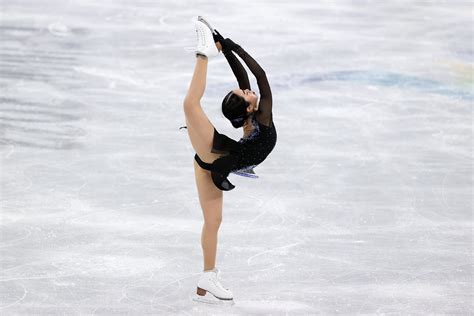
- Upright spins: scratch, back scratch, layback, haircutter, Biellmann, pearl, "I"-spins, "Y"-spins, shotgun, etc.
- Sit spins: pancake, broken leg, tuck behind, cannonball, etc.
- Camel spins: catch-foot, layover, donut spin.
Read also: Ice Skate Innovation: Bauer TUUK
Understanding Spin Levels
Under the new International Judging System (or the Code of Points System), spins are given levels ranging from 1 to 4 with 4 being the highest level. Be aesthetically pleasing. The skaters should not be too far from each other.
To make a spin harder, skaters can enter into a jump through very difficult transition movements. Butterfly - The skater’s legs make a scissoring motion in the air and the skater’s body is horizontal above the ice before entering into the spin. The takeoff is done in a twisting motion with 2 feet.
Flying spin - In which a skater does a bit of a jump before entering the jump. Skaters often start in a layback position and finish in the Biellmann spin. In a Biellmann spin, the skater pulls the free leg up above their heads (it is not a Biellmann unless the foot is above the head) with one or two hands.
The pearl spin was created by Caroline Zhang and despite its pretty name, it’s actually just a catchfoot layback that transitions into the Biellmann spin.
In addition, the arms are usually held above the body. The layback spin is more commonly done in ladies figure skating whereas the previous two spins are done in both the ladies and men’s competition. The layback is done in an upright standing position with the skater’s back arched and the head is dropped back. However, some skaters will do variations of a layback spin where they hold their free leg (a catchfoot layback).
The sit spin is, as the name implies, done in a sitting position where the skater’s skating leg must be parallel to the ice and the buttocks must not be higher than the knee. The camel spin is done in an arabesque position or with the free leg (the leg that’s not on the ice) parallel to the ice or higher than the hip.
When we learned about jumps, we learned about inside and outside edges. You can change edges in a spin as well. For those of you who are a little OCD, you can spot the change of edge when the circle of the spin (when you spin, you don’t rotate on an axis but the blade makes a very small circle on the ice) gets a little bigger or changes a little. This makes the spin more difficult but for the average viewer, the edge change can be a little hard to spot. Personally, I wouldn’t be too worried about this if you want to be an informed viewer at the Olympics.
Pair Skating Spins
Side-By-Side Spins - An element done only in pairs skating in which both skaters execute the same spins at the same time. The spins should be done in perfect unison and not too far from each other. If you listen closely at live competitions or in videos, you can hear one of the partners yell, “Change” when they need to change their positions.
Dance/Pairs Spin - The spins themselves are similar but are named differently depending on the discipline in which they are performed. In a dance or pairs spin, the two partners must always be connected to each other while spinning.
Basic Skate Levels
If you don't know how to ice skate at all, then you need to start in the Basic Skating classes to learn how to move around the ice well BEFORE you start learning jumps and spins. No one is going to put you in a Freestyle class until you demonstrate you can skate well.
Basic Skate classes are:
| ISI Level | USFS Level |
|---|---|
| Pre-Alpha | Basic 1-2 |
| Alpha | Basic 3-4 |
| Beta | Basic 5 |
| Gamma | Basic 6 |
| Delta | Basic 7 |
| Freestyle 1 | Basic 8 |
Some rinks will have separate Adult basic classes simply labeled "Adults 1-4". But it's the same skills as the Basic Skate classes. Adults can still take the Basic Skate classes instead of the Adult 1-4 classes because there is no age limit on Basic Skate.
Depending on the rink and class setup, I sometimes recommend taking the Basic Skate classes instead of the Adult 1-4 classes in order to advance faster. Kids aren't afraid to fall down and you can learn quickly in those classes. The Adult 1-4 classes are usually full of adults terrified of falling down, which slows down how fast the teacher moves on to teaching the next element. If you're a fast learner, you will quickly grow bored waiting on terrified adults. But it just depends on your rink and how fast you want to progress.
Some rinks will have group lessons for Freestyle levels, and some only have private lessons. I don't really recommend private lessons until you hit Freestyle level 1 or level 2. But you will always learn faster in private lessons once you hit Freestyle levels. Many Freestyle skaters continue to take both group lessons and private lessons in order to advance as fast as possible.
You might be able to make it through Freestyle 1-3 on group lessons alone, but Freestyle 4+ is going to be very, very difficult without a private lesson.
Note: All ice rinks are set up differently and may have different names for their classes. Some rinks have named their Basic Skills or MIF classes "Freestyle" or "Free skate"! Which means there are no jumps or spins taught in the class! In this set up, they usually call the advanced classes "Spins class" or "Jumps class". So just ask and make sure you know what you're signing up for.
First, a skater passes the Moves in the Field test at a particular level, and then the Free Skating test. In USFS, Moves in the Field tests and free skate tests are separate. You cannot take a Free Skating test without first passing the corresponding Moves test, but you can continue advancing in the Moves levels even if you never take the Free Skating tests. In the ISI testing system, Moves in the Field and Jumps/Spin elements are included together in one test.
The USFS specifically has an Adult track (age 21+) that adults can test in, which has lower required passing scores to make it easier for adults to pass tests, instead of testing in the standard track with all of the kids. However, the USFS Adult track switches to the normal track at the Intermediate test level.
Adult levels are called Pre-Bronze, Bronze, Silver, and Gold. After that, an adult skater switches to the Intermediate level in the standard track.
Adult Pre-Bronze, Bronze, Silver, and Gold have the same required elements as the kids' standard track levels, so you're not missing anything, you just get judged less severely during tests, which is great for adults who may not be as strong or flexible as young kids.
Advanced Spin Variations on Ice: Mastering All Basic Positions
One-Foot Spin
A one-foot spin is a basic, upright figure skating spin on one foot. This spin is the basis for other more difficult upright spins, such as the scratch spin. There are multiple different entrances to this spin. The instructions below are for a counterclockwise spinner.
- Have your left arm in front of you and your right arm to your right. For right footed skaters, this will be your left arm. For left footed skaters, this will be your right arm.
- Keep your head up, and look to the left.
- Keep your body stable. Feel the center of the spin.
- Begin to pull your arms into towards your left.
- Try bringing your right foot to different heights, from just above the ice to your knee. Do not drop your hip when you lift your leg.
- When you are ready to end the spin, put your right foot down, and lift your left foot behind you.
If you are right footed, you will spin on your left foot, meaning you will start off your spin by doing right over left backwards crossovers. If you are left footed, you will spin using your right leg, so you will start off your spin from left over right backwards crossovers.
It is difficult to spin on your toe pick, and doing so can damage the ice. Be aware of your surroundings. Make sure you look behind you when doing the backwards crossovers, for it is easy to accidentally hit someone. Find your center before raising your free leg or stepping into your spin.
Overcoming Dizziness
Skaters initially get dizzy, but then it becomes second nature. "Joe Rosato Jr. Former National skating champion Shane Douglas said the key to getting over dizziness is to keep skating. "What we tell our students is keep spinning," said Douglas. "The more you do, the less dizzy you get." Douglas said it could take skaters about a year to get used to the dizziness. That’s how we felt when we first got our monocle.
As a figure skater for 17 years I can attest to the fact that it does go away…spotting a point on a wall DOES NOT help and can make it worse and can cause you to lose your balance!! You really have to think of a line that goes vertically through your body and you have to learn to balance your weight between both sides. I know that probably dosen’t make sense. Closing your eyes can work only if you have a really good propreoceptive awareness. I personally do a fixed gaze out to nowhere! lol Literally I fix my gaze out infront of me at nothing imparticular….when I don’t do this I get crazy dizzy! Also keeping your whole body strong during the spin will help keep even blood flow through your body therefore reducing dizzyness….but really practice makes perfect!!
We teach on spinny poles here at the studio I instruct at, and I tell students to spot something moving WITH them, i.e. their fingers on the pole, their foot, etc. and not focus on the world spinning around them. This trick has helped me overcome the dizzyness and I have had other students tell me that it has helped them as well.