Every hockey player has their own pre-game ritual, but taping the stick is one of the most personal. Taping your stick isn’t just a routine-it’s part of your hockey identity. In many locker rooms, perfectly taped hockey sticks are considered a work of art.
Within this article you can expect to learn:
- How to tape hockey sticks
- Why players tape their hockey sticks
- Pictures of standard hockey stick tape jobs
- How the pros tape their hockey sticks
- Removing hockey tape from your stick
Stick taping styles not only add character but also influence puck control, shot release, and blade durability. Do you like the smooth glide of a clean forehand pass, or the grippy hold for a booming slap shot? Your tape job makes a difference, but the stick underneath matters most.
From heel-to-toe for control to toe-only for creativity, each stick taping style has its strengths.
For hockey players, one of their most prized possessions is their hockey stick, especially when it’s new. One of the best ways to take care of a hockey stick is to make sure you have an effective hockey tape job on both the blade and the hockey shaft. This is a tedious process for some, but a properly taped hockey stick blade can also be the deciding factor to whether or not you snipe that overtime game-winning goal!
Read also: Features of Custom Hockey Gloves
HOW TO CHOOSE YOUR HOCKEY STICK FLEX AND CURVE - MATT REDMOND
How to Tape a Hockey Stick
Just like tying skates, there is no “correct” way to tape a hockey stick. Whether your tape job looks like Patrick Sharp’s, David Pastrnak’s, or anyone’s in between, ultimately it comes down to whichever style and method works best for you.
After purchasing your hockey stick, you will want to make sure that it is the correct length before taping. While on skates, sticks should stand between your chin and your nose, depending on your preference.
First things first, you will need a roll of 1.5-inch or 1-inch Renfrew Hockey Tape (white or black, depending on preference), stick wax, and a pair of scissors, if needed.
There are three main sections of a hockey stick that can be taped: the handle, the shaft, and the blade. With each section, it is important to remember the following tips. Use cloth tape. Never use sock tape or any tape that has a non-grippy surface. Cloth tape will give you control of the stick and puck while in action. Another tip is to try to be as precise and consistent as possible. Take your time and make sure you are getting even spacing between each wrap and ensure there are no bumps or spaces.
How to Tape a Hockey Stick Handle or Butt End
Taping the top of the stick is important, as this is from where almost all control of your stick will be generated. It will have a direct effect on your shooting, passing, stickhandling, and so on. With that said, there are many variations and it will take some time to figure out which method you like best. Some players like a big knob at the top with a lot of tape wrapped around, some prefer little to no knob, some like the “candy cane” grip, some prefer a stick grip like the Buttendz Twirl 88 grip, and some prefer a completely different style. The most universal style is a simple mid-size knob.
Read also: The story of Craig Needham
You will want to start at the top of the stick and wrap the tape around the top of it until it gets to your desired size. Simply cut the tape when the knob gets to your desired size. Most players stop when their pinky finger comfortably wraps around the knob while holding the stick with a pair of gloves on.
From there, starting just below the knob, you will firmly wrap the tape around the stick, moving down diagonally, until you reach your desired length. The common lengths for tape handles are between 4 and 10 inches. Once you get to your desired length, do one last lap at the bottom that is horizontal and overlapping a bit, and then cut it.
How to Wrap a Hockey Stick or Taping the Shaft
Because some sticks have grip and others do not, another option for added grip and control is to tape the shaft of the stick. One name that comes to mind when discussing taping the shaft is that of Phil Kessel. The setup here is the traditional candy cane method. With 1-inch tape, start right below the buttend and wrap around the stick with your 1.5 to 2 inches in between each wrap. Proceed down the stick until you reach your desired length, and then finish it off just like you did with the grip at the top.
This method is not commonly utilized, as most players prefer to have the ability to remove and slide their bottom hand when necessary on the ice.
How to Tape a Hockey Stick Blade
Lastly, we arrive at the blade of the stick, which is arguably a hockey player’s most important part of their stick. Much like the grip of the stick, there are many variations when it comes to taping the blade of the stick.
Read also: Inside Aaron Ness's Career
One of the most commonly asked questions is whether the tape job should be done toe-to-heel or heel-to-toe. Some say the heel-to-toe method, while slightly decreasing their shot speed, adds spin to the puck that makes it difficult for goalies to control. Wrapping your blade toe-to-heel is said to slightly shorten the time it takes for the puck to get off your blade during shots.
Starting off, you need to decide what color tape you want to use. The most common colors are black and white. While this may not seem like it plays a significant role, there is more to the decision than you would think. Using black tape on your blade is said to make it harder for goalies to locate the puck during shooting. The downside to that is it is a little bit harder for players to track the puck during stickhandling. A black puck against a black blade may be difficult to see. The exact opposite is said about white tape. Although it is a little bit easier for goalies to track the puck when there is white tape on your blade, it is easier for the stickhandler to track the puck using their peripheral vision, due to the contrast of the black puck against a white blade.
After choosing what color tape you want to go with, you can then start taping the blade. Whichever end of the blade you choose to start from, proceed from there to the opposite side. As mentioned before, it is important to make sure that your spacing is consistent with each wrap. Doing this will give you that consistency you are looking for in your passes and shots.
After picking a starting point, wrap the tape vertically across the blade, overlapping each previous wrap a little bit less than halfway. Once you get to your desired length, cut the end and overlap the previous wrap. Generally speaking, you do not want to extend the tape job up to the shaft, although it does come down to preference.
Upon completion, rub your hand along the tape area in the direction your tape faces to ensure that the tape is completely secured and smooth.
You can add stick wax to your newly taped blade as well. There are multiple brands of stick wax, but you will want to make sure that it specifically states it is stick wax and not just general wax. Stick wax gives you added control of the puck on your blade, helps wick away ice and water, and helps increase the longevity of your tape job. Simply take the wax and make 4-6 passes horizontally across the front of the blade. Repeat this process 2-4 times to the backside of the blade, as well.
Another alternative to wax is to use friction tape, which has an adhesive finish on both sides of the tape.
After following these three main steps, you are now ready to try out your new tape job and score some epic snipes!
Taping a hockey stick for roller hockey is slightly different. Players typically place precut strips of tape horizontally from the toe to the heel. If you were to use traditional stick taping, the tape will create resistance when making contact with either tile or concrete.
Why do Hockey Players Tape Their Sticks?
Almost all hockey players use some form of tape on their sticks, and for good reason. Taping your handle and blade both have multiple benefits. As briefly mentioned earlier, the biggest benefit of taping your stick is control. Composite sticks in today’s game have a little bit of tactile grip on the blade, but the surfaces do not offer the control and feel that tape provides.
Taping the blade also provides a small cushion when receiving passes, allowing you to catch and release the puck off your stick that much quicker. This will also give the blade a stronger, more durable feel.
Another benefit of taping the blade, specifically, is that it helps with surface protection. During games, your stick is susceptible to stick checks, skates, the ice itself, and so on. Taping your blade can help protect against these types of issues. It can also help to prolong your blade structure against small hairline cracks.
Taping the handle of the stick gives you full control with your top hand during stickhandling, passing, and shooting. It is especially crucial for defensemen, who control their stick with their top hand for most of the game, allowing them to poke check and defend against opposing players.
After taping your stick for the first time, you will quickly realize that there are many different options and possibilities. Starting with the handle, apart from the classic handle discussed earlier, the “candy cane” handle is another popular option, especially among younger players. Thanks to the ridges this method provides, it adds an extra layer of grip, providing you with a more controlled feel.
Regarding the blade, other popular options include taping the toe and ending at the halfway point of the blade. This style is considered to be more advanced and caters towards players who take powerful, quick snapshots with the puck launching predominantly from the toe of the blade. While this option is great for players taking quick snapshots and utilizing toe drags, it leaves the back half of the blade unprotected, making it susceptible to damage.
Another popular option for taping the blade is taping the part of the blade where it makes initial contact with the ice. This is known as the mid-blade wrap and caters towards players taking mainly wrist shots. Jamie Benn of the Dallas Stars and Phil Kessel are both known for variants of this tape job. While it does work for them, it is important to note that not only does it leave the heel of the blade exposed, but it leaves the toe exposed as well.
Pictures of Hockey Stick Tape Jobs
Here are some popular hockey stick tape jobs:
| Tape Job Style | Description | Pros | Cons | Image |
|---|---|---|---|---|
| The Classic Hockey Stick Tape Job | This standard tape job has been around forever. It consists of a heel-to-toe style that leaves just a sliver of the heel and toe exposed. | Excels in protecting the entirety of the blade and gives players full control of the puck during stickhandling and shooting. | Uses more hockey tape in comparison to some of the other methods. | 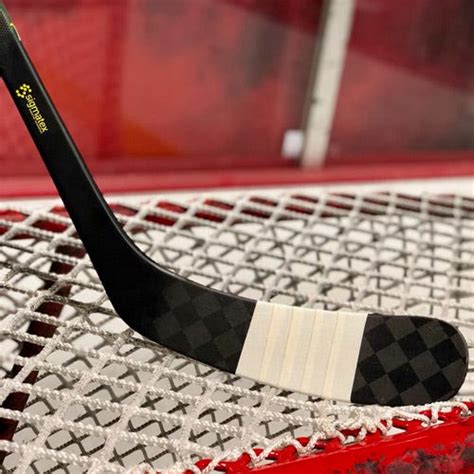 |
| The Toe Tape Job | Starting at the center of the blade, continue up to the toe of the blade, and completely wrap it. | Uses significantly less tape than other options. Greatly benefits players who take mostly quick wrist shots from the toe of their blade. | Can take some time to perfect this method. Leaves the back half of the blade unprotected, leaving it susceptible to potential damage. |  |
| The Five Strand Tape Job | Starting just past the midpoint of the blade and complete five wraps around the blade, moving forward towards the toe. | The quickest and easiest to complete and does not require a lot of tape. | Leaves the most of the blade unprotected as well, both on the toe and heel. | 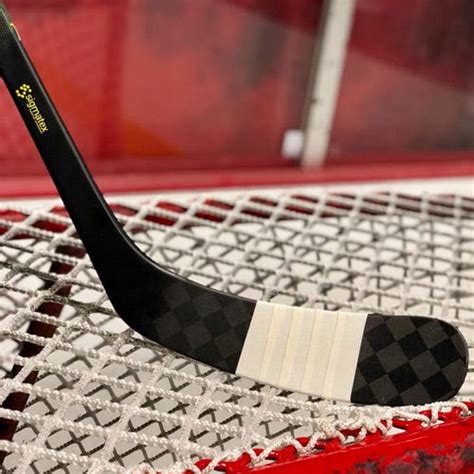 |
| The Sock Tape Job | Starting at the heel, and proceeds heel-to-toe all the way to the toe, covering it completely. | Blade will stay fully protected from heel to toe. You will have consistent control of the puck anywhere on your blade. | Uses the most tape out of any on this list and can potentially take the longest to complete as well. |  |
How the Pros Tape Their Hockey Sticks
Sidney Crosby Tape Job
Throughout his career, Sidney Crosby has been known for his unparalleled stickhandling and puck control in tight areas. Assisting him with this is his ‘Classic’ tape job, as he has been seen using for the majority of his NHL career. Additionally, he is almost always seen using black hockey tape on the blade.
Since being drafted, it was quickly apparent that Sidney Crosby had the potential to become one of the best all-around hockey players ever with his unmatched hockey sense, deadly precise edge work, and deceptively quick hands. Since his junior hockey days, he has followed his same taping style. Crosby utilizes the aforementioned “candy cane” handle, giving him added control of his stick in tight spaces when stickhandling. Crosby generally uses white tape for his handle, but lately has been seen taking advantage of grip tape, which helps to preserve glove palms.
As for the blade, Crosby tapes most of his blade, leaving just a sliver of the heel and toe exposed, predominantly in black tape.
Alex Ovechkin Tape Job
A year prior to that, one of the best goal scorers of all time entered the league. His name is Alex Ovechkin. Not only does he have one of the deadliest snapshots and one-timers the league has ever seen, but he can lay a decent hit as well. So, to what does a guy with nearly 650 career goals, and climbing, attribute his success? Part of that must be the way he tapes his stick, right?
Ovechkin is known for the wicked toe curve on his stick, and he knows how to use it to his advantage. He tapes his stick around the toe to just past the halfway point of the blade, using 1.5 inch white cloth tape. Since Ovechkin takes mostly quick one-timers and heavy snap shots, it is important for him to have that extra grip and protection right at the toe of his blade. Ovechkin almost always goes with the same handle: white tape with red grip tape over top, about 8 inches down.
Connor McDavid Tape Job
The name Connor McDavid is probably one you have heard of as well. During his junior hockey days, it was apparent that this kid was a generational-type player. Since going first overall in the 2015 NHL Draft, McDavid is already closing in on 350 points. It seems like every week we see him on a highlight video making an unthinkable play.
For the handle of his stick, McDavid’s prefers his to be much shorter than what is considered “standard.” Starting from the top of the stick, his tape only goes down about two or three inches, with a medium sized knob at the top. McDavid opts to go with the full tape job on the blade. He covers the toe of his blade and then continues the taping process all the way to the end of the blade, just at the end of the flat part of the blade. This provides McDavid with ultimate grip and control of the puck.
At some point, the entire taping process will need to be redone. Again, how often you do it comes down to your personal preference. Some players will retape their blades before each game, yet some ... No two hockey players are the same - not even the Sedin brothers.
Different styles of play call for gear that fits players like they were born with it, and that means a lot of trial and error and careful consideration. When it comes to finding the ideal stick, knowing how to choose one made with the proper level of flex and curve is certainly critical, but that's not the whole story.
Taping your stick enables you to customize the feel and performance of your twig so you can feel as comfortable and confident on the ice as possible. Made from durable fabric with strong adhesive, hockey tape helps protect your equipment as well as boosting your game. Not only does it keep ice and moisture from building up and harming the stick, but it also gives you more control of the puck along with other benefits.
There are almost as many ways to tape your stick as there are players, so it's a good idea to play around with different taping styles to find the one that feels right for you. If you're new to the sport, our guide on the basic method of taping a hockey stick should be your starting point. Because how you tape your stick depends on how you want it to affect your play, there's no “right” way to tape.
However, you should be aware of how taping influences how your stick feels and how it interacts with the puck if you want to get the best results. Taping the blade and the shaft can have different effects, depending on how you do it.
- Control: Having tape in the right places along the handle and shaft of your stick can change the way it feels in your hands, as well as its responsiveness.
- Feel: Taping the blade can influence how it feels when you're handling the puck.
- Accuracy: When you're able to tape your blade without overlaps or gaps, it creates a smooth, consistent surface for delivering shots.
Although most sticks manufactured today come equipped with grips already installed at the handle, a lot of players still prefer to customize theirs with a bit of tape. For many players, the best way to add some additional grip to their sticks is what's known as the “candy cane” tape job in hockey. This involves using a long piece of rolled tape and wrapping it around the shaft, ensuring there are gaps a gloved finger's width between each wrap. Of course, you may not want a lot of extra stickiness on your stick because you prefer to be able to move your hands quickly during play.
Where taping becomes really interesting is when you move down to the blade of your stick. There are a number of different styles some players swear by, and in general there are four main techniques.
- Classic: Starting at the heel and ending at the toe, this method tapes most of the blade, leaving only a small amount uncovered at each end.
- Toe: Players who don't want to cover their entire blade usually start at the midpoint of the blade and tape down to the end of the toe.
Once the tape is applied, many players like to apply some stick wax over the taped area of the blade.
Here are some common mistakes to avoid:
- Using too much tape: Usually there's no need to wrap the entire shaft of your stick with tape.
- Not using hockey tape: Hockey tape is made specifically for improving the grip of your stick.
- Being sloppy: If you overlap the tape or apply it with wrinkles, it can create an uneven surface that results in wonky shots or passes.
Maybe the best advice you could get about finding the right hockey tape styles for you is this: Hit the ice! The more you play, the more you'll learn about what's fun for you and what feels most natural. Once you have that figured out, the right way to tape your stick will come to you as naturally as lacing up your skates.
tags: #personalized #hockey #tape