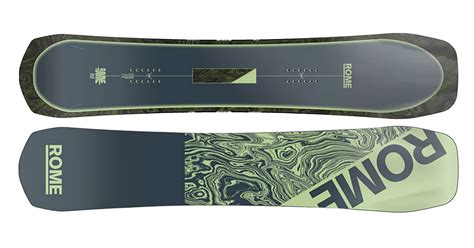
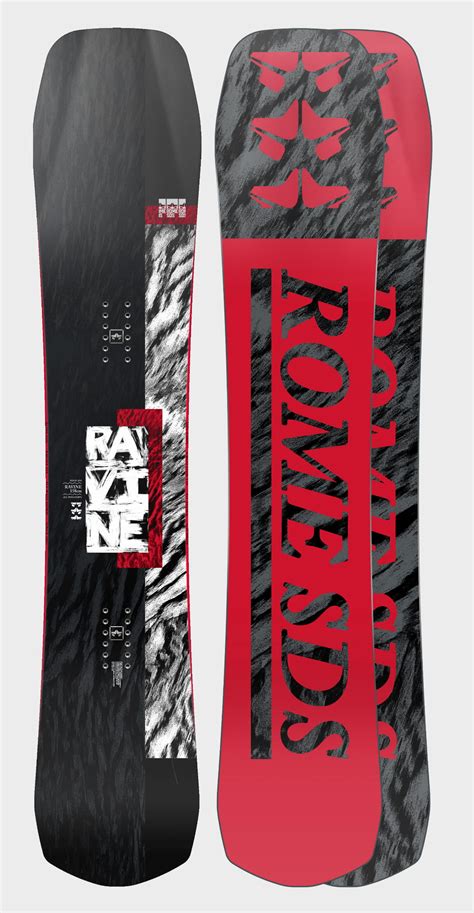
When it comes to choosing a snowboard for those deep and fluffy powder days, we genuinely can't recommend a better ride than the Rome Ravine Pro. This all-mountain snowboard is playful and stable without being overly aggressive. The Ravine is a one-of-a-kind quiver-smasher that excels at charging, jumping, or pow-slaying. After riding this board for a full year at three ski resorts - through tight trees, moguls, steep groomers, and deep pow plus a bit of park - it still has a spot at the top of my short list.
Let's delve into the details that make the Rome Ravine a standout choice for snowboarders of various skill levels and riding styles.
First Impressions and Initial Feel
I first got a taste of the Ravine at the Interlude Snow Show at Utah’s Snowbasin Resort, and the conditions were rough. It was freezing, humid, socked in, and icy, followed by dust on crust. But even through such a broad swath of variability, the Ravine made a solid first impression as a board that was maneuverable, poppy, and stable with middle-of-the-road flex. From the very first turns I noticed how easy the Ravine was to guide. It’s steerable without feeling twitchy.
Design and Features
It's shaped as a directional all-mountain board with a uniquely designed tri-radial sidecut of 7.9 meters. By focusing on three sidecuts, this mid-stiff board flexes into the snow on edge, creating a more progressive and predictable turn shape that allowed our testers to swiftly become comfortable on the Ravine Pro's rail. The Ravine Pro has a triax fiberglass pattern, offering three different flex patterns and ultimately providing more consistent pop across the board.
The classic feel of this board is elevated by its unique flex patterns and downright rocket-powered pop. The initial feel of the Ravine Pro starts within its core. By adding alternating strips of poplar and paulownia, and then milling carbon fiber hot rods into the tail, this board is ultra-stiff in the back. Not only does the back end of the Ravine Pro have steadiness and strength, but the entire board is wrapped in flax-integrated sidewalls, ultimately adding rigidity throughout the whole board. There are also flax impact plates layered underneath the binding inserts, which further add to durability and actually dampen heavy impacts. Fortunately, with the added flax sidewalls and impact plates, we could immediately feel the difference in how this board rode compared to others in the lineup.
Read also: Rome Service Dog Snowboard Review
This board's camber profile is different, starting with rocker on the nose, flat under the front foot, and then camber under the tail. In addition, its core is made of poplar and paulownia strips, which are then given carbon fiber rods milled directly into the core. Rome's carbon fiber hotrods protrude from the tail for extra stability, pop, and stiffness without hindering torsional flex.
Key Features:
- Directional Shape with Tapered Tail
- Tri-Radial Sidecut
- All-Mountain Camber Profile
- Poplar and Paulownia Core with Carbon Fiber Hotrods
- Flax Integrated Sidewalls
- Flax Impact Plates
- Sintered Base
Performance
The Rome Ravine Pro is a guillotine when it comes to powering through carves, initiating turns easily, and ensuring edge security. On edge, this board feels like slicing through butter with a hot knife. With its all-mountain camber profile, this snowboard features traditional camber throughout the back half, cultivating a sturdier and more traditional feel not only for ollieing but also for springing out of carves.
When approaching smoldering velocity, it is crucial to have a sturdy snowboard underfoot that can handle rough bumps and varied terrain at speed. When ripping down moguled terrain, our team found safety in knowing that the tail of this super juiced snowboard could withstand intense drops and bumps, and even generate power through turns. Its traditional camber is displayed by rising off a flat surface on the back of the board.
Once we reached some of the flatter parts of the mountain and needed extra speed to carry through the snow, we found reassurance knowing that the Ravine Pro's sintered base is one of the best on the market, providing superior speed and wax retention. When it comes to snowboard bases, a sintered base will hold onto wax for longer and create less friction with the snow, resulting in higher speeds.
During our deepest and steepest days of testing, we truly appreciated this board's 1.5 millimeter setback stance, which helped prevent our back leg from burning. We also discovered that the hotrods, both in the tail, helped keep our edges solid during large powder carves, and we felt quicker response times during tighter turns and hacks.
Read also: Is the Rome Royal right for you?
Flex: Rome rates this as a 7 flex, and even though I’m within the weight range for the 155 I felt like it rode quite a bit softer than that, especially through the nose, but a bit stiffer in the tail. At lower and moderate speeds, I found edge-hold was good and turn initiation was easy. In more aggressive carving scenarios and/or at higher speeds, the edge hold is a little lacking, and that softer, spoon nose is going to get away a little bit - it’s not a super hard-charging board, more of an all-mountain Jack of all Trades that can get the job done when you need it to.
My favorite note on this board is that it easily transfers edge to edge without strong reactivity. While it’s not as aggressive, snow-biting, or firm as other boards built for carving and hard-charging steeps or variable snow, it’s capable of carving chalk, traversing steeps, and navigating chop.
The 2026 Rome Ravine Snowboard Review
Powder Performance
If you love powder more than any other condition and want a snowboard designed explicitly for days when you might need a snorkel, then the Ravine Pro is our powder pillaging pick. If there is one board throughout our lineup that's built to charge pow, it's the Ravine Pro. Our team immediately noticed how responsive this powder boat is, starting with a large surface area created by an all-mountain shape and a minimum 7.5 mm taper. This board not only features a large, scooped nose that is rockered on the bottom, but it also incorporates a 3D-shaped early rise for added buoyancy in the front.
Dubbed the directional diamond 3D, the sides of the nose are slightly raised off the snow in a concave shape - hence, the diamond comparison. I felt confident pointing the Ravine down steeps or slicing through side hits with speed. Even when conditions turned cruddy, the board didn’t get bucked around. It didn’t feel overly responsive.
Playfulness and Freestyle
A playful snowboard can mean a more enjoyable day during spring conditions or when spending time in the park with friends. Luckily for our testers, the Rome Ravine Pro was fun throughout a range of days and conditions, including slushy park laps and nose buttering boxes. Despite its freeride focus, this snowboard still brings a playful energy to the mountain.
Read also: Comprehensive Tuckerman Ravine Skiing Overview
First of all, this Rome snowboard's profile shape is an all-mountain camber, meaning the nose is reverse camber, then turns flat under the front foot, and finally transitions to a traditional camber throughout the tail. In addition, the nose has a 3D scoop and early rise. These two features make the front of the Ravine Pro immensely entertaining when initiating knuckle spins, nose-pressing features, and even popping frontflips. Nose pressing is much easier than tail pressing on the Rome. The Rome added thin carbon rods in the tail, and you can feel it -there’s stellar pop on ollies. I loved boosting off rollers, cliff drops, little transitions, and small park jumps. And while it’s not a dedicated park board, the Ravine has enough life to make every run feel fun.
When tackling the local jump line, our testers noted that the Ravine Pro “has a super solid tail”. Its unique shape and minimal taper provide more surface area and therefore create a large landing base when jumping. The stance placement also allows riders to be in a more ergonomic position for both ollies and landings, adding yet another mark to its already sterling score in this metric.
Playfulness: The Rome Ravine is pretty playful for an all-mountain deck. While it’s maybe not as soft as it feels initially, the spoon + reverse camber zone through the nose of the board exaggerates the playfulness. Switch riding is manageable but keep in mind the Ravine isn’t a twin by any stretch of the imagination.
With multiple insert packs and flax impact plates underfoot, this board can be set up to ride more freestyle.
Limitations
The slightly narrower waist width could be an issue for people with larger feet, but we didn't have more than a minor moment of toe or heel drag during our testing with men's 10.5 boots. If you’re someone who rides icy hardpack often, this board might not be your best match, especially for steep slopes. It holds an edge well enough, but it’s clearly tuned for softer snow and natural terrain. Also, if you’re hoping for a truly surfy, super-soft board for buttering around the resort or primarily hitting the park, this isn’t that.
Even with its medium flex and stability underfoot, I noticed that after riding about 900 vertical feet of steep powder moguls off Telluride’s Plunge Lift, the board started to feel a bit squirrely. It held strong for the first part of the descent, but in extended technical terrain, the flex began to soften under pressure, making the ride feel slightly less confident. The board gets a little overwhelmed with prolonged, demanding use, due to the materials and flex profile.
Despite these more advanced features, Rome did a good job keeping this board user-friendly, and it is super playful when slashing around banks and chucking slushy snow. This board is very stiff, which may make it difficult for a beginner or intermediate rider to harness its potential popping power entirely. However, once you do, you won't want to go back. Although the bow of this board is beautifully buttery, it received some setbacks in its playfulness score due to stiffness. This thing is built to handle large terrain, including hefty drops, jumps, and deep powder; therefore, someone looking to venture into the park might find other models a better fit.
Who is this Board For?
Intermediate riders will be able to handle the Ravine Pro, but an expert rider will truly maximize its potential. If you're looking to charge pow with a freestyle approach, the Rome Ravine Pro is for you! We recommend this board for stronger riders who will be able to tackle its next-level snowboard tech.
Alternatives to Consider
If you still want one of the stiffest and poppiest snowboards we reviewed, take a look at the Arbor Rain. It was built by and for one of the heaviest riders in the game, Pat Moore, and it fits. It is a classically cambered snowboard with a Powerply paulownia, bamboo, and poplar core for superior pop stability. If you want something much more playful, less stiff, and meant for park laps and power, then you should look at the Yes Airmaster XTRM Fridge.
Handling: The Rome Ravine performs capably but I keep coming back to that flex. It rode like a much softer board.
Summing it Up: Overall the Rome Ravine was a really fun board even if that flex rating was a bit of an enigma. Think of it this way: it’s a damn capable board that maybe rides a little bit looser and more playful than it’s spec’d.