A sled can be a valuable asset for ice fishing, simplifying the transportation of your gear across the ice. The best ice fishing sled is simply anything that helps you transport gear across ice and snow, from Point A to Point B, with the least amount of friction. Ice fishing sleds often resemble small boats, featuring solid bottoms and sides that can be around 8 inches high. These sleds can also be used to transport other items over snow, such as firewood.
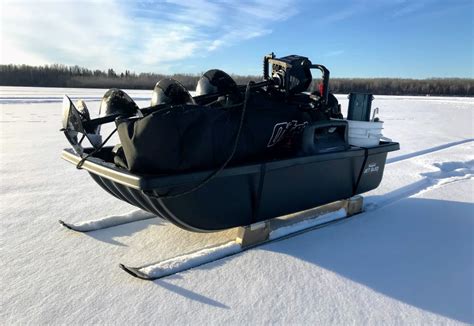
Here's a guide to help you select the best sled for your ice fishing needs.
Factors to Consider Before Choosing a Sled
To choose the best sled for ice fishing you must consider multiple factors.
- Distance: How far will you travel on ice to go ice fishing? Traveling 1 km versus 10 km can significantly impact your choice, especially when pulling the sled by hand. For hikes longer than 1 km most people will prefer motorized transportation like a snowmobile or truck.
- Vehicle Access: Can you drive your truck on the lake? In some places people drive on the lake with their vehicles. This is safe in areas like maintained ice roads... but anywhere else can be very risky. Consider the risks and insurance implications of driving on the ice. For places with low snowpack and ATV is a lighter option that's more likely to float and be easier to recover. For snow packed areas a snowmobile is the best choice.
- Towing Method: What will pull the sled? If you pull the sled by hand, then you need a sled just big enough to carry all your gear for the day 1 km to your fishing spot. If you pull by snowmobile, you can carry significantly more gear.
- Frequency of Fishing: How often will you fish? If you only want to do one ice fishing trip per year you may consider hiring a guide that will supply all the gear. It will be cheaper overall. Good gear is a big investment that will pay great dividends in fun over a lifetime... If you use it often.
- Number of People: How many people will regularly go with you? Solo fisher people can carry everything on their back for short ice fishing trips. Family with young kids need to be able to transport WAAAAY more gear. Warm tents, heaters, snacks, changes of clothing, games, play pens. Keep kids warm and fed and your day will go well. This type of setup is always better with a HUGE sled and a snowmobile to shuttle gear and people.
- Camping: Will you camp on the ice? Sleeping in a ice fishing hut is possible with a heater. For this a large tent like Vortex monster lodge is preferred. You can fit 3 cots strategically inside. For more than three people you need alternate accommodations. For best experience i suggest sleeping in a wall tent or Arctic Oven, keeping the fishing tent for just fishing. My experience is that its tricky sleeping in fishing tent and fishing if more than two people in MONSTER LODGE.
- Ice Shelter Size: how big of ice shelter will you use- if you’re a minimalist you can get by with a very small tent that can be pulled in a small sled by hand. I prefer insulated tents for 6 to 8 people even for 2 people because it gives to a place to put all your gear to keep from blowing away when left outside. Once you get the tent warmed up you don’t want to open door and cool off. Big tents require propane BIG BUDDY heaters with 20Lb propane tank and a propane extension hose. The 1 lb bottles heaters for are too small for a day of fishing and extremely costly. Warm ice fishing with big tents is always better with a big sled pulled by a skidoo.
- Vehicle Type: what type of vehicle do to transport your sled full of ice fishing gear? ATV is good for areas without snow, but they really lack traction and are bad for getting stuck. The lack of traction usually limit volume of cargo can be pulled. If pulling by ATV we prefer using a ATV trailer that performs better than a sled (toboggan) sleigh. Our preferred machine to tow ice fishing gear is snowmobile. The type of skidoo depends on how big of sled its pulling, the distance traveled, and how much slush/ overflow, they will encounter while travelling. My FAVORITE snowmobile for HARDCORE ice fishing with HUGE loads of fishing gear where we regularly encounter slush is a Skidoo Skandic or Skidoo Expedition WT (wide track 20") or SWT (super wide track 24") These skidoos perform best in slush with a studded track and extra wide ski skins. For engine selection the best will be 900 ace or 600 ETEC. Other engines lack a bit of power when bogged down in slush pulling a load.
- Trailer Size: do you have a trailer and how big is it? selecting a sled also depends on how you transport it. The biggest sleds are too heavy to lift by one person. The best way to transport a big sled is with a trailer with 20ft + foot length that allows fully loaded sleds to be pulled in and out while being fully loaded. If a person has a smaller trailer the sled will need cargo to be unpacked before lifting on trailer. If a person uses a Sled Deck they need a sled that will fit under sled deck. If a person has a short, enclosed trailer its best to be 7 feet + wide to fit a sled beside the snowmobile.
- Multiple Activities: do you have any other activities that can use a sled? People who ice fish also enjoy winter camping, trapping, and hunting. People who can use sleds for multiple adventures must consider all the gear required for each trip.
- Storage: where will you store the sled in the off season? big sleds require big storage solutions. People store big sleds under their house, in sheds, enclosed trailers. At the very least big sleds should be wrapped up in a double layer tarp and stored in a place that gets no sunlight. Sunlight wrecks all plastic sleds over time.
- Fishing Spot: are you a person who will go to the same place every time? if you go to the same place every time you can use a much smaller sled and do multiple trips. You may consider leaving a shelter set up for the season.
- Exploration: do you want to try various places? if you are always searching for new places to fish then you need much more gear. You need gear to prepare for all emergencies. Some of the most common risks are, getting stuck in slush, breaking through ice, machine breaking down, getting lost, running out of fuel, your partners snowmobile breaking down. To manage these risks, it requires allot of gear to manage all these risks. Allot of gear requires a big sled like the 9.5ft Yukon Expedition Sled or 9.5 Yukon Responder Sled. These big sleds need big snowmobiles to have enough traction to pull. The best sled for this is a Skidoo Skandic or Skidoo Expedition with 900 ace engine and a studded track with extra wide ski skins. These sleds can pull the biggest loads and easily get 100 km range per 20 Liters of fuel pulling a loaded sled in most terrain. This incredible fuel economy means that less fuel containers are needed. This frees up more cargo in the sled.
- Trophy Fishing: are you a trophy fisher? trophy fisherman requires a TON of gear and are encouraged to use the biggest sleds like the Yukon Responder. The reason is the high sides keep everything from falling out. Just throw it in and go. Trophy fisherman should seriously consider the new Yukon Expedition Sled fishing box that is set up hold the most valuable gear such as ice auger, ice scoop, pan optic, fishing rods, shovel, panoptic rod, axe, chainsaw. etc. Purchasing this box will prevent gear from rattling apart in the sled when travelling in rough terrain.
- Exercise: are you fishing for exercise? towing an UHMW style pulk from Yukon Expedition Sleds with a harness and poles will allow you to tow with skis or snowshoes. The poles keep the sled from running you over when going down hill.
- Ice Thickness: how thick is the ice? Thickness of ice will determine how much weight you want to carry. Its a good rule to say off ice with snowmobile until 6" of clear ice without snow covering. The more ice the better. Always check before proceeding.
- Auger Type: will you use a hand auger or a power auger? hand augers are fine for ice up to 2 feet. They are a physical challenge that is particularly hard on your shoulders. They also limit how many holes you can make. Fish are less active in the winter and to be successful your may have to drill lots of holes to find an area that holds fish. Electric/ Gas/ and propane fueled augers are all good choices for hunting for fish. These are heavy, bulky, and best pulled by a skidoo... or supported on a bracket on a snowmobile. Yukon Expedition Sleds has a box that holds ice augers securely on snowmobiles.
- Trails: are there established packed trails, or do you make trails? packed trails make travel easy and almost any skidoo will work for this application. Travelling on unfamiliar terrain is way riskier and demands a good utility type snowmobile like the Skidoo Tundra, Skidoo Expedition, Skidoo Skandic. These machines are engineered specially for breaking trail pulling loaded sleds.
- Temperature: what is the average temperature where you plan to fish? when fishing in warm temps above -20 deg Celsius people can get away with moulded plastic and fiberglass sleds that are very cost effective. For temperatures below -20 degrees Celsius we highly recommend a sled made from UHMW plastic. The reason is that UHMW stays flexible down to -107 degrees. This flexible nature of the material means it wont crack when impacting trees, rocks, hard ice etc. The durable nature of material also means that it wont wear out fast when dragged over rocks and sand. UHMW last 13x longer than steel plate the same thickness when dragged over rocks and sand. Yukon Expedition Sleds make all their sleds from UHMW for ultimate cold weather performance.
Once you answer these questions then you can start planning for success.
Types of Ice Fishing Sleds
Even a large ice fishing sled can be crafted out of wood, PVC, or other stuff you might have laying around in back of the garage. A list of the top 10 ice fishing sleds would probably have to include some DIY versions. Expense can factor into determining the best ice fishing sled, but if you aren’t very handy (a-hem) by the time you consider your time, you may just want to consider choosing from a variety of sleds on the market. Top 10 ice fishing sleds often include rod holders to help protect fragile rod tips. If the sled is to be towed by a snow mobile or 4-wheeler, a cover is a good idea to prevent snow from being thrown all over your gear.
Read also: MLine Pro Deck: Three-Season Performance
Kicksleds
The kicksled or spark is a small sled consisting of a chair mounted on a pair of flexible metal runners that extend backward to about twice the chair's length. The sled is propelled by kicking (sparka or sparke in the Scandinavian languages) the ground by foot. There is a handlebar attached to the top of the chair back. Kicksled is a direct translation of the Finnish word potkukelkka. Estonian calls it either a 'pushsled' (tõukekelk) or 'Finnish sled' (Soome kelk). The typical adult sized sled has runners about 2 m (79 in) long, spaced 400 mm (15.7 in) apart. The kicksled is driven forward by the driver standing on one runner, kicking backwards on the ground with the other foot, hence the name. The flexibility of the runners allows the driver to steer the kicksled by twisting the handlebars. One can have a passenger or luggage on the chair seat.
A kicksled is designed to be used on hard, slippery surfaces like ice or hardpacked snow. To kicksled in deeper, more powdery snow, extra-wide plastic snow runners are attached to the standard, thin runners of the sled. On very smooth, bare ice, the use of traction devices like spiked shoes or crampons improves kicking force. The kicksled is in common use in Sweden, Norway and Finland, especially where roads are not sanded or salted. Kicksleds are growing in popularity in Canada. It is also an excellent means of travelling over frozen lakes to go ice fishing or just to explore the lake.
Some models also include a wheel kit allowing to transform the sled to a kind of walking aid for summer use. The first definite record of a kicksled was in a newspaper in northern Sweden around 1870. The kicksleds of that era had stiff wooden runners and were heavy. which quickly became standard in Sweden, Finland and Norway. In the years 1890 to 1910 kicksled racing was a popular sport, especially in Sweden. Around 1990 kicksled racing was revived as a serious sport in Finland. There are races of up to 100 kilometres (62 mi) long and the average speed is around 30 km/h (19 mph). A light-weight racing kicksled model is mass-produced by the Finnish kicksled company ESLA.
In Canada, the kick sled has been modified for dog sports. A bridle is attached to the kick sled, and a gangline to that, with one to three dogs pulling. This small sled is useful for the urban dog owner, as it is lighter and easier to transport than a full scale dog sled.
Yukon Expedition Sleds
Here are some Yukon Expedition Sled recommendations for each type of ice fisher person.
Read also: Exploring the History of Horse-Drawn Sleds
- Solo ice fisher traveling less than 1 km who is doing it because they want exercise. = a 5 ft pulk made by Yukon Expedition Sleds could fit into the back of an SUV and has enough volume to carry a 2-person ice fishing hut, a small heater, and auger. Personal gear can be carried in a backpack. This sled can be pulled by a cross-county ski harness with poles or with a long rope. Cost $350
- Ice fishing enthusiast who likes to explore places who already has a skidoo. They like to day trip for ice fishing. They have a power auger and no tent or heater. The best set up would be a UHMW Yukon Expedition Sled Ice fishing box with ice auger holder, shovel holder, ice scoop holder, and rod holder, with quick release mount. The benefit of not having a sled is that no trailer is needed to transport gear. And gear doesn’t get vibrated apart pulling in a sled.
- Ice fisherman who likes to explore and bring a 4-person hot tent. The Yukon Expedition Sled Ice Fishing Box with quick detach base will hold all the fragile gear. And a 5.5 ft Yukon sled will hold the tent, heater, chairs, cooler etc. The Yukon Expedition Sled Ice Fishing Box for all the fragile gear. And for a warm camp the 9.5 Yukon Expedition Sled or 9.5 Yukon Responder would give you all the volume needed for a weeklong winter camping trip. The big sleds require big trailers to transport. The 2 ideal sized trailer are 7ft x 14 ft enclosed trailer for 1 Skandic snowmobile and 1 Yukon Expedition Sled. A better option for 2 snowmobiles with 2 Yukon Expedition Sleds is a Snowmobile trailer with deck over wheels 8.5 ft wide and length 20ft +.
КАК правильно ВЫБИРАТЬ САНИ - ВОЛОКУШИ для рыбалки. Синие, красные или черные.
Ice Fishing Locations and Conditions
Here's a summary of ice conditions and fishing hotspots in various regions:
| Location | Ice Thickness | Access Points | Fishing Targets | Hazards |
|---|---|---|---|---|
| Red Lake (MN - North/Central) | ~4-8″ in sheltered spots | JR’s Corner, remote sleeper bear tracks | Early‐ice walleyes | Pressure ridges and open water |
| Lake Winnibigoshish (MN - Central) | ~6-8″ in most safe zones | Big Winnie landing, Trout Point, Rowe Island | Perch and early walleye | Snow cover hiding ice quality |
| Leech Lake (MN - North) | ~3-5″ in many spots | Walker Bay launch, Pike Bay | Early panfish + jigs, late-day walleyes | Open water in larger bays |
| Devils Lake (ND) | ~8-11″ in protected finger bays | West Bay, Prairie View, Pelican Point | Jumbo perch and seasonal walleye | Main bay still thin in places |
| Big Stone Lake (SD / MN border) | ~8″ reported near Schmidt’s Landing | Schmidt’s Landing, Big Stone Lake State Park | Early perch and bluegills | Current near straits slows ice |
| Detroit Lakes Area (MN) | ~6″ on Big & Little Detroit | Detroit Lakes city launches, Little Detroit public access | Perch and early pike | Hard-packed snow drifts |
| White Potato Lake (WI) | Lake reportedly frozen over with snow cover | County access points near Pound | Panfish schools | Ice thickness not widely reported |
| Mississippi River Backwaters (WI - La Crosse area) | Early thin coverage forming | French Island, La Crosse backwaters | Raptors for perch/bluegill | Flow zones delay safe ice |
| Saginaw Bay Rim (MI - Great Lakes perimeter) | Ice formation starting near shoreline | Bay City State Recreation Area, Quanicassee Park | Walleye/perch potential | Great Lakes freeze slowly |
| Michigan Inland Lakes | Early plugging on shallow, small lakes | Local public access points | Early panfish action | Most inland spots still early |
Best Bite Windows:
- Late afternoon to dusk (2-5 pm): increased walleye movement around structure on Red, Winnibigoshish, and Devils.
- Mid-day (10 am-2 pm): peaking panfish activity (perch/bluegills) on shallow weeds/edges.
- Morning low-light: pike cruising flats near vegetation edges.
Current Hazards:
Ice is never 100% safe. Flowing water, springs, inflows/outflows, and pressure cracks are common thin spots. Early ice with snow cover hides weak spots; always test with an auger/spud bar as you move.
Pro Safety Tip:
Read also: Sled Pullers for Ice Fishing
Carry ice picks, rope, flotation, and a whistle, and always let someone know your access point and expected return.