If you're looking to replace your trailer jack, you're in the right spot! In this guide, we will explore the different types of trailer jacks available, their features, and how to choose the best one for your needs. We'll also walk step-by-step through the process of using your new jack safely and which upgrades to consider for your trailer setup.
Understanding Trailer Jacks
First, let’s make sure we’re all on the same page for what we mean when we use the term trailer jack. In this guide, when we refer to a trailer jack, we are talking about a trailer tongue jack, the lifting apparatus on the tongue of a trailer. For some, a jack is the part of the trailer that keeps it level. For others, a jack is used to stabilize the trailer. This type of jack is comprised of a tube or body, as well as a leg or post.
Jacks vs. Stabilizer Jacks vs. Leveling Jacks: Stabilizer jacks are used to stabilize an RV or other trailer once it’s set up. They are intended to absorb shifting weight, keeping the unit stable. On the other hand, leveling jacks are designed for leveling the trailer.
Anatomy of a Standard Trailer Jack
A trailer jack may seem like a fairly simple component. However, when talking about different options and especially when you’re operating or replacing parts, it’s vital that you have your terminology straight.
- Head: The top portion of a jack is called the head. The head contains the gears and other mechanical components to allow the jack to raise or lower its leg. This is where the transmission of power goes from the user’s hand-cranking motion into the lifting force of the jack leg.
- Tube / Body: The outer tube is the main body of the trailer jack. Most jacks consist of an outer tube and an inner tube or leg.
- Tube / Leg: The inner tube or leg is the part of the jack that moves up or down to lower or raise the trailer tongue. This is a secondary tube that fits inside the outer tube.
- Handle: The handle is the cranking apparatus that allows the user to operate the jack. Turning the handle one way will raise the jack leg, and turning it the other way will lower it. Some handles come with a grab handle, while others have a knob. Some are foldable, and others are fixed.
- Foot (or Wheel): The foot is the part of the trailer jack that touches the ground and provides a stable base. A jack foot is usually a simple metal plate with an attachment pin or bolt to mount onto the jack leg. Some jacks are sold with a foot included. Others are without. Some also have a wheel, instead of a foot, for added mobility.
- Mounting Bracket: The mounting bracket allows the trailer jack to be attached to the trailer frame. Some brackets bolt into place, while others are welded on.
Electric Jack Components
- Electric Jack Head - Like a manual crank jack, the head of an electric jack is the power transmission center of the unit. Instead of harnessing the user’s cranking efforts, an electric jack head uses the trailer battery or another 12-volt power source to power its internal gears and raise or lower the jack leg.
- Outer Tube / Body - An electric jack has an outer tube or body in which the inner tube or leg can slide up or down.
- Inner Tube / Leg - The inner tube or leg of an electric jack is virtually identical to that of a manual jack.
- Controls - Instead of a handle, electric jacks use buttons to allow the user to raise or lower the trailer jack. The controls are built into the head unit, and some feature an LED backlight for easier viewing in low-light conditions.
- Foot - Most electric trailer jacks come with a foot plate on the bottom that provides enhanced stability for the trailer tongue.
Types of Trailer Jacks
There are several different styles of trailer jacks to choose from, each with its own pros and cons.
Read also: G-Force One: First Impressions
Manual Jack
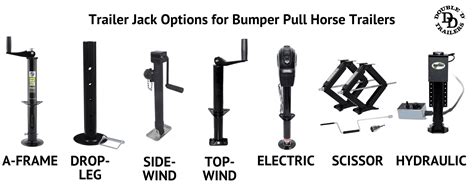
A manual jack is simply a trailer jack that’s operated by hand with the user’s own strength. There is no electric assist. Manual crank jacks or hand-cranking jacks are perhaps the most common on any given trailer type. Manual jacks typically come in two styles: top-wind and side-wind.
Electric Jack
An electric jack is a trailer jack that uses electricity to move the leg up or down with the press of a button. The power source is usually the trailer’s onboard battery or the tow vehicle.
How To Choose the Correct Snowmobile Trailer!
Electric vs. Manual
The biggest difference between electric jacks and manual jacks is that electric jacks use a powered motor to raise and lower the jack leg, while manual jacks use a hand crank. Electric jacks are more convenient and require less effort, but they also tend to be more expensive and can be less reliable if the battery dies. Electric jacks can also have extra features for even more convenience, such as auto-level capabilities and an integrated LED light.
Smart Jack
A smart jack is a type of electric jack that operates with the single press of a button. With one touch, the jack leg raises or lowers to a prescribed height. One thing to keep in mind with a smart jack is that a 12-volt battery will be needed as the power source.
A-Frame Jack
A-frame jacks get their name from the A-frame trailers they’re used on. A-frame jacks are quite common, especially on RV trailers, and they can be manually operated or electrically powered.
Read also: Register Your Snowmobile in IL
Jack with Wheel
Some jacks have a built-in wheel on the bottom instead of a foot, making it easier to pivot and even move the trailer around by hand. Our trailer jacks with wheels make navigating your trailer through all terrain simple. No more struggle to fit it in place - just roll it into position, and you're ready.
Heavy-Duty Jack
Heavy-duty jacks are in a class all their own. Most are designed to be welded directly to the trailer frame. Instead of bolting into place or using a separate bracket component, these powerful jacks are fused, metal-on-metal, with the trailer tongue.
Style: Round vs. Square
When it comes to tongue jacks, one other distinction worth pointing out is the style of the jack tube or body. The majority of trailer jacks have a round-tube body, as well as a round-tube leg.
However, some of the heavier-duty jacks feature a square tube. Because they fall into the heavy-duty category, square-tube jacks require a direct-weld installation, and the square shape allows for more surface area to weld the unit onto the trailer frame.
Drop Leg Option
Some jacks, including some heavy-duty weld-on jacks, feature a drop leg. This type of jack leg makes it faster and easier to hook up or unhook your trailer. Jacks with a quick-drop leg usually have a spring-loaded pin that holds the leg in place within the inner lift tube. When you release the pin, the drop leg is free to move independently of the lift tube, allowing the leg to instantly drop to the ground or be lifted back up into the tube by the user.
Read also: Snowmobile Tunnel Bag Comparison
If you’re unhitching your trailer with a quick-drop-leg jack, you don’t have to stand there turning the crank several rotations as the jack leg slowly makes its way to the ground. When it’s time to hitch up again and hit the road, simply raise the jack leg with the crank handle enough so that it clears the ground.
Swivel Jack
Swivel jacks are designed to rotate on their mounting point for maximum ground clearance during travel. The swivel-mount allows the entire jack tube to rotate up and out of the way, keeping it well protected for travel.
Top-Wind Jack
A top-wind jack is a hand-operated jack that has the handle for raising or lowering the leg on top of the main tube. The handle or knob can then be rotated by the user on a parallel plane with the ground.
Side-Wind Jack
Similar to a top-wind jack, a side-wind jack is a manually operated model.
Side-Wind vs. Top-Wind
The difference between side-wind and top-wind jacks is mainly about user preference and ergonomics. Side-wind jacks have the handle on the side. Top-wind jacks have the handle on top.
If you’re choosing between the two, it’s a simple question of which one feels more comfortable to operate. You may also wish to consider the design of your trailer.
Handle vs. Knob
Another difference in trailer jack handle design is the grab handle versus the knob. The knob, on the other hand, has more of a crown shape, allowing you to grasp the knob with a claw-like grip.
The knob-style handle is typically only found on top-wind jacks, while the grab handle is on both top-winders and side-winders. Once again, it’s a matter of preference and ergonomics. Which one feels more comfortable for you personally? If you feel like the grab-handle-style gives you a better grip, then choose a jack with a grab handle. If you like the feeling of the knob style, then choose a jack with a knob.
Drill-Operated Jack
Drill-operated jacks are a sort of hybrid jack, combining the features of manual and electric. They are designed for use with a standard power drill to raise or lower the leg. However, a drill-operated jack also supplies the option for manual raising and lowering, featuring a standard crank handle. One thing to consider before purchasing a drill-operated jack over a purely electric model is that it does add one more thing to the packing list.
Jack Mounting Options
When choosing a new jack, it's important to consider the available mounting options. One of the best ways to do this is to look at the existing or old jack on your trailer. However, you may wish to upgrade your jack from a bolt-on system to a weld-on, or vice-versa, depending on your preferences.
Weld-on
Weld-on jacks are designed to be welded directly to the trailer frame. Weld-on jacks come in a few different varieties. Some are designed so that the body of the jack gets welded directly to the frame, while others come with a separate bracket that serves as an intermediary component between the two.
Overall, weld-on jacks are the most secure option and typically have the highest weight ratings. However, it is important to note that a weld-on jack requires welding equipment for installation. You may need to seek professional assistance for this option.
Bolt-on
Bolt-on jacks are designed to be mounted onto the trailer using hardware, namely nuts and bolts. This is a more DIY-friendly option, but it may not be as secure as its welded counterpart.
Bracket-Mount
Bracket-mount jacks are mounted to the trailer frame using an intermediary piece of metal, namely a bracket. Some may require drilling holes into the trailer frame, while others can mount over the top of it. Brackets can also differ in style and function, including swivel-style, fixed, horizontal and vertical.
Pipe-Mount
Pipe-mount jacks are mounted to a round pipe or tube that is attached to the trailer frame.
Note about Jack Materials & Finishes
Many different jacks are designed to be installed with either option; that is, welded or bolted into place. Additionally, almost all jacks come with some kind of protective finish to keep them resilient to the outdoor elements. Some have a powder coat finish, and others a zinc plating.
These help keep the steel underneath from rusting when exposed to moisture and road salt. However, before welding your jack into place, you need to make sure you take the necessary steps to prep the mounting surface to achieve a proper weld.
What Size Jack Do I Need?
When shopping for a new jack, there are a few key dimensions to consider, not just in length or distance but also weight capacities. Below is a trailer jack chart showing the key dimensions and capacities of each jack type.
Jack Lift Capacity vs. Support Capacity
All trailer tongue jacks should come with two weight ratings, and it is important to make a distinction between the two. The lift capacity is the maximum weight that the jack can lift vertically; that is, while it is raising the trailer tongue. This specifically pertains to the trailer jack in motion.
As the jack is operating (whether manually cranked by the user or electronically), how much weight is it rated to hold up? On the other hand, support capacity is a static rating. It refers to the weight rating of your trailer jack when it’s in a resting position.
The jack leg could be fully extended or retracted, but either way, it isn’t moving. When your trailer is parked and the tongue is simply resting its weight on the jack, how much weight can the jack handle? The support capacity will characteristically be higher than the maximum lift capacity. This is because a jack is under greater strain when it is in motion versus when it is standing still.
Make sure the jack you choose for your trailer meets or exceeds the needs of your trailer for both lifting and supporting.
Tongue Weight vs. Trailer Weight
As you think about trailer jack capacity, also keep in mind the difference between tongue weight and gross trailer weight. This is important to know when replacing your trailer tongue jack because a jack doesn’t need to support the weight of the entire trailer, nor is it designed to.
Stroke: The Vertical Travel of Your Jack Leg
The primary purpose of a trailer jack is to add the ability to easily raise and lower the trailer tongue. If you were to measure the length of the jack leg from its fully retracted position out to its fully extended position, this would be the stroke.
When looking for the right amount of jack stroke or vertical travel, consider the coupler height of your trailer, as well as the ball height of your vehicle’s trailer hitch.
Retracted Height vs. Extended Height
It goes without saying, but the extended height of the jack will be greater than the retracted height. Conversely, when thinking about retracted height, it isn’t so much about how low the jack can drop your trailer tongue (although that’s important, too).
Swivel Jack
Worried about your trailer jack scraping on the ground? Worry no more! Instead of just retracting the jack leg, a swivel jack is mounted on a rotating bracket. This adds the ability to swing the entire jack up 90 degrees, making it parallel with the trailer frame.
Bracket Height
The bracket height on a trailer jack is the measurement between the bottom of the jack and the mounting bracket. This distance (not unlike the retracted height) is important, particularly for non-swivel models.
Diameter
Some jacks, namely A-frame jacks, are designed to mount through a hole in the trailer frame. This makes that tube diameter important for A-frame jacks. The tube must fit the diameter of the hole. If the tube is too big, it won’t be able to drop into place.
Before replacing an A-frame jack, measure the diameter of your trailer frame hole or your existing jack tube and make sure the new one will fit!
Head & Handle Clearance
One final thing to consider when shopping for a new jack is obstructions on the trailer. You’ll want to make sure the jack will have enough room to be installed without being blocked by a trailer tongue tool box or winch.
And, once installed, will the jack handle have enough clearance from the objects around it to operate freely and safely? You don’t want to jam your hand against the LP tank every time you turn the crank!
Here's a quick reference table summarizing the key features of different trailer jack types:
| Type of Jack | Power Source | Pros | Cons |
|---|---|---|---|
| Manual | Hand Crank | Simple, reliable | Requires physical effort |
| Electric | Battery/Tow Vehicle | Convenient, less effort | More expensive, relies on power source |
| Smart | Battery | One-touch operation | Requires battery |
| A-Frame | Manual or Electric | Common, versatile | Can be manual or electric |
| With Wheel | Manual | Easy to maneuver | Less stable than footed jacks |
| Heavy-Duty | Manual or Electric | High weight capacity, secure | Requires welding for installation |
XO Series Trailer Jacks by Ark Corporation
Ark Corporation's XO Series Trailer Jacks are designed to withstand the toughest conditions. A blend of quality meets innovation, Ark’s heavy-duty jacks for trailers will elevate your towing experience. We understand that the right equipment can make a life-changing difference, and our trailer jacks are designed to ensure your towing endeavours are smooth, stable, and stress-free.
Explore a range of high-performance trailer jacks meticulously designed to meet your needs. Start your towing adventures with Ark's trailer jack stands, expertly crafted for a sturdy foundation. Our trailer jack stands offer unmatched stability when you need it most. The secret lies in the precision engineering that goes into each stand. The adjustable height options allow you to adjust your trailer's height easily. Our XO series of trailer jack stands adapt to your terrain, ensuring a stable platform for loading and unloading your trailer.
Consider the peace of mind you can have when your trailer is securely anchored, knowing it won’t budge.
tags: #snowmobile #trailer #jack