Timothy E. Kerr, born on January 5, 1960, in Windsor, Ontario, is a Canadian former professional ice hockey right winger who played 13 seasons in the National Hockey League (NHL) for the Philadelphia Flyers, New York Rangers, and Hartford Whalers. Known for his goal-scoring offense, Kerr reached the NHL's prestigious 50-goal plateau on four occasions during his career.
Kerr ranks 10th all-time (minimum 200 goals) in goals per game with 0.565. Despite facing numerous injuries throughout his career, Kerr's contributions to the sport, particularly during his time with the Philadelphia Flyers, have left a lasting impact. This article delves into Kerr's career, highlighting his achievements, challenges, and post-retirement endeavors.

The Untold Story of Tim Kerr's Heroic Career
Early Years and Draft Day Snub
As a youth, Kerr was not considered an elite talent in minor hockey leagues but stood out due to his exceptional size, measuring 6 feet tall and 210 pounds by age 14, which often led coaches to place him in older age groups despite his developing skills. This physical stature foreshadowed his future playing style as a power forward, emphasizing strength and presence around the net once his abilities caught up.
Following a brief stint with Windsor, Kerr was selected by the Kingston Canadians in the 1977 OHL Priority Selection, 4th round (46th overall), and joined the team for the 1977-78 season. Over his three full seasons with Kingston from 1977 to 1980, he demonstrated steady progression as a goal-scoring winger, benefiting from his size and improving shot accuracy while working on overall mobility.
Read also: Features of Custom Hockey Gloves
Playing juniors in Kingston, Tim went unselected in the 1979 entry draft, largely because the draft was limited to just 6 rounds and at the time, Kerr was considered "gangly", scoring just 15 goals in his first year of juniors.
The Flyers Take a Chance
Flyers scout Eric Colville saw something special in Tim - but so did the Detroit Red Wings. Detroit was just over the border from Tim's hometown (and was his boyhood's favorite team). Kerr wasn't suppose to make the team for the 1980-81 season, but a preseason injury to Ken Linseman changed all that. As a replacement for the injured Ken Linsemen on "Rat Patrol" line with Propp & Holmgren, Kerr scored 22 goals during his rookie year.
Late that rookie year his parents made a trip to see their son play the first time in an NHL game. Tim didn't disappoint, scoring his first NHL hattrick on March 19th 1981 in a 5-3 win over Boston. His second year saw pretty similar results with another 20 goals season. During that second year Kerr had a seven game scoring streak.
Kerr did not play in the World Hockey Association (WHA), as his professional career began shortly after the league's merger with the National Hockey League (NHL) was announced in March 1979. As a depth forward, Kerr focused on developing his physical presence and net-front skills amid limited ice time, competing against more experienced players in a system that emphasized resilience and adaptation during the post-merger era.
The Rise of a Star: 50-Goal Seasons and Playoff Heroics
Kerr's rise to stardom began in the 1983-84 season, when he erupted for 54 goals in 79 games, launching a remarkable streak of four consecutive 50-goal campaigns that solidified his reputation as an elite sniper. During that season Kerr would be selected to the mid-season all-star game, getting 1 assist.
Read also: The story of Craig Needham
The following season saw Kerr match those 54 goals and getting what would be a career high 98 points. During that 84-85 season Kerr would have an amazing total of 3 games where he would score 4 goals (which is a regular season Flyers record). Kerr had already developed an ability to get away quick hard shots while having opponents draped all over him.
But in '84-'85 Kerr started to show an knack that would get him in the record book - scoring power play goals. During that year, Kerr would almost double his career output, as he led the entire NHL with 21 powerplay goals. This peak continued with 54 goals in 1984-85, followed by NHL career-highs of 58 goals each in 1985-86 and 1986-87, during which he led the league in power-play goals three straight years (21 in 1985, a record 34 in 1986, and 26 in 1987).
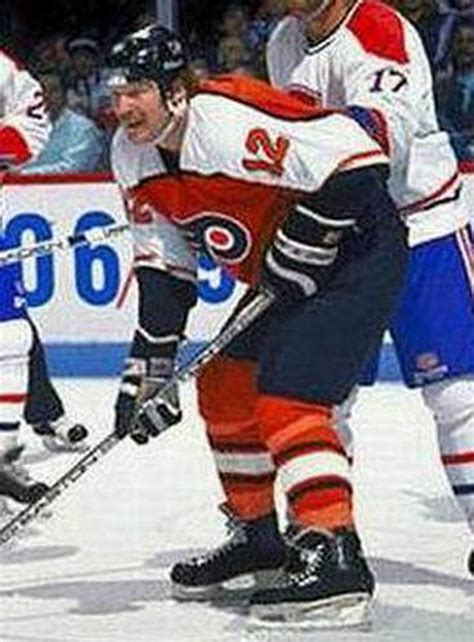
Central to his success was his role on the Flyers' potent power play, where he formed key partnerships with centers like Ron Sutter and Murray Craven, who fed him precise passes for tip-ins and one-timers from the slot, accounting for a significant portion of his production.
Playoff Performances
When the playoffs started, Kerr continued scoring, particularly during on memorable night. On April 13th 1985 Kerr set NHL records with the fastest 4 goals (8:16) and most goals in one playoff period (4), as the Flyers won the game 6-5, sweeping the Rangers.
Read also: Inside Aaron Ness's Career
In the playoffs, Kerr's scoring prowess shone during the Flyers' Stanley Cup Final runs in 1985 and 1987, where he delivered clutch performances despite the team's ultimate defeats. In 1985, he tallied 10 goals in 12 games, including a still-standing NHL record of four goals in one period (scored in 8:16 during Game 3 of the division semifinals against the New York Rangers), helping Philadelphia advance to the Final before a knee injury sidelined him for the later rounds.
Two years later, in 1987, Kerr scored 8 goals in 12 games en route to the Final against Edmonton, providing offensive firepower alongside rookie sensation Ron Hextall until a shoulder injury ended his postseason. Kerr made a brief appearance in the 1992 playoffs, where the Rangers defeated the New Jersey Devils in seven games before falling to the Pittsburgh Penguins in six.
Injuries and Setbacks
But then during the third year saw more of what would plague Kerr during his entire career - injuries. During Tim's first three years he missed a total of 87 games due to a variety of injuries (shoulder, lower back, hernia, broken right leg, impacted wisdom teeth). Surgery on his right knee forced Kerr to miss 37 games in '82-'83 during a season where he played in only 24 games.
However injuries once again hampered Kerr. Kerr got injured during the first game of the semifinals against Quebec, straining his right knee. The 1989-90 season exemplified the ongoing impact of Kerr's knee and related injuries, as he played only 40 games and scored 24 goals amid multiple surgeries and recovery periods, a sharp decline from his peak 58-goal output two years prior.
Arthroscopic procedures on his shoulder also factored in, but knee instability remained a core issue, contributing to the Flyers' missed playoffs that year.
Tim Kerr's early professional career with the Philadelphia Flyers was marred by significant knee injuries. In his first two NHL seasons (1980-81 and 1981-82), he sustained a pair of serious knee injuries that caused him to miss a combined 31 games. Kerr's physical, power-forward playing style-characterized by screening goaltenders and battling in the net-front area-contributed to a pattern of recurrent injuries, including recurrent knee problems, bruises, and strains throughout his career.
Despite these challenges, he demonstrated resilience, returning strongly in 1983-84 to score 54 goals in 79 games after dedicated rehabilitation. However, knee issues persisted intermittently; in the 1985 Stanley Cup playoffs, a knee injury hampered his performance during the Flyers' Finals run against the Edmonton Oilers.
That shoulder injury would limit Kerr to only 8 games for the '87-'88 season. But through hard work and determination Kerr would come back strong in the '88-'89 season, scoring 48 goals in 69 games. Only a broken thumb stopped Kerr from scoring another 50 goals. Kerr's hard work won the admiration of all, winning Tim the Bill Masterton trophy for dedication to the game.
Like a broken record, Kerr had yet more shoulder injuries during the 1989-90 season which limited Tim to 40 games and 24 goals. But little was in comparison to the tragedy that happened when Tim's wife Kathy passed away after complications arose after delivering their 3rd child.
Later Career and Retirement
With Kerr's performance, the Flyers rewarded him with a $200,000 contract. He was named starting RW at the 85-86 all-star game and ended the season with 58 goals, becoming the first Flyer to have 3 fifty-goal seasons. That year saw Kerr get an NHL record 34 powerplay goals a record that still stands today. There are not many people that can saw they hold a single scoring record without their name being Wayne Gretzky - Tim Kerr is one such man.
The following season saw yet another 58 goal season. During that year Kerr led the NHL once again in powerplay goal (26), was second in goals and would be named to the second all-star team. Unfortunately an injury would once again hit Tim. This time a severe shoulder injury would force Kerr to miss the team's final 14 playoff games. Even without Kerr the Flyers managed to force Edmonton to a seventh game in the Stanley Cup finals before losing.
Expansion hit the NHL for the 1991-92 season and the Flyers gambled, leaving the injury prone Kerr unprotected. The Rangers had made a side deal with the expansion San Jose Sharks. The Sharks selected Kerr then promptly traded him to New York for a second round choice. The Rangers had a woeful powerplay and hoped Kerr would assist. But on October 5th of the year during the Rangers 5th game of the year, Kerr suffered yet another shoulder injury, and ended up playing just 32 games.
Kerr ended up his career in 1992-93 with the Hartford Whalers, playing just 22 games failing to score.
Following his retirement in January 1993, Tim Kerr faced significant long-term health consequences from the cumulative toll of multiple knee surgeries and related immobility during his career, particularly the right knee procedure performed in November 1992 that ultimately prevented his return to play. In the years after retirement, Kerr has managed these effects through consistent lifestyle adjustments, including daily workouts on an elliptical machine and light weights to preserve joint function and overall fitness.
By 2011, he reported needing a knee replacement due to the wear from his three prior knee surgeries and other lower-body injuries, stating, "I gave everything I had with my body..." Kerr has publicly reflected on these challenges in interviews, highlighting the physical price of his high-scoring career despite the adversity.
Career Statistics
The following table summarizes Kerr's regular-season statistics by season, including games played (GP), goals (G), assists (A), points (Pts), and penalty minutes (PIM).
| Season | Team | GP | G | A | Pts | PIM |
|---|---|---|---|---|---|---|
| 1980-81 | Philadelphia Flyers | 77 | 22 | 23 | 45 | 77 |
| 1981-82 | Philadelphia Flyers | 74 | 26 | 25 | 51 | 107 |
| 1982-83 | Philadelphia Flyers | 24 | 13 | 6 | 19 | 27 |
| 1983-84 | Philadelphia Flyers | 79 | 54 | 32 | 86 | 111 |
| 1984-85 | Philadelphia Flyers | 78 | 54 | 44 | 98 | 131 |
| 1985-86 | Philadelphia Flyers | 76 | 58 | 26 | 84 | 105 |
| 1986-87 | Philadelphia Flyers | 75 | 58 | 30 | 88 | 127 |
| 1987-88 | Philadelphia Flyers | 8 | 1 | 2 | 3 | 6 |
| 1988-89 | Philadelphia Flyers | 69 | 48 | 40 | 88 | 113 |
| 1989-90 | Philadelphia Flyers | 40 | 24 | 19 | 43 | 59 |
| 1991-92 | New York Rangers | 32 | 5 | 4 | 9 | 17 |
| 1992-93 | Hartford Whalers | 22 | 0 | 1 | 1 | 11 |
| NHL Totals | 655 | 370 | 252 | 622 | 890 |
Tim Kerr's playoff performances were marked by explosive goal-scoring bursts that propelled the Philadelphia Flyers deep into multiple postseason runs, though chronic injuries increasingly limited his participation in later years. Kerr's postseason statistics reflect his peak productivity in the mid-1980s, followed by diminished output due to health issues.
Post-Retirement Ventures
After retiring from professional hockey in 1993, Tim Kerr transitioned into business ventures, leveraging his public profile and connections from his athletic career to build enterprises in real estate and sports ownership. Kerr co-founded PowerPlay Realty in 1992 with Ryan Vince, focusing on luxury residential properties in Avalon and Stone Harbor on the Seven Mile Island.
The firm, which Kerr serves as owner and president, joined the Sotheby's International Realty network in 2017 and rebranded as Tim Kerr Sotheby's International Realty, expanding its reach in New Jersey's high-end coastal market. In the early 2000s, Kerr ventured into minor league hockey team ownership, acquiring the Pensacola Ice Pilots of the East Coast Hockey League in 2003 before selling it in 2005. He later owned the Pensacola Ice Flyers and the Mississippi Surge in the Southern Professional Hockey League during the late 2000s and early 2010s, contributing to league operations and community engagement in those markets.

Tim Kerr Charities
Kerr founded Tim Kerr Charities in the summer of 1989 with his wife, Midge, to raise funds for various charitable organizations through family-oriented multisport events. The nonprofit, headquartered in Avalon, New Jersey, has hosted over 134 events-including triathlons, runs, and swims like the IslandKids Triathlon and 7 Mile Island Run-drawing more than 60,000 participants and generating approximately $3 million in proceeds donated to 105 partner charities focused on children's health, education, and community support.
While not exclusively centered on hockey access, the events promote physical activity and inclusivity for youth.
Legacy
Kerr is 3rd on the alltime Flyers goal scoring list with 363 (the best for any right winger), first (by more than 40 goals) in powerplay goals with 145, has the best career shooting percentage of any player with at least 15 goals (19.44 %), and has more career hattricks (17) and 4 goals games (4) of any player in team history.
His goals per game average trail only Lemieux, Gretzky, Bossy and Brett and Bobby Hull on the NHL's all time scoring list. Tim will not only be always remembered as a great goal scorer but also as a great man.
Currently Tim works in the aptly named "Powerplay Realty".
Tim Kerr received numerous accolades during his NHL career, recognizing his exceptional goal-scoring ability and perseverance through injuries. Kerr was signed as an undrafted free agent by the Philadelphia Flyers in 1980. It proved to be a great move for Philadelphia, as Kerr scored 50 goals four times, and set the NHL single-season record for power-play goals in a season with 34 in the 1985-86 season.
Kerr was an almost unmovable presence in the slot during his prime. Hockey Hall of Famer Bryan Trottier once joked that the only way to stop Kerr was to wrap chains around his arms and legs.