The Never Summer Proto FR stands out by offering versatility that caters to various conditions, terrain, and, most notably, different abilities. Designed with the modern rider in mind, it bridges the gap between freestyle playfulness and freeride performance. This board is a jack of all trades and appeals to the riders looking for the convenience of one board that does decently well in most areas.
The Proto FR is one of the most capable yet user-friendly boards in the review, and our test team feels that it will be a great board for intermediates to advanced riders to progress on. Intermediates should be able to capitalize on this model's potential without the fear of outgrowing the performance capabilities down the road.
The Never Summer Proto FR is an excellent choice for riders seeking a versatile all-mountain board that can handle various conditions and riding styles. If you are looking for a board with more floatation, you should consider the Jones Stratos.
How Does Never Summer's Triple Camber Work Exactly?
Key Features and Performance
One of the Proto FR's most impressive characteristics is its liveliness on edge. Equipped with a medium-stiff flex and a hybrid rocker-camber profile, this board manages to strike a balance between edge hold and forgiveness. We found the board provided a reliable and impressive grip on firm snow, allowing us to ride with more confidence. The board was happy to make energetic short-radius turns or medium-speed long-radius turns for a powerful riding style.
The Power Grip sidecut is the brand's edge enhancement to improve edge hold and control, especially on firm snow. The side cut blends in different radii to provide more contact of the edge throughout the snow, which translates to more grip when carving on hardpack or icy conditions. Riders will find that the Proto FR offers a confident carving experience on groomers, with smooth and predictable edge-to-edge transitions. Overall, it is suitable for intermediate to advanced riders who enjoy carving but also want the flexibility to explore both a playful or driven riding style. Intermediate riders will appreciate the user-friendly, playful, and reliable nature of its turns. Expert riders will enjoy the fun and powerful nature of the core but may prefer more stiffness in the nose and get more performance out of a stiffer, more specialized board.
Read also: Benefits of Positive Camber Boards
The Never Summer Proto FR is very quick edge to edge for an agile ride. For a board with a modest setback, taper, and traditional shape, the Proto FR performs better than expected but provides less float than expected from a more powder-specific model. The hybrid rocker-camber profile, a slight setback stance, and a tapered profile help stack the deck in your favor. However, speed is very helpful in helping this board keep its nose up. If you want to jump off cliffs and kickers, this board provides enough float and stability for confident landings. This design makes the Proto FR a versatile board that shines at busier, freeride-oriented resorts that get tracked out quickly aside from those more freeride-oriented lines. A Proto was great tool for a small storm because of its quick turn initiation and stable platform.
The Proto FR offers easier-to-harvest and ample pop compared to equally capable freeride boards. The bamboo, paulownia, poplar, and birch core magnifies energy for pop and stability for takeoffs and landings without being too rigid for smaller features. This makes it a fun option for smaller and larger side hits across your favorite mountain.
Regarding stability at speed, the Proto FR does not disappoint. The medium-stiff flex and Triple Camber profile work to provide a stable platform underfoot. Its damp feel helped absorb uneven snow surfaces like a solid freeride board. The camber sections improved the board's ability to track and proved to be better than other Never Summer Boards that we have tried but it still didn't provide the same stability as a true camber model. The Proto FR does very well at muting chatter and moving through uneven snow surfaces to provide a stable ride. Never Summer has always provided one of the dampest rides around, and the FR employs one of the most robust damping systems yet with their E.C.D.S, which are rubber-topped carbon stringers running from the inserts to the tips of the board, which dampens the ride feel and micro chatter. While the dampening properties are top-notch, our test team wanted more stiffness and reliability out of the nose. We rode slower on snow surfaces with larger firm bumps and disruptions than on other stiffer cambered boards. The FR offered the most stability at speed on smooth surfaces. It still performed well on disrupted off-piste snow; we definitely rode slower than other boards.
The Proto FR is one of the most playful board models within our review fleet, making it an excellent choice for freeriders looking to have some freestyle flair around the mountain. Our test team found this board to be one of the more capable yet user-friendly boards. The easygoing ride is a hallmark trait of Never Summer boards, and the FR delivers a more powerful package. Its medium-stiff flex strikes a good balance between responsiveness and forgiveness, allowing riders to press and butter. The triple camber profile stiffens up the mid-section of the board compared to a more distinct rocker camber hybrid profile. The center of the board has a tighter balance point but remains generally easy to find and maintain for stylish buttering. The hybrid profile contributes to this playful feel, providing a loose, nimble ride when desired. The hybrid profile gives the board a unique character with easy turn and butter initiation but can also carve hard fast and pop well when you want it to. The triple camber profile has noticeably more camber than other NS profiles, with three distinct sections isolated by smaller rocker transition zones located at the start of the insert packs.
We placed a standard weight on the boards over 2 sawhorses to measure their flex. It's important to note that every manufacturer has a different flex scale. This test helps us standardize the flex ratings by measuring the distance the board flexes from our level. The flex of the FR, was middle of the road compared to the review fleet.
Read also: Snowboard Profile Comparison
Understanding Camber Profiles
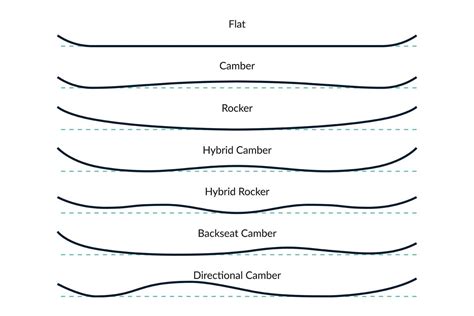
Picking the right camber profile can seem like a daunting task, but when it comes to choosing your board there is no "good" or "bad" profile. The most important thing to keep in mind is that each type will relate to different riding styles and snow conditions. With a variety of camber profiles on the market today, we think it is important to recognize and keep in mind the three basic profile classes: camber, rocker, and flat when making your decision. A snowboards flex and how it will handle and perform is directly related to the camber profile it features.
Outlined below are the three basic snowboard camber profile classes, along with hybrid variations that blend multiple camber profiles together for versatility in a variety of snow conditions.
Traditional Camber Snowboard
Camber is the most traditional snowboard profile. The process of de-cambering the board (flattening out the profile arc (camber) with the rider’s weight during a turn) loads the board with energy the rider can then “release” to initiate and “snap” into the next turn. While camber boards are more prone to catching an edge and can be more unforgiving for the beginner (particularly if the board is too stiff for the rider), they offer the most powerful and energetic ride with a feel that’s hard to replicate with any other board profile.
Hybrid Camber Snowboards
Beyond pure traditional camber, there are hybrid camber profiles. While the dominant profile between the rider’s feet remains cambered, these blended profiles try to incorporate some of the advantages of rocker and flat profiles towards the nose and tail of the board. Camber with rocker produces a more forgiving ride by lifting the board’s contact points off the snow. The rocker also offers better float in powder. Camber mixed with a flat profile will also be less “catchy” than traditional camber. They may not float quite as well in powder as a camber/rocker hybrid, but they retain more of the lively “pop” of camber for a playful ride that’s popular with freestyle-minded riders.
Rocker Snowboards
Rocker is the opposite of camber. Rockered snowboards move the contact points inward towards the center of the board resulting very quick and easy turn initiation that virtually eliminates the chance of catching an edge. Rocker also floats insanely well in powder but it can be squirrely at higher speeds due to reduced effective edge; that is, less board edge engaging the snow when on edge.
Read also: Comprehensive Guide to Hybrid Camber Snowboards
Hybrid Rocker Snowboards
Rocker hybrid profiles offer the quick, easy turn initiation of rocker but, like camber hybrids seek to also incorporate some of the benefits of camber and flat profiles into the same board. A rocker/camber hybrid typically incorporates rocker between the feet with cambered sections extending from under the rider’s feet towards the board’s contact points to bring back some of the energy and stability that’s lost in pure rocker boards. Likewise, instead of camber, some rockered hybrids incorporate flatter profiles extending out from the centered rocker section toward the nose and tail. While lacking some of the energy and stability of the rocker/camber hybrids, a rocker/flat hybrid will retain more of the catch-free playfulness of a rocker board.
Flat Camber Snowboards
Flat profiles are the middle ground between camber and rocker. Generally, flat profiles are found on softer freestyle boards that have a focus on riding non-snow features like rails and boxes. They're also great for newbies who want a board to progress quickly on yet still enjoy riding in the future. Flat profiles offer some of the stability and edge hold of camber while allowing for a more forgiving all-around ride.
Flat Hybrid Snowboards
Just like Rocker and Camber profiles, Flat has a mix of hybrids. Flat with cambered sections toward the nose and tail gives a more camber-like, stable ride at speed but the flatter, typically softer section between the feet makes edge to edge transitions easier. Flat with Rocker on the other hand provides a bit more effective edge than pure Rocker so you get a little more stability at speed while retaining the catch-free, super-float ride quality that Rocker fans love.
Understanding Snowboard Flex
Snowboard flex refers to the board’s torsional and lateral bend under pressure. A “softer” flex requires less pressure to initiate and hold the bend while a “stiff” board requires greater force. Unfortunately, there is no standardized flex rating system for snowboards. The majority of snowboard manufacturers use a 1-10 flex rating system (1=super soft, 10=very stiff) while others will use a proprietary system to convey the same message. We think it’s most helpful to break flex down into three classes: soft, medium, and stiff. Choosing the right flex in a snowboard depends on the rider’s experience level, size, and preferred use.
Below is a table summarizing the characteristics of different snowboard flex types:
| Flex Type | Characteristics | Ideal For |
|---|---|---|
| Soft | Requires less pressure to bend, forgiving | Beginners, lighter riders, freestylers |
| Medium | Versatile, balances stability and control | Wide range of riders and uses |
| Stiff | Requires more force to bend, stable at high speeds | Experienced riders, steep terrain, variable snow |
Soft Flex Snowboards
Softer flexing boards are ideal for beginners, lighter weight riders, as well as freestylers focused on jibbing and riding terrain park features. Just as the ”loose” power steering on a big old Cadillac makes it easier to navigate a crowded parking lot, for beginners and lighter weight riders, a softer board makes it easier to flex and control the board through turns at slower speed . The ability to more easily flex the board also benefits terrain park riders focused on sliding rails and boxes, or just “buttering the muffin” with sustained nose and tail presses. So why isn’t everyone on a soft board? Softer snowboards fall short during higher-speed, more aggressive riding. When a board isn’t beefed up to at least a medium flex, it will tend to produce excessive board chatter at higher speeds resulting in less edge hold and a loss of control.
Medium Flex Snowboards
The majority of snowboards are built with a medium flex in order to accommodate the widest range of riders and uses. Heavier weight beginners, and dedicated lightweights who aren’t afraid of a few bumps on their first days on this hill, can usually tolerate a medium flexing board right out of the gate. Although not as user-friendly as a soft board on the mellowest slopes at slow speed, a mid-flexing board will provide better stability and control as the rider progresses to steeper terrain and higher speeds.
Stiff Flex Snowboards
If soft boards resemble loose power steering and make for a more forgiving ride at slow speeds, they can make it downright sketchy when the pedal’s to the metal. When the terrain gets steep and gnarly, riders need the tight ride of a stiffer flexing snowboard. At high speeds in variable snow conditions, stiff boards are stable, more responsive to the rider’s slight weight adjustments, and better able to “track” the rider’s intended line. Finally, because riders come in all shapes and sizes, a stiffer board can also be a good choice for the experienced, heavy-set rider whose added weight might turn a medium flexing board into a soft one.