Picking the right camber profile can seem like a daunting task, but when it comes to choosing your board there is no "good" or "bad" profile. The most important thing to keep in mind is that each type will relate to different riding styles and snow conditions.
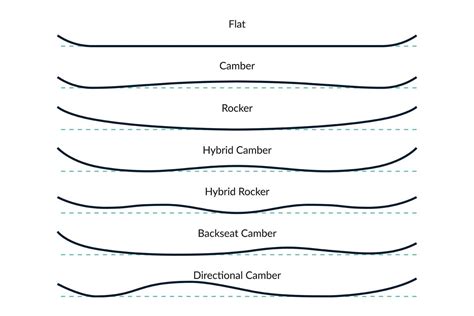
A snowboard's flex and how it will handle and perform is directly related to the camber profile it features. With a variety of camber profiles on the market today, we think it is important to recognize and keep in mind the three basic profile classes: camber, rocker, and flat when making your decision. Outlined below are the three basic snowboard camber profile classes, along with hybrid variations that blend multiple camber profiles together for versatility in a variety of snow conditions.
Traditional Camber Snowboard
Camber is the most traditional snowboard profile. This simple snowboard profile remained the standard until the advent of camber. When Sherman Poppen nailed his daughter’s skis together to create the first modern snowboard (aka the ‘Snurfer’) back in 1965, the base was totally flat with just an upturned nose.
A cambered snowboard is pre-bent so that - when you look at it from the side - the middle of the board sits above the ground. The process of de-cambering the board (flattening out the profile arc (camber) with the rider’s weight during a turn) loads the board with energy the rider can then “release” to initiate and “snap” into the next turn.
While camber boards are more prone to catching an edge and can be more unforgiving for the beginner (particularly if the board is too stiff for the rider), they offer the most powerful and energetic ride with a feel that’s hard to replicate with any other board profile. For years, skis and snowboards used cambered designs exclusively, and camber is still a popular choice.
Read also: Choosing the Right Salomon Snowboard
Camber offers precise edge control, stability at high speeds and pop for jumps.Camber performs best on hardpack and well-groomed runs, offering precise edge control and pop for jumps. Its responsiveness and stability make it an excellent choice for carving up corduroy and navigating icy patches.
Camber provides springiness and good edge control while carving turns on hard snow. When placed on a flat surface, a cambered ski or board has an uplifted waist (midsection) while the contact points rest on the ground near the tail and tip/nose. The area where the ski or board arcs upward by a few millimeters is known as camber. When a skier or rider applies body weight and presses into the skis or board, the camber flattens, creating continuous edge contact with the snow.
Cambered skis and boards offer several advantages:
- Control at high speeds: Racers use cambered skis and boards for the precision and security they provide at high speeds.
- Grip on hard snow: The continuous edge contact provided by camber creates good edge hold on hard snow, such as the groomed slopes of a resort.
- Stability while turning: The good edge hold that camber provides creates a stable feel while turning.
The main drawback of traditional camber snowboards is that it can be easy to catch an edge, especially for beginners, because it encourages the widest part of the board (the ‘contact points’) to touch the snow.
Rocker Snowboards
Rocker is the opposite of camber. You’ve probably heard of rocker (aka reverse camber) snowboards, and even rocker-camber or flat-to-rocker hybrids. This whole trend exploded about a decade ago, but it’s not actually a new idea. For instance, Tom Sims advertised rockered boards back in the 80s - taking his inspiration from surfboards.
Read also: Innovation in Skateboarding: Toy Machine
Rockered snowboards move the contact points inward towards the center of the board resulting very quick and easy turn initiation that virtually eliminates the chance of catching an edge. Rocker also floats insanely well in powder but it can be squirrely at higher speeds due to reduced effective edge; that is, less board edge engaging the snow when on edge.
Rocker is essentially the opposite of camber: It's a balanced, continuous arc that curves up from the center of the ski or board, a shape that resembles the floor rails of a vintage rocking chair (hence the term "rocker"). A board or ski's contact space is directly below the rider, located close to the feet. In some circles you'll hear rocker referred to as reverse camber, negative camber or alternate camber.
A pure rockered snowboard is the opposite of classic camber: the middle of the board sits on the snow, and the base curves gradually up towards the nose and tail. If you placed a rockered snowboard on a hard floor and kicked one end, it would spin around easily.
Rocker offers skiers and snowboarders several advantages:
- Improved flotation in powder: The early-rising tips and tails on skis and nose and tail on a snowboard help skiers and riders stay on top of soft snow.
- Greater maneuverability: Fully rockered skis and boards that are made to stay afloat have a shorter effective edge. Less edge contact with the snow permits easier, more nimble turning.
- Enhanced park experience: Without all the spring that comes with camber, it is often easier to slide rails on rockered skis or a rockered snowboard. The risk of catching edges is reduced as well. Rockered skis and boards are nice for riding switch, too.
If you're a freestyle rider who spends most of your time in the park, the forgiving flex of rocker snowboards makes it easier to perform butters, presses and jibs without catching an edge. For beginners, rocker snowboards are more forgiving and easier to learn due to their catch-free nature and seamless turn initiation. The upward arc between the bindings reduces the likelihood of catching an edge, making the learning process less daunting.
Read also: Is Lib Tech Right For You?
Rocker excels in deep snow and trees, enhancing float and maneuverability. The upward arc between the bindings allows the board to plane on top of the snow, reducing leg fatigue and providing a surfy feel. In tight tree lines and technical terrain, rocker's quick turning capabilities and forgiving nature come in handy.
Shape and profile: The most obvious difference between rocker and camber snowboards is their shape. Camber features an upward arc underfoot, with contact points near the tip and tail. In contrast, rocker has an upward arc between the bindings with contact points closer to the center. Flex: Camber snowboards typically have a stiffer and more responsive flex pattern. Rocker boards tend to have a softer and more forgiving flex.
Sure, it’s harder for a beginner to catch their edge on a reverse camber snowboard, but it’s also harder for them to carve properly. On a rocker snowboard you can’t really engage the full edge so your turns feel skiddy, like you’re sliding around on a tray. To be honest, it kinda sucks for anything except powder.
Flat Camber Snowboards
Flat profiles are the middle ground between camber and rocker. Generally, flat profiles are found on softer freestyle boards that have a focus on riding non-snow features like rails and boxes. They're also great for newbies who want a board to progress quickly on yet still enjoy riding in the future.
Flat profiles offer some of the stability and edge hold of camber while allowing for a more forgiving all-around ride.
Hybrid Camber Snowboards
Finding The Right Snowboard Shape - Snowboard Camber Explained
Beyond pure traditional camber, there are hybrid camber profiles. While the dominant profile between the rider’s feet remains cambered, these blended profiles try to incorporate some of the advantages of rocker and flat profiles towards the nose and tail of the board.
Camber with rocker produces a more forgiving ride by lifting the board’s contact points off the snow. The rocker also offers better float in powder. Camber mixed with a flat profile will also be less “catchy” than traditional camber. They may not float quite as well in powder as a camber/rocker hybrid, but they retain more of the lively “pop” of camber for a playful ride that’s popular with freestyle-minded riders.
Hybrid Rocker Snowboards
Rocker hybrid profiles offer the quick, easy turn initiation of rocker but, like camber hybrids seek to also incorporate some of the benefits of camber and flat profiles into the same board. A rocker/camber hybrid typically incorporates rocker between the feet with cambered sections extending from under the rider’s feet towards the board’s contact points to bring back some of the energy and stability that’s lost in pure rocker boards.
Likewise, instead of camber, some rockered hybrids incorporate flatter profiles extending out from the centered rocker section toward the nose and tail. While lacking some of the energy and stability of the rocker/camber hybrids, a rocker/flat hybrid will retain more of the catch-free playfulness of a rocker board.
Flat Hybrid Snowboards
Just like Rocker and Camber profiles, Flat has a mix of hybrids. Flat with cambered sections toward the nose and tail gives a more camber-like, stable ride at speed but the flatter, typically softer section between the feet makes edge to edge transitions easier.
Flat with Rocker on the other hand provides a bit more effective edge than pure Rocker so you get a little more stability at speed while retaining the catch-free, super-float ride quality that Rocker fans love.
Triple Base Technology (3BT)
Triple Base Technology (3BT) was the brainchild of a Norwegian biophsysicist named Jorgen Karlson. He was fascinated by the way boards naturally flexed and changed shape when in motion.
His thinking led him to the idea of altering the profile of a snowboard not just from the nose to the tail, but from one edge to the other. In short: 3D shaping. He took his concept to various snowboard companies who weren’t interested, so he teamed up with a few people who shared his enthusiasm and, in 2003, Bataleon was born.
To understand Triple Base Technology, you need to look at a Bataleon snowboard in a cross section. A flat strip in the centre of the base is combined with uplifted sides, which get more pronounced towards the widest points at the nose and tail.
When you jam your board into a powder bank, drive it through a transition or just crank out a turn, it’s always going to want to adapt its shape to the terrain. 3BT embraces this phenomenon, optimising a snowboard to the forces at work. Just as the curved hull of a boat ploughs through the waves, or the wings of a plane are designed to slice through the air, Triple Base Technology moves through its chosen environment with maximum efficiency.
Crucially, 3BT finally solves the puzzle of how to improve camber. Unlike rocker or hybrid camber profiles, Triple Base Technology actually works. And over two decades, we’ve carefully refined it to develop five variations, depending on your preferred riding style: Jib, Twin, Freestyle, Freeride and Pow.
In the last couple of years, we’ve also added SideKick to the recipe in most of our snowboards, including the best-selling FunKink and Whatever. SideKick dramatically increases the uplift at the widest points of the nose and tail. This makes turn initiation even smoother, increases float in powder and handling of the board in rough terrain.
Snowboard Flex
Snowboard flex refers to the board’s torsional and lateral bend under pressure. A “softer” flex requires less pressure to initiate and hold the bend while a “stiff” board requires greater force. Unfortunately, there is no standardized flex rating system for snowboards.
The majority of snowboard manufacturers use a 1-10 flex rating system (1=super soft, 10=very stiff) while others will use a proprietary system to convey the same message. We think it’s most helpful to break flex down into three classes: soft, medium, and stiff.
Choosing the right flex in a snowboard depends on the rider’s experience level, size, and preferred use.
Soft Flex Snowboards
Softer flexing boards are ideal for beginners, lighter weight riders, as well as freestylers focused on jibbing and riding terrain park features. Just as the ”loose” power steering on a big old Cadillac makes it easier to navigate a crowded parking lot, for beginners and lighter weight riders, a softer board makes it easier to flex and control the board through turns at slower speed .
The ability to more easily flex the board also benefits terrain park riders focused on sliding rails and boxes, or just “buttering the muffin” with sustained nose and tail presses. So why isn’t everyone on a soft board? Softer snowboards fall short during higher-speed, more aggressive riding.
When a board isn’t beefed up to at least a medium flex, it will tend to produce excessive board chatter at higher speeds resulting in less edge hold and a loss of control.
Medium Flex Snowboards
The majority of snowboards are built with a medium flex in order to accommodate the widest range of riders and uses. Heavier weight beginners, and dedicated lightweights who aren’t afraid of a few bumps on their first days on this hill, can usually tolerate a medium flexing board right out of the gate.
Although not as user-friendly as a soft board on the mellowest slopes at slow speed, a mid-flexing board will provide better stability and control as the rider progresses to steeper terrain and higher speeds.
Stiff Flex Snowboards
If soft boards resemble loose power steering and make for a more forgiving ride at slow speeds, they can make it downright sketchy when the pedal’s to the metal. When the terrain gets steep and gnarly, riders need the tight ride of a stiffer flexing snowboard.
At high speeds in variable snow conditions, stiff boards are stable, more responsive to the rider’s slight weight adjustments, and better able to “track” the rider’s intended line. Finally, because riders come in all shapes and sizes, a stiffer board can also be a good choice for the experienced, heavy-set rider whose added weight might turn a medium flexing board into a soft one.
How to Choose Between Camber and Rocker
So, which to choose-camber or rocker? It's not really an either/or proposition. Shortly after rocker came onto the scene, ski and snowboard manufacturers realized camber and rocker could be combined to address specific performance needs. Today, most skis and snowboards use some combination of underfoot camber and tip and tail rocker in their designs to enhance performance on certain types of terrain and snow.
To choose the amount of camber and/or rocker that's right for you, it's helpful to consider the terrain you ski or snowboard on and your experience level.
How to choose camber or rocker based on your usual terrain preference:
- Groomed slopes: Cambered skis and boards are popular here for their stability at speed and reliable edge control. Skis and snowboards with a mix of rocker and camber perform well, too, and can make getting through chopped up snow or crud a bit easier. Fully rockered snowboards can do well on resort slopes, but they falter a bit when conditions are icy, when edge control becomes more important.
- All-mountain: For snowboarders who roam freely from groomers to sidecountry and backcountry, rockered boards are an excellent choice for their ability to turn easily and quickly. The extra float they provide in powder is one of their most popular advantages. Snowboards that combine camber and rocker are also popular in varying conditions. For skiers, a popular combination is a rockered tip (for easier turning and good flotation for skiing off-piste in powder), cambered or flat midsection (providing some edge control), and possibly a flat or low-rise tail (for skiers eager to hold speed).
- Powder: This is where fully rockered skis and boards were originally designed to rule. Their early-rising tips/noses and tails easily float in the soft stuff and are much less likely to catch an edge. Rockered snowboards allow you to ride more centered over your bindings in deep snow, which greatly reduces back leg burn. Skis and boards that combine rocker and camber do well here, too, and are versatile for use in other conditions. Cambered snowboards can ride powder, though usually using a setback stance.
- Park/pipe: Some skiers and snowboarders like the stability of cambered skis and boards when executing jumps in parks. The camber design traditionally gives you more consistent pop off jumps. However, rockered skis and boards simplify the task of transitioning from nose to tail. For jibbing, rockered skis and boards are popular for avoiding hang-ups on boxes and rails. Pressing into a rail is much easier with a rocker design.
How to choose camber or rocker based on your experience level:
Snowboarders and skiers of all skill levels can benefit from rocker. Yet recreational riders, progressing riders and people who haven't been on the slopes for years can enjoy an almost immediate boost from using a ski or snowboard that features some amount of rocker.
For advanced riders, rocker and its constantly evolving combination with camber works for them, too. Designers have concocted all types of nuanced rocker variations that address specific rider needs.
Consider what feels best underfoot and aligns with your riding aspirations. Some riders prefer the lively and responsive feel of camber, while others enjoy rocker's loose and surfy sensation. If you have specific goals, such as improving your freestyle skills or tackling steep terrain, let those objectives guide your decision.
Trying different profiles is the best way to determine which suits you best. Many ski shops offer demo days or rental programs, allowing you to try various boards and profiles. Take advantage of these opportunities to see how each profile performs and responds to your riding style.
Understanding the differences between camber and rocker snowboards is essential to finding your perfect board. Choosing the right snowboard profile can make a big difference in your performance and enjoyment on the slopes.
| Profile | Characteristics | Best Use |
|---|---|---|
| Camber | Upward arc underfoot, precise edge control, stability at high speeds, pop for jumps | Hardpack, groomed runs, carving |
| Rocker | Upward arc between bindings, enhanced float, maneuverability, forgiving | Deep snow, trees, beginner riders, freestyle |
| Flat | Middle ground, some stability and edge hold, forgiving | Freestyle, rails and boxes, beginners |
| Hybrid Camber | Camber with rocker or flat sections, combines advantages | Versatile, all-mountain riding |
| Hybrid Rocker | Rocker with camber or flat sections, combines advantages | Versatile, all-mountain riding |
tags: #snowboards #camber #vs #rocker