Choosing the right hockey stick is essential for elevating your performance on the ice. One of the most critical factors to consider is the kickpoint. If you're not familiar with the term kick point or how it affects ice and roller hockey sticks, walking into a pro shop probably leaves you puzzled. You'll see that every large scale manufacturer (CCM, True, Bauer, Warrior) has at least two different looking sticks that seem to have the same curve and flex rating.
The kick point is the term the hockey industry uses to identify where the stick is intended to bend and recoil from with standard pressure applied. Whether you're a sniper, playmaker, or power forward, your kickpoint determines how efficiently you can shoot, pass, and play the game. But what is a kickpoint? Why does it matter? This comprehensive guide will answer all of these questions.
By the end, you’ll know everything about Low Kick, Mid Kick, and Hybrid Kick sticks, which kickpoint suits different player types, and which specific hockey sticks from major brands like CCM, Bauer, TRUE, Warrior, and Sherwood feature these kickpoints. The kickpoint of a hockey stick refers to the flex point, or the spot along the stick’s shaft where it bends the most when pressure is applied during a shot. Essentially, it’s the location where the energy gets stored before it's released to propel the puck forward. Knowing your kickpoint helps you maximize your shot efficiency by channeling your strength and playstyle into the stick.
Hockey sticks are designed to be able to bend, or what we call “flex.” The amount of flex is indicated by a number on your shaft, and choosing the right one can help add more power to your shots. A higher number offers a stiffer feel that’s great for powerful slapshots, while a lower one is whippier and can be easier to flex for lighter players. The kick point is where your stick flexes the most.
Your shaft shape plays a big role in determining how your stick feels in your hands. The curve of your blade heavily influences how you shoot and stickhandle. Mid-curves help you cradle the puck and generate spin on your shots, while toe curves are great for toe-dragging defenders and pulling the puck towards you before you release it.
Read also: Features of Custom Hockey Gloves
Listed above are the two most common styles of kick points in use today. Because of the specialization ability in hockey stick manufacturing, there have been a variety of other kick point stick styles out there available that are lesser used and not made by all manufacturers, but they're good to know as they be right for your game.
Each brand typically offers all three kickpoints in different lines of sticks. If you're unsure which kickpoint suits you best, feel free to speak to one of our store experts. Choosing the right stick for your style of play is crucial to your performance and success. Every BAUER stick features a unique combination of designs and technologies that, when properly selected, can positively influence your game.
Understanding Kick Points
For all the talk and advertising surrounding kick points, it is difficult to find a consistent and meaningful definition. The most frequently cited definition is that it is the point along the stick that flexes most during a shot. As such, it is generally categorized into three types: mid, low, and variable. The mid-kick point flexes most in the middle and has the most power, the low kick point flexes most in the lower third of the stick and is good for quick but less powerful shots, and the variable kick point is supposed to adapt itself to the shot.
This definition was not entirely satisfying. First, both calculations (Flex of a Hockey Stick - the Kick Point) and experiments showed that the maximum bending always occurs near the middle of the stick unless extreme, impractical methods were used. With regard to the first option - kick point being the most flexible point - we measured the flex variation of 13 high performance sticks over the length of the stick (See Hockey Stick Flex Profiles). That showed that almost all sticks are softest at the top end and stiffest in middle or blade end. So, perhaps it was the last definition: the kick point being the point on the distal end of the stick where bending begins.
When a stick bends, a segment on each end remains almost straight. The maximum bending point was found by projecting straight lines from the straight portions of the stick on each end. The maximum bending point is located opposite the intersection of these lines.
Read also: The story of Craig Needham
The maximum deflection point follows the transition point between stick thicknesses. All these results indicate that given the right construction, stiffness, and flex points, manufacturers can move the point of maximum bend slightly up and down from the middle. It also follows the stiffness transition point. However, the radical change in stiffness used in the variable stiffness sticks would, however, never occur in real sticks.
Though much of the literature on hockey sticks refers to the kick point as the point of maximum bending, our tests did not find this to be the case - the point of maximum bend is always close to the middle of the stick, does not move very much, and does not match very closely to advertised kick point locations. The kick point is the "point along the shaft where the predominant bending begins." The distance of the separation point from the top of the stick was measured and calculated as a percentage of the stick's length from the top. This location more closely matches the kick point as designated by manufacturers.
Kick point defined in this way correlates well to the location on the stick of the kick point as designated by manufacturers for each stick. However, this is just the end point of maximum deflection. The maximum deflection point and the kick point are talking about the same bend. As such they are not different things and do not account for different performances or feel. A stick's kick point and maximum deflection point are just different ways of talking about the same performance.
The kick point is a side effect of stiffness and hand position. As such, it is simply a convenient term to convey properties in marketing terms. Hand position and stiffness variation along the stick alter the maximum deflection point and with it the kick point. Overall stick stiffness is probably a more indicative property to relate to power and feel than trying to conceptualize in terms of kick points.
What is a Mid Kick?
Mid-kickpoint sticks bend and store energy in the middle of the shaft, allowing for a longer load time and more powerful shots. With the energy loaded at the mid-point, you can put your full weight into your shot, transferring a tremendous amount of energy into the puck.
Read also: Inside Aaron Ness's Career
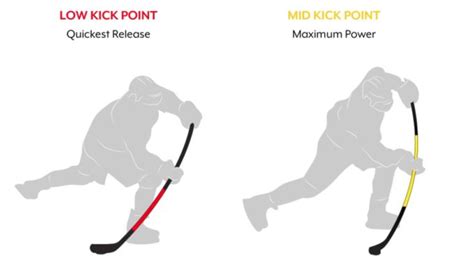
By default, a complete uniformly constructed stick will bend in the middle when pressure is applied. This is known as a mid-kick stick and is the most common style in use by players from the NHL downward, across the board.
Who Should Choose a Mid Kick Stick?
Mid-kick sticks are great for defensemen and power forwards who take heavy shots from further out, particularly when winding up for slapshots. If your game involves big slapshots from the blue line or driving hard into shooting lanes to rip heavy shots, a mid-kick stick is what you need.
Located in the center, a mid kick point for a hockey stick fits a more-balanced style of play. These are the most common kick points on a hockey stick and for good reason. It’s easy to get the hang of no matter what style of play you prefer, making it suitable for both forwards and defensemen.
When we talk about the kickpoint on a hockey stick, we're referring to where the stick flexes the most when you lean into it. The mid kickpoint is your power stick. This style loads up energy when you flex it, resulting in a slower release but with a ton of power behind your shot.
Mid kick are the more traditional types of flex profile. The bend is in the middle of the hockey stick and are designed to give the feel of wood and early composite hockey sticks.
How to Choose Hockey Stick KICK POINT for Beginners!🏒
Kick Point Styles: Low Kick vs. Mid Kick vs. Hybrid Kick
When deciding on the best kickpoint for you, it’s essential to consider your style of play, your position on the ice, and the type of shots you take most frequently. Shot Mechanics: If you take quick-release shots off your toe, a low kick might be better. The right kickpoint can drastically improve your shot speed, accuracy, and overall performance on the ice. Whether you’re a quick-shooting forward or a powerful defenseman, choosing a stick that matches your shooting style is crucial.
Remember, the key is understanding your own mechanics and tendencies on the ice. Try different kickpoints, get a feel for how they impact your game, and find the perfect match for your playstyle.
Two variations of a pendulum mechanism were built to simulate the swing of a stick. In one variation, a bungee cord pulled the pendulum arm through contact with the puck (100 g brass weight), regulating a constant speed and force of contact. In the second variation, a pull-weight was used to pull the pendulum arm through contact.
In addition, a sliding drop mass was attached to the stick. This mass slid down the stick as the pendulum dropped and was timed to "bottom-out" at "ice" contact. This added extra bending energy to the stick, just as a player does when leaning into the stick after ice contact. The drop mass landed on a spring that increased the duration of loading as the stick slid along the ice.
An aluminum beam (37 mm wide and 3 mm thick) was used as a stick. The beam was bolted to the pendulum and could be easily adjusted up and down to allow for different degrees of slapping and sliding along the table (referred to as the "ice") before hitting the puck. The stiffness of the stick was altered by attaching a second beam to the first with double sided tape. The length of the second beam was adjusted to either 46%, 62%, 66% or 100% of the length of the first beam. It extended from the top of the stick downward.
Using these different length second beams, the stiffness could be altered either uniformly (using 100%-length beam), or variably (using the 46%-, 62%-, and 66%-length beams). The 66% length beam was also less stiff, being only 2 mm thick instead of 3mm.
The hand position was adjusted by sliding and tightening the angle brace. The hand positions were located 22%, 31%, and 50% from the top of the stick (the "top hand").
Key Considerations for Choosing a Hockey Stick
Several factors should be considered when selecting a hockey stick to ensure it complements your playing style and enhances your performance.
One-Piece vs. Two-Piece Sticks
- One-Piece Hockey Stick: Complete with shaft and blade fused together, ensuring manufacturer’s specifications are met.
- Two-Piece Hockey Stick: Separate blade and shaft units that can be mixed and matched.
Anatomy of a Hockey Stick
Understanding the different parts of a hockey stick can help you make a more informed decision:
- Butt end: The top end of the hockey stick where your top hand holds the stick.
- Blade Heel: The back part of the blade where it meets the hosel of the shaft.
- Blade Lie: The angle between the hockey stick blade and shaft, determining where the blade sits on the ice.
- Blade Pattern and Curve: Determines the blade lie, curve type, curve depth, face angle, blade toe, and blade length.
- Blade Curve Depth: The actual, measurable amount of curve to a hockey stick blade.
- Blade Face Angle: Describes how much of the face of the blade you can see when looking down at the ice.
- Blade Toe: The end opposite the blade heel, with shapes that are round, square, or a combination of both.
- End Plugs: Composite or wood stick shaft extensions used to increase the length of a hockey stick.
- Flex: The stiffness rating of a hockey stick.
- Grip Shaft vs Clear Shaft: Grip shafts provide better grip, while clear shafts allow more hand movement.
- Kick point: The specific flex zone of where the stick is designed to flex the most at point of impact and pressure.
- Left hand versus right hand: Indicates whether a player is a right-handed or left-handed shot.
- Hockey Stick Length: Matched to the size of the hockey player.
- Shaft: The long length of the stick between the butt end and the blade.
- Stick Wax: A wax compound rubbed onto the tape of the stick blade to keep the blade dry and provide better puck feel.
- Tapered shafts: Provide a lower kick point, impacting shot release velocity.
Composite vs. Wood Hockey Sticks
The choice between composite and wood hockey sticks often comes down to personal preference:
- Composite Sticks: Popular for their weight reduction, flexibility, and performance.
- Wood Hockey Sticks: Offer a different feel and can help build strength over time.
Ultimately, the choice of a hockey stick depends on your individual needs and preferences. By understanding the different types of kick points and other features, you can select a stick that helps you perform your best on the ice.
Conclusion
Choosing the right hockey stick is a crucial decision that can significantly impact your performance on the ice. Understanding the different types of kick points, blade patterns, flex, and materials will help you select the perfect stick for your playing style. Whether you prioritize a quick release, powerful shots, or a versatile combination, there is a hockey stick designed to meet your needs.