Paradise does not necessarily have palm trees. Let’s cruise down the powdery pistes only to stop for hot chocolates and al fresco lunch. When the sunshine gives way to thick snowflakes, it’s time for spa, cheese fondue and a nightcap or two by the roaring fire… Or to the sound of a roaring crowd. Because, let’s face it, there is no better après ski than in the Alps!
The Alps are an extensive mountain system located in south-central Europe. A staggering 120 million tourists from all over the world visit the Alps on a typical year, most of them to enjoy their favourite winter sport. There are currently more than 1,100 ski resorts throughout the Alps with France, Austria, Switzerland and Italy taking the lead in ski resort quantity, size and prestige. Many ski resorts are interlinked, forming immense ski areas (known in France as Grands Domaines). Some of them spread across two countries! All-in-one ski passes allow skiing from one resort to another at one’s leisure.
The highest peak of the Alps is Mont Blanc (‘the White Mountain’) which rises to an elevation of 4,808m / 15,774ft on the border of France and Italy. The equally famous, pyramid shaped, Matterhorn rises to a height of 4,478m / 14,692ft at the border of Switzerland and Italy.
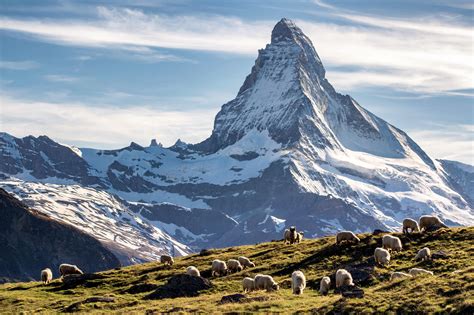
The iconic Matterhorn peak.
Top Ski Resorts in the Alps
The highest ski resort in Europe is Val Thorens in the French Alps. Its base is located at 2,300m / 7,500ft and its highest chairlifts reach 3,270m / 10,730ft. Most modern purpose built ski resorts in the Alps, such as Alpe d’ Huez and Avoriaz in France or Sölden and Gurgl in Austria are based at around 1,800m / 5,900ft. Historical resorts such as Kitzbühel in Austria or Gstaad in Switzerland are based a lot lower, at around 1,000m. However, in most cases, elevations of up to 3,000m / 9,850ft can be easily reached via a network of gondolas. A typical example of the evolution of ski resorts over time is glitzy Courchevel in France.
Read also: Comprehensive MTN Analysis
Here are some of the most popular ski areas in the Alps:
- Saint Martin de Belleville: The biggest ski area in the world features 342 pistes & 158 ski lifts.
- Peisy-Vallandry: 70% of the ski area is above 2,000m / 6,560ft. Double-decker Vanoise Express cable car is amongst the largest worldwide.
- Verbier | Bruson | La Tzoumaz | Nendaz | Veysonnaz | Thyon: The largest ski resort in Switzerland offers a panorama of the most famous Alpine peaks at 3,300m / 10,830ft.
- Sestriere | Sauze d’Oulx | Oulx | San Sicario | Cesana | Pragelato | Montgenèvre: The ‘Milky Way’ features 6 Italian ski resorts & 1 French -pretty Montgenèvre. Its highest point is at 2,800m / 9,190ft.
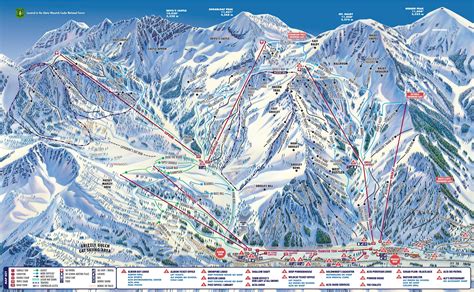
A typical ski resort map.
When to Visit the Alps for Skiing
The ‘official opening’ of the winter season in the Alps is the end of November or early December. Most major ski resorts typically open their ski lifts then. By mid-December, the Alps typically experience significant snowfall, so most ski resorts can more or less guarantee that their slopes are open at Christmas. Still, during years of little precipitation, the situation might differ. For that reason, it is always best to choose higher altitude resorts for your Christmas ski trip to the Alps. High season takes off from mid-January. By then, snow coverage is good on most resorts. During February and well into March, the Alps are at their best. Skiing conditions are generally excellent. Towards the end of March, some ski resorts can face melting snow though high-altitude (>2,000m / 6,560ft) and north facing slopes will still have good snow conditions. It is around mid-April that the ski season in the Alps comes to an end.
A week-long ski trip is a typical choice when visiting the Alps in winter and Saturday to Saturday ski holidays have long been the standard for the European ski industry. Most organised ski trips are booked on that basis but even if you travel independently, many chalets and even hotels will request that you book on that schedule. Moreover, most of the ski schools follow suit and offer group lessons from Sunday to Friday. As a result, Saturday is known as changeover day. Usually Saturdays on ski resorts are synonymous with more traffic on the road and less traffic on the slopes.
Have you ever noticed a sharp spike in flight and hotel prices in European ski resorts over specific weeks (apart from Christmas, New Year’s or Easter)? That is because of the, lesser known, winter term school holidays. The dates vary from country to country and even within different regions of the same country. However, the second half of February seems to be a recurrent hotspot for school holidays in most European countries. My advise is to avoid ski trips on those weeks if you can help it. Not only is there a significant increase in prices but ski resorts get really busy.
Read also: Skiing on Christmas Day
Europe's Best Ski Resorts: Find the Right One for You - TOP 15
Skiing in the Alps vs. North America
Here's how skiing in the Alps compares to skiing in North America:
- Multiple interlinked ski resorts create massive ski areas for endless skiing on world class terrain.
- Breathtaking views of the Alps, vibrant culture and the famous all-day après scene.
- Cross-border ski areas allow you to ski in two countries in one day!
- Spectacular train rides and historical village stays (even pedestrian only) can be part of your ski trip.
- Above the tree line terrain is common and is often exposed to bad weather.
- There are no in-bounds off-piste areas - if you are not skiing on a designated run you ski at your own risk.
Pistes are colour coded according to their level of difficulty (symbols may also be used). Piste classification may vary from country to country and is not a fixed measure.
Ski Resorts by Country
Here's a quick look at what each country offers:
- France: Renowned for its spectacular ski resorts, offering a wide range of options for skiers and snowboarders of all levels.
- Italy: Ski resorts are known for their breathtaking landscapes, gourmet cuisine, and a perfect blend of skiing and relaxation.
- Austria: Boasts some of the most charming and picturesque ski resorts in Europe.
- Switzerland: Synonymous with luxury ski resorts, stunning alpine scenery, and world-class skiing.
- Andorra: Nestled in the Pyrenees, offers a unique blend of Spanish and French cultures, along with some of the best skiing experiences in Europe.
- Bulgaria: An emerging destination for winter sports, offering affordable and diverse skiing experiences.
- Georgia: With its stunning Caucasus Mountains, offers an exotic and adventurous skiing experience.
- Finland: Offers a unique skiing experience with its pristine landscapes and snowy winters.
It’s worth checking the altitude of your ski resort (base and lifts), especially if you are travelling towards the beginning or end of the season (opt for >1600m / 5,250ft) or if you are really keen on authentic alpine architecture (most likely found <1600m / 5,250ft). Wishing for a bit of both? Saint Martin de Belleville
| Country | Key Features | Popular Resorts |
|---|---|---|
| France | Diverse terrain, luxury resorts | Val Thorens, Courchevel, Alpe d'Huez |
| Austria | Charming villages, après-ski | Kitzbühel, Sölden, Gurgl |
| Switzerland | Luxury, stunning scenery | Zermatt, Verbier, Gstaad |
| Italy | Gourmet cuisine, relaxation | Sestriere, Sauze d’Oulx |
Read also: Employee Benefits at Vail Resorts