The German men's national ice hockey team is the national ice hockey team of Germany and is controlled by the German Ice Hockey Federation. It first participated in serious international competition at the 1911 European Hockey Championship. When Germany was split after World War II, a separate East Germany national ice hockey team existed until 1990. By 1991, the West and East German teams and players were merged into the United German team.
Ice hockey in Germany is overseen by the German Ice Hockey Association, which has been a member of the International Ice Hockey Federation since 1909. The men’s national team made its international debut in 1910, followed by the women’s and junior teams in 1988 and 1976, respectively.
Early History and Development
Hockey-like sports had been played during the winters mostly in the Alps and on lakes and rivers throughout Germany for centuries. The first registered hockey game in Germany was played on February 4, 1897, on Halensee Lake in Berlin. It wouldn’t be until 1901 that Germany would see its first ice hockey club called Berliner Schlittschuhclub (roughly translated to Berlin ice skating club). It is still active today under the name Eissport und Schlittschuh-club (roughly translated to ice sport and ice skating club).
Germany was actually the 6th member of the IIHF. In 1910 several German teams participated in the first Ice Hockey European Championship. The German National Team won bronze at the 1932 Olympic Games. They wouldn’t medal for another 44 years when they got bronze in the 1976 Olympics.
The West German team's greatest success came in 1976 at the Winter Olympics, when the team went 2-3-0 and won the bronze medal. In 1980, the team did not do as well and only won one game in the preliminary round, which kept them from advancing. In 1984, the team was invited to the Canada Cup.
Read also: The German Ice Hockey Jersey
Recent Achievements and World Ranking
The team is not considered to be as elite as Canada, the Czech Republic, Finland, Russia, Sweden or the United States; they are ranked 9th in the world (2022) by the IIHF. Since re-unification, their best recent results include finishing 6th place at the 2003 World Championships where they lost a close quarter-final match in overtime to Canada, and 4th at the 2010 World Championships where they lost to Sweden in the bronze medal game. Previously, they finished third in the European Group and qualified for the quarter-finals at the 1996 World Cup after a surprising 7-1 victory against the Czech Republic.
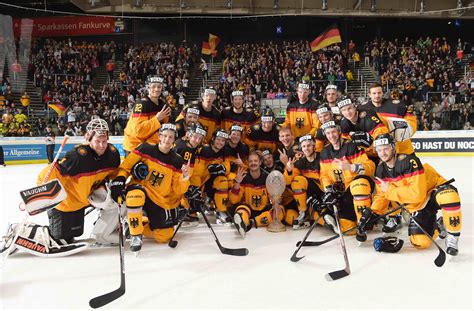
Germany has never won an international competition, and their most recent medal was silver in the 2018 Olympic Winter Games, when they lost to the Olympic Athletes From Russia 4-3 in overtime. It was the first time that Germany had reached the Gold Medal Game at the Winter Olympics.
By beating Canada, the defending gold medalists from both the 2010 Winter Games in Vancouver and 2014 in Sochi, 4-3, Germany not only advanced to the final, but secured at worst a silver medal, making this the most successful Olympic ice hockey tournament in the country's history.
Germany headed into the 2010 Men's Hockey World Cup with a largely young and inexperienced squad but reached the final of the World Cup after strong performances throughout the tournament. Germany has played in the annual 2011 Hockey Champions Trophy held in Auckland, New Zealand. The team competed in pool B with Korea, Netherlands and host nation New Zealand.
Despite a rich history, Germany has not secured a medal in a major tournament since 1953. This overview highlights the development and achievements of the men’s, women’s, and junior national teams.
Read also: National Team Jersey Designs
The DEL (Deutsche Eishockey Liga)
The Deutsche Eishockey Liga (for sponsorship reasons called PENNY Deutsche Eishockey Liga) or DEL, is a professional ice hockey league in Germany and the highest division in German ice hockey. Founded in 1994, it was formed as a replacement for the Eishockey-Bundesliga and became the new top-tier league in Germany as a result.
Teams from the DEL participate in the IIHF's annual Champions Hockey League (CHL), competing for the European Trophy. Participation is based on the strength of the various leagues in Europe (excluding the European/Asian Kontinental Hockey League). Going into the 2022-23 CHL season, the DEL was ranked the No. 7.
In the 2016-17 season, the league was the second-best supported ice hockey league in Europe, behind the Swiss National League A, with an average attendance of 6,198 spectators per game.
Fourteen different teams comprise the league, playing their home games in a diverse mix of venues, including a few large, modern arenas (e.g. in Berlin, Mannheim, Cologne, and Düsseldorf) and older, smaller venues (e.g. in Iserlohn, Schwenningen and Straubing).
The DEL is known for its game-day atmosphere, as well as producing NHL talents including Dominik Kahun, Tim Stützle and Lukas Reichel. Many of the German national team that took silver at the 2018 Winter Olympics in Pyeongchang played in the DEL, while EHC Red Bull München became the first German team to reach the Champions Hockey League final in 2019, losing to the Swedish team Frölunda HC.
Read also: Evolution of NHL Team Logos
Former DEL logo (1994-1996). The DEL was founded in the 1994-95 season, consisting of teams from the Eishockey-Bundesliga's 1st and 2nd divisions. The condition of these earlier leagues had become intolerable. Many 1st and 2nd division teams were heavily in debt.
The 2004-05 season was significant due to the NHL lockout. The DEL is an independently run league, fully owned and operated by its 14 member teams.
The 2020 season was ended prematurely due to the coronavirus pandemic, which caused the cancellation of the play-offs.
Leon Draisaitls Top 10 NHL-Karriere-Highlights
German Players in the NHL
Now getting to the history of German NHL players. The first German to be selected in the NHL Draft was Orest Romashyna. He was selected 3rd overall in 1963 by the Boston Bruins. He is tied for the highest German ever drafted.
The first German to play in the NHL was Udo Kiessling. Kiessling was a defenseman who played in 1 NHL game on March 13, 1982 for the Minnesota North Stars. Not a great start for Germany, but it will get better.
The first German to have a real presence in the NHL was Uwe Krupp. He was selected in the 11th round, 124th overall, by the Buffalo Sabres in 1983. He would go on to play in 729 NHL games for the Sabres, Islanders, Nordiques, Avalanche, Red Wings, and Thrashers between the 1986-87 season and the 2002-03 season.
Olaf Kölzig is widely considered to be the best German goalie. He played in 719 games in the NHL, all but 8 with the Capitals and the other 8 were with the Lightning, putting up a 303-297-87 record with a 2.71 GAA, a .906 sv%, and 35 shutouts throughout the 90s and 2000s. Kolzig is also the first German to win an NHL award, having. won the Vezina in 1999-00 and the King Clancy in 2005-06.
Marco Sturm is the current NHL leader in points for German players with 487 points, 242 goals, and 245 assists, in 938 games played with the Sharks, Bruins, Kings, Capitals, Panthers, and Canucks. Sturm will most likely be 2nd in this regard after this 2020-21 season ends. Some other notable past Germans in the NHL include Christian Ehrhoff, Dennis Seidenberg, and Marcel Goc.
Since 2010, there have only been 2 drafts without at least 1 German player selected, 2012 and 2013. There are Germans sprinkled throughout the NHL, some notable ones include Tobias Rieder, Tom Kühnhackl, Nico Sturm, and Dominik Kahun.
In 2014, Leon Draisaitl was selected 3rd overall by the Edmonton Oilers, tying Orest Romashyna as the highest German ever selected. Draisaitl has proven to be, without a doubt, the best German player ever. He has the record for most goals in a season by a German, 50, most assists, 67, and most points, 110. He is the first, and only German player so far, to have a 100+ point season. He is the first German player to win the Hart, Art Ross, and Ted Lindsay. Also, the first German to win more than 1 award in a season. Draisaitl currently has 447 points, 176 goals and 271 assists, in 437 games all played with the Oilers.
2020 was a huge year for Germans, not only was Leon Draisaitl cementing his status as the best German player after cleaning up at the NHL Awards and leading the league in points, but the NHL draft in October would be a historic one.
The 2019 NHL draft was historic enough with it marking the first time a German player had gone in the first round in back-to-back drafts. Dominik Bokk was selected 25th overall by the St. Louis Blues in 2018 and Moritz Seider was selected 6th overall by the Detroit Red Wings.
2020 would continue the tradition by being the 3rd draft in a row where at least one German would be taken in the first round, the first time ever.
All we know for certain is that they will have some great and promising players with Leon Draisaitl, Tim Stützle, Lukas Reichel, John-Jason Peterka, Moritz Seider, Tobias Rieder, and Dominik Bokk just to name a few.
Leon Draisaitl is more than likely to continue to be one of the best NHL players for years to come. Moritz Seider is poised to be the future of the Red Wings’ blue line for years to come. Dominik Bokk is still young, but looks to be somewhat of a project after being traded to the Carolina Hurricanes. Tim Stützle is looking really good and promising in his very young NHL career and could be the 2nd best German NHL player ever. John-Jason Peterka has looked great since the draft, still has some time before he makes the NH, but could be a very solid player.
Olympic Success in 2018
GANGNEUNG, South Korea - When the remarkable German hockey team plays the Olympic Athletes from Russia in the men’s hockey gold medal game Sunday, it will be fitting to have a hulking defenseman named Krupp blocking shots in front of the German net.
The fearless defender is red-haired Bjorn Krupp, the American-born son of Uwe Krupp, considered one of the best German players ever to play in the NHL.
“They even look alike too, just the red hair and brown hair (difference),” German coach Marco Sturm said. “He is our sixth/seventh (defenseman), but when he comes in, he takes care of business just like his dad.”
In some ways Bjorn Krupp, 26, is like his team in that they were both long-shots to advance this far.
“It’s been a crazy journey,” Krupp said.
The Germans, already assured of winning at least the silver medal, have only won two bronze medals in the history of the Olympic hockey tournament, the last coming in 1976.
The Germans didn’t even qualify for the 2014 Olympics in Sochi, Russia.
“I’m kind of speechless to be honest,” Krupp said. “Obviously, it’s a bit different with the NHL players not being here. But it’s a great opportunity. Who would have thought Germany would be in the final against Russia?”
And who could have predicted Krupp, born in California and not learning to skate or play hockey until age 11 in Atlanta, would end up on the German national team?
Krupp’s dad was playing for the Atlanta Thrashers in 2002-03 when teammates Dan Snyder and Jeff Cowan persuaded him to put Bjorn in hockey.
“(They) said, 'Why don’t you give him some equipment, put him in a house league and let him skate around?' ” Bjorn Krupp said.
Snyder was killed in an automobile crash not long after lobbying on Bjorn’s behalf.
By the time young Krupp laced skates, Uwe Krupp was at the end of an impressive NHL career. Even as a defenseman the elder Krupp put up 281 points, top 10 among NHL players born in Germany.
When his father was hired as a coach in Cologne, he suggested Bjorn come to Germany and work his way up to Germany’s top league. Bjorn surprised everyone by making the top league in his first season.
“It kind of shows that there is not really one way to go,” Bjorn Krupp said. “If you follow your dream, you never know what will happen.”
Sturm chose Krupp because he believed he could fill the shot-blocking role on the team.
“He really deserved it this year because he’s a good teammate and he blocks a lot of shots,” Sturm said. “He’s really good on the (penalty kill) and that’s what I needed. He does a tremendous job.”
Krupp is averaging 11:18 per game. “He puts his body in front of any shot and is a real hard-working guy and makes simple plays and plays the body all the time,” said former NHLer Christian Ehrhoff, who is Germany’s top defenseman.
Krupp said since Germany upset Canada in the semifinals he has heard from people who he hadn’t “talked to in five, six or seven years” who want to congratulate him on Germany’s incredible run.
He also heard from his father, who had to stay in Germany for work reasons.
National Teams Rosters
Men’s National Team
The following players were named to the roster for the 2025 IIHF World Championship.