Tying ice skates correctly is essential for providing ankle support and ensuring that your body's energy is efficiently transferred to the blade. This prevents energy loss within the boot and enhances your skating performance. If you feel that your feet are able to move independently from your skates, it means that they need to be tightened.
Here's a step-by-step guide to help you achieve the perfect fit:
- Seating Your Foot: Seated in a chair, with your skate on a mat, press your foot firmly into a loosened skate.
- Initial Tightening: Put your foot in the skate and tighten the already laced portion. Pull the loose ends of the laces as you go to take out the slack. Once you reach the middle of the boot, the slack in the lace may start pulling the loose ends of the laces out of the holes in the top of the boot. The top few holes of the boot are likely not laced at this point.
- Lacing the Top: Once you have tightened the laces up to this section, follow the same pattern as the rest of the laces to complete lacing the boot to the top.
- Hook Lacing: Some skates have hooks at the top. Cross the laces as you would if you were lacing through holes, then draw the laces either from the top of the hooks down, or the bottom of the hooks up. Either direction will work.
- Snug Ankle (If No Hooks): If you do not have hooks at the top of your skates and would like to make the ankle even more snug, try this trick. Instead of crossing your laces to the top holes, take the laces directly up to the next hole on the same side. Feed the lace from the outside in through the top hole, creating a loop on each side. Now cross the laces and put them through the loops you just created on the opposite sides and pull to tighten.
- Creating Space: Pull up on the laces while rocking the toes of your skate forward. This will create a space between your crossed laces and the top of the skate.
- Tying the Knot: From there, draw the laces together in front of the skate to begin your knot. Just like you would tie a shoe, cross one lace over the other and wrap it under and back out to the side.
- Double Knot: Like tying a shoe, make a loop in one lace, then loop the other under and over the loop. This time, repeat this looping process to create a double loop for your knot. This will help make your laces more secure.
- Securing Excess Lace: Wrap the remainder of the laces around the boot. Take the laces around the back of the top of the boot and pull them back to the front. You don't want to have any laces touching the ice or loops in your bow which are too big. These could cause the lace to end up between the skate and the ice and cause a tripping hazard. If you would like, hook the loops of your double bow over the top eyelets, and then tuck in the other part of the bow into your skate.
Your skates must become one with your legs, like a part of your body.
Important Considerations:
- Lace Tension: Pulling the laces tight enough with your fingers is hard. Lacing holds the foot in place with tension, this needs to be released off the ice.
- Lace Type:
- Wax Laces: The laces will stay in place (tight at 3rd eyelet down, loose in top 2 eyelets) if you use wax laces. Regular laces will not hold the variable lacing tightness that you describe. Some people love waxed laces - they don't slip much, so you don't need ISk8NYC's trick.
- Nylon Laces: I find nylon laces easier, because they stretch, so if they slip a tiny bit, they are still tight.
- Cotton Laces: Nylon laces are brutal on fingers and they slip too easily, so I always use cotton or cotton/poly laces. They don't seem to get away from me as much.
- Lace Thickness: Some laces are thinner than others (they come with some beginner level boots), so you don't have a big enough surface area to pull on. Try to find the widest laces (wide across the direction that your skin touches) that will fit in your lace holes.
- Double Knot: A double knot helps hold the tension.
- Wrapping Laces: Do NOT wrap the laces tightly around the back of the skate. If you do, they loosen every time you point your foot. If you need to take up a really long lace, tie it, then wrap the lace ends back around the lower lace hooks, or loop the loose ends under the other laces.
Additional Tips:
Read also: Ice Skating in Central Park
- Be careful whilst on the ice that your lace does not come untied. If it does, skate to the nearest edge, hold onto the side, and tuck in your lace.
- Do not pull your laces too hard.
How Tight Should You Tie Your Skates?
Lace Hook Pullers:
The only figure skater I know who uses a hook to pull laces tight has arthritis. Hockey players use them a lot to tighten laces, though.
After I undo the top of the skate down to the eyelets, I use the hook to pull the excess lace through the eyelets (without pulling them all the way out - just loosening) and then slip my foot out.
Edea Skates Lacing:
Edea skates are designed to support the foot and not for flex like old, traditional boots. This innovation means you need to lace the Edea way. Out-in lacing is far superior giving better hold and control than in-out lacing. When lacing, make sure the laces stay flat and do not twist.
Read also: Ramsey County Skating
There are two main ways to lace the hooks. Cross and pull tight. The new innovative fourth hook on Tempo, Wave and Verve, has been introduced to make lacing easier. To close the instep more effectively this extra hook should be laced bottom to top to allow the shell to wrap the foot. Lacing should keep the heel in its pocket, minimizing movement. To do this, it is important to lace the last eyelets and the first hook more tightly. SOFT across the top two hooks to keep movement range.
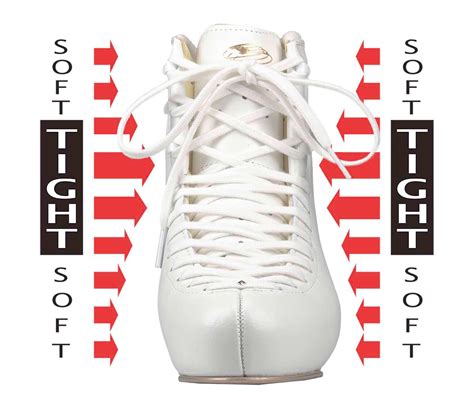
Once laced, check the tension by passing a finger across the lacing intersections.
Socks
Although your feet may be warmer to begin, cotton socks will tend to absorb moisture more and will rapidly make your feet cold, which could cause discomfort while skating.
Read also: Keystone Skates: A Historical Overview