Looking to visit South America for a quality ski trip this summer? Chile’s La Parva is an under-the-radar option. While not as flashy as some of its neighbors, the resort’s Euro-style village and local vibe have long been selling points for those who know the area. But is La Parva the right choice for your next Chilean ski trip, and why does it have so much less of a foreign presence than its neighboring ski areas?
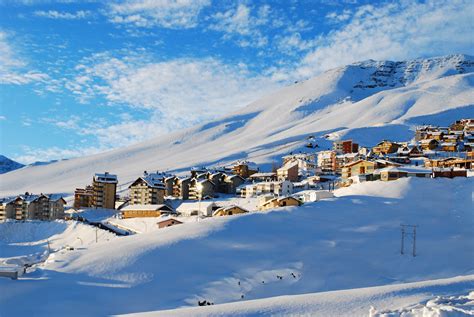
Panoramic view of La Parva Ski Resort in Chile.
Mountain Aesthetic
For those looking to soak in the natural beauty of the Andes, La Parva won’t disappoint. From the upper mountain, visitors will be treated to panoramic views of the towering peaks above the resort, some of which reach over 17,000 feet. The downward views are plainly impressive as well, with the resort facing directly towards the skyline of Santiago, a city with a metro area of nearly 7 million people. You’re so high above the city that you can see an entire chain of mountains leading into the valley below, making for quite the incredible sight.
It’s typically a smoggy view down into Santiago, but if you get there on a bluebird day, you’ll often see that haze clear out for a crystal clear view down into the city. The Euro-inspired base and less-touristy clientele also combine to make for a more local feel than La Parva’s closest and best-known competitors.
Size and Terrain Layout
With 988 claimed skiable acres and 1,650 acres from boundary to boundary, La Parva is somewhat modestly-sized by North American standards, although it’s still within the typical realm of what one should expect at a good Chilean ski resort. The resort essentially spans one big mountain face across a handful of ridges, resulting in several distinct mountain pods. The resort offers a vertical drop of just over 3,000 feet, although the bottom 500 or so feet are mainly just village access and learning area runs.
Read also: Wolf Ridge Lodging & Activities
Terrain Breakdown
Beginner Terrain
Speaking of learning, despite a well-insulated bunny hill, La Parva is not a good ski resort for true beginners. Green trails are completely non-existent outside of this bunny hill, with guests needing to progress to blue or harder terrain to ski or ride any mid- or upper-mountain areas. While La Parva’s blue trails are somewhat easier than what one might find at a typical North American ski resort, most of them are either traverses or still steeper than those who haven’t figured out linked turns may be able to handle.
Intermediate Terrain
Speaking of blue terrain, La Parva becomes a more open mountain once visitors reach intermediate proficiency. However, the resort still isn’t perfect for this ability level. On the plus side, guests can ski or ride the full vertical drop of La Parva on blue-rated terrain, and these trails offer some of the best views at the resort. This all being said, La Parva’s true cruiser terrain at the blue-rated level is limited.
A significant portion of the resort’s blue-rated trail network, including all of its blues in the mid-mountain, are traverses that are more designed to give skiers and riders access to reds and blacks rather than function as enjoyable trails in their own right. These traverses have some flat sections and can get repetitive quickly, and most low-intermediate guests will find themselves wanting more.
When it comes to La Parva’s red terrain, these trails are best suited for advanced-intermediate and regular advanced skiers and riders. This terrain level is where the resort starts to seriously show its strengths, with these trails bringing great steep groomer terrain. La Parva’s red-triangle runs are extensive in nature, with several existing off most of the mid- and upper-mountain lifts.
Advanced Terrain
When it comes to La Parva’s red terrain, these trails are best suited for advanced-intermediate and regular advanced skiers and riders. This terrain level is where the resort starts to seriously show its strengths, with these trails bringing great steep groomer terrain. La Parva’s red-triangle runs are extensive in nature, with several existing off most of the mid- and upper-mountain lifts. Reaching the red level of terrain also unlocks access to 100% of La Parva’s chairlifts.
Read also: Ultimate Guide to Brighton Skiing
For the steepest groomed trails, guests will want to check out La Parva’s black-rated runs. While not quite as extensive as La Parva’s reds, these runs provide an opportunity to tackle earnestly steep terrain and pick up some serious speed in the process.
Expert and Off-Piste Terrain
But for expert skiers and riders looking to really push themselves to the limit, La Parva offers a handful of designated freeride zones. These mid- and upper-mountain terrain areas, which are shaded in purple on the trail map, offer an opportunity for ungroomed skiing and riding with some resort maintenance and safety control. Those looking to ski or ride steep mogul or powder terrain will want to check these areas out. In addition, some of the areas just outside the red and black runs offer great opportunities for mogul and powder skiing as well when conditions allow.
However, to really get the most out of La Parva, guests will want to check out the true off-piste. A number of excellent backcountry lines sit just outside the resort boundary, including some bowls and chutes you can traverse to, especially directly off of Lift 1. In addition, a variety of hikeable lines and touring routes are accessible from in-bounds trails, making the resort a standout for those who want to earn their turns and hit some incredible peaks.
This all being said, La Parva’s off-piste terrain is not maintained, patrolled, or marked by the resort at all, and avalanches can and will occur if you are not careful. Those looking to ski or ride these areas should have a clear plan for entering and exiting, avalanche equipment such as a beacon, shovel, and probe, and a partner (or experienced guide if you aren’t thoroughly familiar with your route).
If you’re looking to go further into the Andes, La Parva also offers an extensive heli-skiing operation up to several of the mountains that extend well above the official resort boundary. The resort claims that over 200,000 acres of terrain are available to explore, and operations can get you to some of the most incredible untouched powder on the continent.
Read also: In-Depth Sundance Snowboarding
HOW TO BACKCOUNTRY SKI (ULTIMATE GUIDE & VIDEO)
Snow Quality and Resiliency
Like other central Chilean ski resorts, La Parva receives reasonable snowfall on average each Southern Hemisphere winter. With accumulation figures that tend to range between 100-200 inches from June through September, snow totals usually aren’t quite as high as the nearby higher-elevation Valle Nevado, but they are close.
But where La Parva really stands out, provided you time the resort right, is in its snow quality. The higher altitude and arid climate typically results in light and dry accumulation when storms roll through, and while the quality of the snow can vary, it’s usually at least very good, and can be absolutely exceptional-even beating that of the most renowned Utah resorts-under the most favorable circumstances. Those who are properly equipped to explore La Parva’s off-piste will be in for quite the treat, as the areas outside of official trails can take days or even weeks to get fully tracked out.
When it snows in La Parva, it’s typically raining several thousand feet down in Santiago, and the lower the snow line of the storm, the lighter the snowfall typically is.
That said, snow accumulation at La Parva tends to be feast or famine. The resort may see some big storms throughout the season, but they’re often followed by long periods of ample sunshine and drought conditions. In fact, the resort’s season-long snow base is often formed off of just a handful of storms, with the quantity of snow these accumulation events bring playing a major role in conditions for the following days, weeks, or even months.
During bad snow years, the resort may be reliant almost entirely on snowmaking to maintain operations. La Parva’s on-piste trails maintain a baseline-level of resiliency thanks to the mountain ops team, but in bad years, the conditions just off the maintained trails can be just about bare.
Navigation
But La Parva’s strong on-mountain maintenance extends over to more than its physical skiability. The resort offers significantly better signage than most other South American ski resorts, including neighboring Valle Nevado and El Colorado, with widely-available English markings for foreigners and clear overall trail guidance. Also unlike Valle Nevado and El Colorado, La Parva has readily-available physical trail maps, which can prove very useful when you have some time to kill on the lift. If you need to speak to someone at the resort, English-speaking staff are generally available, although it does help to know some Spanish.
Lifts
Speaking of lifts, La Parva’s uphill lift network feels modern compared to several of its Chilean competitors, although those coming from more developed regions may note some significant drawbacks. On the plus side, visitors can access a significant portion of La Parva’s terrain via chairlift, including much of the resort’s expert and upper-mountain terrain footprint. At least on high-elevation and difficult terrain, this is a comfort rarely found at other Chilean resorts, where surface lifts are the default.
Surface lifts do serve some of La Parva’s terrain-and guests will need to take the #7 platter to reach the family-oriented, upper-mountain #4 triple chair-but they generally follow a moderate pitch and are reasonable in length. That said, just because La Parva has chairlifts doesn’t mean they are fast. The resort has two quads, two triples, and one double, all of which are fixed-grip. Some of these lifts are especially lengthy for what one might find acceptable, with the advanced-oriented #1 quad having over 200 chairs on it and involving a staggering 15-minute ride time. Those used to skiing or riding elsewhere in Chile may appreciate the relaxed ride compared to surface lifts, but those used to high-speed lifts are likely to get frustrated.
Crowd Flow
But luckily, La Parva’s slow lifts are somewhat counteracted by the lack of crowds. Unlike Valle Nevado and El Colorado, La Parva is much more of a winter-sports-goer’s mountain, with substantially fewer tourists on the mountain than sightseers, meaning that skiers and snowboarders won’t be competing for space on the chairlifts. La Parva also benefits from a wide footprint, which spreads out potential congestion on the slopes, as well as a number of lift redundancies in its most popular areas.
On-Mountain Facilities
La Parva also stands out for a strong on-mountain facility setup. The resort offers multiple mid-mountain restaurants with outdoor seating, with inviting setups by South American standards that give off a distinctly European flair. The Euro-style restaurants extend to the base village too, with several restaurants bordering the lower-mountain pistes and more casual cafeteria-style food options as well.
Pass Partnerships
One way that La Parva is notable is it’s one of the only South American ski resorts to be on a North American megapass product: The Power Pass. The Power Pass and Power Pass Select offer 10 days of skiing or riding at La Parva a season, with the days shared and interchangeable with neighboring Valle Nevado.
It’s also worth noting that La Parva is one of three interconnected ski resorts that make up Chile’s Tres Valles region, alongside Valle Nevado and El Colorado. Although Valle Nevado is somewhat hidden in a valley over, portions of El Colorado are clearly visible from La Parva’s southernmost terrain areas, which might make La Parva itself appear bigger and wider than it really is.
While these three ski resorts have historically been independently operated, they are physically connected by skiable terrain under the right conditions, and as a result, it’s possible to ski or ride between them. But despite their interconnectivity, all three resorts maintain separate lift ticket systems, and skiing or riding into Valle Nevado or El Colorado from La Parva does not necessarily grant you access to their lifts.
However, La Parva and Valle Nevado have been under the same ownership since 2024, and as of the 2025 season, the two neighbors now offer a ticket add-on that allows skiers and riders to access both resorts on the same day.
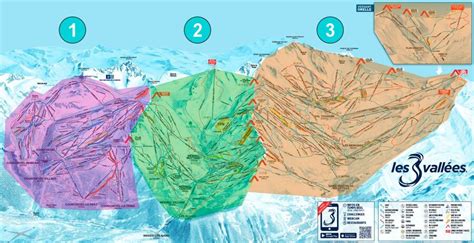
Map of the Tres Valles ski region, including La Parva, Valle Nevado, and El Colorado.
Getting There and Parking
One of the biggest considerations when planning a trip to La Parva is the access road that leads up to the Tres Valles resorts. The drive from Santiago may appear manageable on paper with a travel time of under two hours, but in reality, it’s a challenging, high-altitude mountain route unlike anything most North American drivers will be used to. The road is extremely narrow and winding with over two dozen hairpin turns, and while not quite as crazy as the full route to nearby Valle Nevado, the route still involves a rapid elevation gain of roughly 6,000 feet.
If a snowstorm hits, chains are required, and conditions can deteriorate quickly. Travelers should plan accordingly to avoid being stuck at the wrong time. At least parking isn’t a big issue at the resort, with a convenient main lot near the base and an overflow lot in case things get busy.
If you’re not experienced with driving in the conditions we just described, we highly recommend booking a private shuttle from Santiago. While some taxis will be happy to offer rides, they frequently lack proper snow equipment.
Lodging
Because of the road’s challenges and scheduling circumstances, most travelers visiting La Parva for multiple days opt to stay on-mountain rather than attempting a daily commute from Santiago. But unlike neighboring Valle Nevado and El Colorado, La Parva does not have any traditional hotels within its ski village proper.
Accommodations at La Parva itself are limited to self-catered condos, apartments, and private homes, but unlike at some competitors, which only allow fixed arrival or departure dates for their lodging, many of these homes do offer flexibility in the days you can arrive or depart. These condos are on the expensive side, but they’re very conveniently located and often ski-in/ski-out, and if you have a group, you can split the cost and get a reasonable deal for the number of beds available.
It’s also worth noting if you want cheaper accommodations or true hotels, several options are available down the road in Farellones near the El Colorado base, but if weather doesn’t line up, driving to La Parva may be a bit tough.
Après-Ski
When it comes to après-ski, La Parva's base village provides a solid foundation. The resort's Euro-style restaurants and bars are great for a post-ski drink or meal, and a couple of mid-mountain chalets offer scenic views.
Key Stats
Here’s a quick overview of La Parva’s vital statistics:
| Statistic | Value |
|---|---|
| Elevation | 8,704' |
| Base Elevation | 11,722' |
| Summit Elevation | 3,022' |
| Vertical Drop | 3,022' |
| Number of Trails | 40 |
| Skiable Acres | 800 |
| Number of Lifts | 15 |
| Annual Snowfall | 40" |
| Beginner Runs | 20% |
| Intermediate Runs | 20% |
| Advanced Runs | 43% |
| Expert Runs | 18% |
| Longest Run | 1.5 mi |
With a vertical drop of nearly 1 kilometer from an altitude of 3,630 meters (11,910 ft), this Andes gem gets far less foreign travelers than its neighbors Valle Nevado and El Colorado. The area has a community of well-to-do Chileans who return each season, so it feels more like an exclusive boutique resort.
La Parva is one of the few skiing destinations in The Andes that offers night skiing.
It’s not uncommon to share the ski lift or an Apres-ski pisco sour with some of the best pros on the Planet. La Parva ski village has recently hosted unique events like Eye of the Condor and the PowderQuest Women’s Freeride Camp with Ingrid Backstrom.
Their FIS-approved downhill courses are used for training by international teams including the USA and France.