Choosing the right snowboard bindings is crucial for enhancing your performance and comfort on the mountain. This guide focuses on men's large snowboard bindings, covering everything from initial sizing to advanced customization techniques. The process starts with the size indicated on the box and extends to how you configure them on your board, including stance width, angles, and other personal adjustments.
Understanding Snowboard Binding Sizes
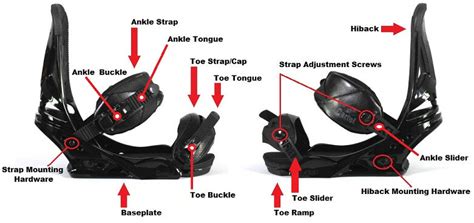
As explained in our detailed guide on selecting snowboard bindings, there are typically three sizes available. It's important to note that these sizes may vary across different brands.
Initial Setup: Adjusting Heel Hoop Length
To adjust the heel hoop length, remove the footbed by unscrewing the screw that holds it in place. Then, unscrew the bolts connecting the heel hoop to the baseplate. Holding the baseplate in one hand and the heel hoop in the other, you can slide it in and out to your desired length.
Mounting the Bindings
Begin by taking out the two disks and mounting hardware. Fold or remove the footbed of your front binding to access the baseplate and insert the first disk. Rotate it to your desired angle using the arrow as a guide. Position the binding on the board so that the insert holes at your desired stance width are visible through the slots. Once you are satisfied with the position and angle, place four washers into the slot and screw the binding down securely.
Customizing the Straps
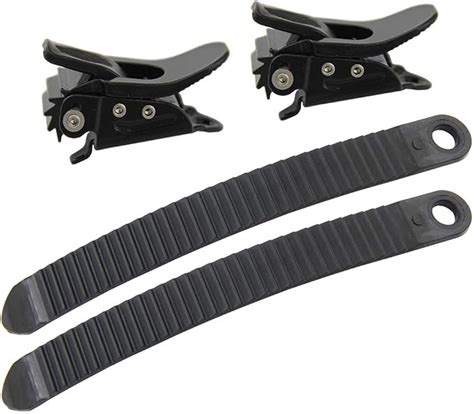
Place your boot into the binding to begin strap customization. Bindings often provide tool-free customization options. For example, some straps allow you to simply flip open the lever on the inside of your ankle strap and slide the padded section to center it perfectly over your boot. Close the lever, then insert the ankle ladder into the ratchet on the other side and tighten it down. The strap should fit snugly in the sweet spot, with a few notches to spare on the ladder.
Read also: Best Ski Goggles
The toe strap can be adjusted similarly. Adjust the length so that you can easily engage the ratchet without struggling to get it over your boot, but not so loose that you run out of teeth on the ladder when tightened. Repeat this process on the other binding.
Advanced Ankle Strap Customization
Certain premium binding models, offer even more ways to customize your ankle strap beyond just adjusting the length. This involves using an additional joint on each side of the binding, with different versions available depending on the binding model. When the strap is in a higher position, it will lock your ankle in more securely, providing greater power during turns. Conversely, lowering the strap gradually creates a looser, more skate-like feel.
Adjusting Forward Lean
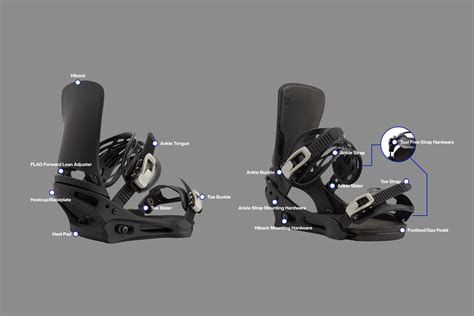
Every binding on the market allows you to adjust the forward lean. Systems vary, but most brands use some kind of block on the back of the highback. Sliding it towards the bottom will increase the amount of forward lean in the highback. This encourages you to keep your knees bent and enhances heelside responsiveness. Sliding the adjuster towards the top will decrease the amount of forward lean, creating a more relaxed and playful riding position. This makes it easier to move your foot, which is beneficial for pressing on rails, and reduces the likelihood of catching an edge. Consequently, most park and street riders prefer minimal forward lean.
Highback Rotation
When new, the highbacks on your bindings are set up parallel to the baseplate when viewed from above. After attaching the bindings to the board and adjusting the angles, you'll notice that the highbacks are not aligned with the edge. While riding this way is possible, rotating the highbacks to be parallel with the side of the board will enhance performance.
Choosing the Right Snowboard Binding Angles
The angles of your front and back binding play a huge role in how you can move your body over your snowboard. Your hips and knees align and move in different ways depending on which direction your feet are pointing. It’s safe to say every rider will want their front foot angled toward the nose of the board. Angling your binding toward the nose is referred to as a positive angle relative to setting your binding at zero.
Read also: Bowdoin College Hockey History
Benefits of a front-foot binding angle opened wider: It opens your hips toward the fall line and lets you rock deeper into your toe-side turns, delivering a more powerful and natural carving feel. Typical front angle range: +15° to +21° Aggressive, surf-style or race riders: +21° or more
While all riders benefit from angling their front binding toward the nose, there are several different schools of thought on the best direction to angle your back binding. Your personal riding style and anatomy will determine what back binding angle club you belong to. The three back binding angle styles are:
Binding angles: positive / zero (+/0)
If you angle your front binding toward the nose and keep your back binding set perpendicular to your edge at zero degrees you are riding positive/zero (+/0). Setting your back binding at zero is a very common back binding stance angle. By keeping your foot straight across the board you can lean into front side carves and ride switch without cross loading your knee.
Setting your back foot at zero is a great place to start as you experiment with the angle of your front binding and stance width.
- Positive/zero binding angles
- Front binding: +15 to +21 or more
- Back binding: +3 to +6
- Key benefits and best use
- Aligns both knees in the same plane
- Easier to dive deep into toe-side turns
- Freeride directional boards (Frontier, Flagship, Stratos)
- Surf-style riders
Binding angles: positive / positive (+/+)
If you angle your front and back bindings toward the nose you are riding positive/positive (+/+). Riders who run +/+ typically run only a few degrees of positive angle in the back binding (+3-6 degrees). By slightly turning your back binding toward the nose it aligns both your knees into the same plane and makes it easier for you to dive into toe-side turns more aggressively.
Read also: The Ultimate Guide to Men's Winter Sunglasses
Running positive angle on your back foot does make riding switch more challenging but the “crossed-up” feeling can be overcome with experience.
Most riders will find a front binding angle of +15-21 degrees is ideal. Racers and more surf style, turn focused riders often run a more aggressive front foot angle (+21 degree or more) as it opens up your hips toward the fall line and allows you to rock deeper into toe-side turns.
- Positive/positive binding angles
- Front binding: +15 to +21
- Back binding: 0
- Key benefits and best use
- Great all-around choice
- Stable for carving + comfortable for riding switch
- Beginner and intermediate riders
- A starting point for experimentation
Binding angles: positive / negative (+/-) Duck stance
If you angle your front binding toward the nose and angle your back binding toward the tail you are riding positive/negative, otherwise known as a “duck” stance. Terrain park rippers who ride switch a lot and freeriders who like to run a wide stance for added balance often prefer a duck stance. These riders typically run only a few degrees of negative angle in the back binding (-3 to -12 degrees). That little bit of negative angle can drastically improve your stability landing switch and will help your body look less “crossed-up” when riding switch.
- Positive/negative binding angles (Duck stance)
- Front binding: +15 to +21
- Back binding: -3 to -12
- Key benefits and best use
- Opens the hips symmetrically
- Stable for landings
- Anyone who rides switch often
- Park riders
Snowboard Binding Flex Based on Riding Level
Beginner: A beginner rider is normally within their first season of riding. For many, this means trying to keep control of your speed and basically make it down the hill in one piece. You may be starting to connect turns but aren’t consistently. A soft flexing binding will aid in keeping your set up forgiving so that you aren’t transferring energy to the board unintentionally.
Intermediate: This is generally the rider that has had a few seasons under their belt. If you’re getting more and more comfortable linking turns and can generally make it down a blue run without catching an edge then you probably could consider yourself at least an intermediate level rider.
Advanced: Riders at this level usually have a feel for what type of terrain they prefer. They are comfortable with making quick turns and are in control at any speed. They may be specifically interested in riding in the terrain park or prefer carving hard on steep runs but either way they are confident in their abilities and generally have a preference as to what they’re looking for in their equipment. They also want a binding with performance and response, which usually means added stiffness.
Expert: An expert rider is extremely confident in their ability to take on any terrain under any conditions. No inbounds run at a resort is too challenging and they may be exploring terrain out of bounds as well. A rider in this category is looking for the ultimate level for performance and technology out of their binding and the stiffest bindings will be found in this category.
Compatibility
Union bindings fit all major snowboard boot brands, models, and sizes.
STEP ON® bindings are ONLY compatible with STEP ON® boots. Do not use either product with non-STEP ON® boots or non-STEP ON® bindings.
Consult the size chart to ensure that you have the correct size binding for your boot size. Pairing incompatible size boots with bindings may lead to malfunction and could compromise your safety.
Women’s and Men’s sizing are based on different size standards. Combining men’s and women’s STEP ON® products will result in malfunction and could compromise your safety.
| Riding Style | Flex Level | Description |
|---|---|---|
| All-mountain | Soft to medium (most riders), Stiff (racers) | Best for any terrain, including groomed runs, powder, park, and pipe. |
| Freestyle | Soft | Best for jumps, spins, tricks, and park features. Offers greater turning ease and maneuverability. |
| Freeride and Splitboard | Stiffer | Best for unmarked backcountry and sidecountry terrain. Stiffer for greater control. |
| Powder | Stiffer | Typically stiffer for greater control on wider, longer boards in deep powder. |
By following these steps and understanding the nuances of snowboard binding setup, you can optimize your riding experience and enjoy greater control and comfort on the slopes.