Before the Colorado Avalanche made their mark in Denver, they were the Quebec Nordiques, a team cherished north of the border in Quebec City, Quebec. The Quebec Nordiques began play in 1972 as part of the World Hockey Association before joining the NHL as part of a four-team expansion in 1979.
Early Years in the WHA
The team that would become the Quebec Nordiques began in 1971 as the San Francisco Sharks, a charter member of the World Hockey Association (WHA), the rebel league established to take on the National Hockey League (NHL). The new league was started by Gary Davidson and Dennis Murphy, the men behind the American Basketball Association (ABA).
During the team's seven years competing in the WHA, it won two division titles and the Avco World Trophy in 1977 as league champions. Major league hockey had come to Quebec City.
Joining the NHL
Quebec, along with the Edmonton Oilers, Hartford Whalers and Winnipeg Jets, joined the NHL in 1979 after a merger agreement was reached between the WHA and the NHL. The survivors were considered expansion teams and, as such, were on the hook for $6 million each as part of their acceptance into the NHL. The Nordiques, which translates to Northerner or Northmen in English, played their first game in the National Hockey League on Oct.
Making his NHL debut that night was Michel Goulet, who was the franchise's first pick in the 1979 NHL Draft as Quebec selected him at No. 20 overall in the 1979 first round. Drafted the same year as Goulet with the 83rd overall pick was Anton Stastny, the first player born and trained in Slovakia to be drafted by an NHL team.
Read also: Features of Custom Hockey Gloves
The Stastny Brothers
He and his brother, Peter, made the trip across the Atlantic Ocean for the 1980-81 season and started the trend of players from Europe's Eastern Bloc making the move to play pro hockey in North America.
In 1980-81, Peter Stastny captured the Calder Memorial Trophy, the franchise's first NHL award, after setting a rookie scoring record in the league with 109 points (39 goals, 70 assists)--a mark that he held until Teemu Selanne registered 132 points in his first campaign in 1992-93. During his time with the Nordiques, Peter Stastny recorded seven 100-point seasons, played in six all-star games and is still the leading scorer in Quebec history after producing 380 goals and 668 assists.
His 1,048 points and 668 assists still rank second in the franchise annals behind Joe Sakic, and his 1.42 points-per-game average still ranks first. The Nords' first stars in their NHL tenure were the famous Stastny brothers: Marian, Peter, and Anton. The latter two defected from the former Czechoslovakia and were signed by the Nords in 1980, while Marian followed suit a year later. In 737 games with the Nords, Peter Stastny scored 380 goals and racked up 668 assists, totalling 1,048 points, the highest point total in the history of the Nordiques.
Retired Numbers
Peter Stastny (No. 26) is one of four players to have his number retired in Quebec, joining J.C. Tremblay, Marc Tardif and Goulet. Tremblay never played for the NHL Nordiques as he was the only person to compete for Quebec in each of its seven seasons in the WHA, and had his No. 3 retired just before the franchise moved into the NHL.
Tardif was the franchise's first captain and played 10 total campaigns with Quebec, six in the WHA and four in the NHL, and his No. 8 was sent to the rafters in 1983. Goulet was a five-time NHL all-star and his No. 16 was retired during the 1994-95 season. He still owns the top three goal-scoring seasons in franchise history, including a record 57 in 1982-83.
Read also: The story of Craig Needham
The Lindros Saga and the Rise of Forsberg
The club also drafted Owen Nolan with the first pick in 1990 and Eric Lindros in 1991. Sundin was selected by Quebec with the first overall pick in the 1989 NHL Draft, the first of three consecutive No. 1 overall selections made by the Nordiques.
Lindros never played for Quebec and was eventually traded to the Philadelphia Flyers in 1992. In return, the Nordiques received Forsberg, Steve Duchesne, Ron Hextall, Mike Ricci, Chris Simon, Kerry Huffman, two first-round draft picks and $15 million. The deal transformed the Nordiques from league doormats to a legitimate Stanley Cup contender almost overnight.
Forsberg made his NHL debut with the Nordiques in 1994-95 and recorded 50 points (15 goals, 35 assists) in 47 contests that year to win the Calder Memorial Trophy, marking the second time a Quebec player was named the NHL's rookie of the year.
The team finished that 1994-95 campaign in first in the Northeast Division but fell in six games to the defending Stanley Cup champion-New York Rangers in the conference quarterfinals that postseason. Despite the disappointing opening-round exit, that playoff experience helped set the foundation for the franchise's success in the coming years.
Move to Denver and Legacy
Overall, the Nordiques qualified for the playoffs in nine of their 16 NHL seasons, including a span of seven-straight years from 1981-1987 and in two of its final three campaigns in Quebec City--also falling to the eventual Stanley Cup-champion Montreal Canadiens in six games in 1993.
Read also: Inside Aaron Ness's Career
Charlie Lyons and the COMSAT company purchased the Nordiques in the summer of 1995 and moved the team to Colorado to play as the renamed Avalanche for the 1995-96 campaign. The Avs won the Stanley Cup in that inaugural season in Denver, giving the city its first major professional sports championship, and the club added a second title five years later in 2001.
The Rise and Fall of the Quebec Nordiques: A Hockey Dynasty Lost
The last NHL player who played for the Nordiques was Adam Foote, who announced his retirement after the 2010-11 season.
Team Identity and Culture
Les Nordiques and their supporters were deeply entrenched in Québécois nationalism. From their founding in 1972 as part of the World Hockey Association (WHA), the Quebec Nordiques came to symbolise not only regional pride but also a distinct cultural identity rooted in Francophone heritage and aspirations for political autonomy. Right from their founding, the team leaned into Québécois identity by using a French-language name.
Uniforms
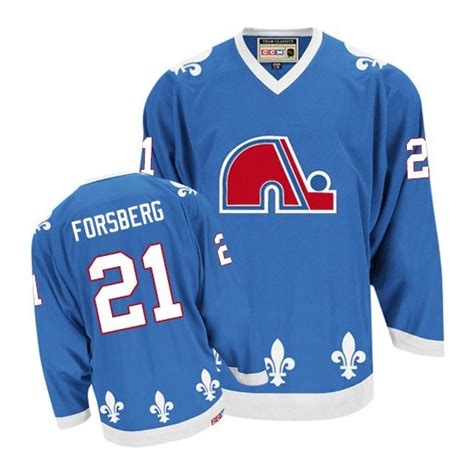
Throughout their history, the Nordiques were famous for their iconic powder blue and white uniforms. But for their first WHA season, the Nordiques' uniforms featured splashes of red on the shoulders, waist and numbers. From 1973 to 1975, the blue on the Nordiques uniforms briefly reverted to a dark royal blue shade.
Prior to the 1975-76 season, the Nordiques unveiled what was now their standard look, returning to a powder blue base and adding three fleur-de-lis symbols on the waist. Red was only used on the logo. For the first season, the Nordiques wore red pants, but switched to powder blue pants afterwards.
Aubut intended to change the team's entire look had he won enough financing to keep the Nordiques in Quebec City for the 1995-96 season. The Nordiques would have abandoned the blue, white, and red palette they had worn throughout their history in favour of a teal, black, and navy scheme.
| Season | League | Record | Playoff Result |
|---|---|---|---|
| 1972-1973 | WHA | 33-40-5 | Did not make playoffs |
| 1976-1977 | WHA | - | Won Avco World Trophy |
| 1979-1980 | NHL | 25-44-11 | Did not make playoffs |
| 1994-1995 | NHL | - | Lost in Conference Quarterfinals |