The unincorporated community of Vails Gate is a hamlet located in the Town of New Windsor within Orange County, New York. The borders of the 640-acre community touch Newburgh, Firthcliffe, Little Britain, Meadowbrook, and Firthcliffe Heights. Windsor Highway, or New York State Route 32, travels across the town.
While the town is often called New Windsor, it became known by its true name in the 18th century. It was named after a former postmaster, John D. Vail. Vail also became the keeper of the Blooming Grove Turnpike tollgate. He was the first postmaster in the post office that was established in 1850. The post office was originally the Mortonville Post Office but would be renamed. The name Mortonville was derived from one of the early settlers that lived in the Ellison House.
In 2000, the hamlet was home to 3,319 residents. This included 1,421 households and 861 families within 1,459 housing units. As many as 19.4% of the residents were born outside of the United States. English is spoken by 73.1%, and other languages spoken include Spanish, French and Vietnamese. The average income per household was $39,851, and the average income for a family was $44,485. The median income for men was $38,636 versus $31,019 for women.
Baron von Steuben and His Connection to Vails Gate
Vails Gate also has a connection to the American Revolution. In 1783, General Von Steuben joined General Knox at Vail's Gate, near West Point, in the fall of 1782 and in early 1783 moved to the Verplanck homestead, at Mount Gulian, across the Hudson River from Washington's headquarters in Newburgh.
To understand Steuben's significance, it's important to know his background. Baron von Steuben was born in the fortress town of Magdeburg in Prussia (now in Saxony-Anhalt, Germany), on September 17, 1730, the son of Royal Prussian Engineer Capt. Wilhelm von Steuben and his wife, Elizabeth von Jagvodin. When his father entered the service of Empress Anna of Russia, young Friedrich went with him to Crimea and then to Kronstadt, staying until the Russian war against the Turks under General Burkhard Christoph von Münnich. In 1740, Steuben's father returned to Prussia and Friedrich was educated in the garrison towns Neisse and Breslau by Jesuits.
Read also: Trusted Auto Repair in New Windsor
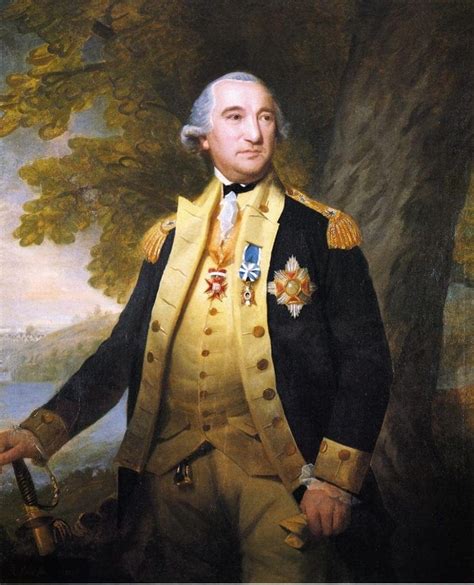
Baron von Steuben joined the Prussian Army at age 17. He served as a second lieutenant during the Seven Years' War in 1756, and was wounded at the 1757 Battle of Prague. He served as adjutant to the free battalion of General Johann von Mayr and was promoted to first lieutenant in 1759. In August 1759 he was wounded a second time at the Battle of Kunersdorf. In the same year, he was appointed deputy quartermaster at the general headquarters.
In 1765, Steuben became Hofmarschall to Fürst Josef Friedrich Wilhelm of Hohenzollern-Hechingen, a post he held until 1777. In 1769 the Duchess of Württemberg, niece of Frederick the Great, presented him with the Cross of the Order of De la Fidelite. In 1771 he began to use the title baron. That same year he accompanied the prince to France, hoping to borrow money. In 1763, Steuben had been formally introduced to the future French Minister of War, Claude Louis, Comte de Saint-Germain, in Hamburg. They met again in Paris in 1777. The Count, fully realizing the potential of an officer with Prussian general staff training, introduced him to Americans Silas Dean and Benjamin Franklin.
The Americans, however, were unable to offer Steuben a rank or pay in the American army. Promoting these men over qualified American officers caused discontent in the ranks. Steuben would have to go to North America strictly as a volunteer and present himself to Congress. Steuben left these first meetings in disgust and returned to Prussia.
After unknown events, Steuben was discharged from his position as a captain and traveled to Paris. It is speculated that he was, or was accused of being, homosexual. Upon the Count's recommendation, Steuben was introduced to future president George Washington by means of a letter from Franklin as a "Lieutenant General in the King of Prussia's service", an exaggeration of his actual credentials that appears to be based on a mistranslation of his service record.
Steuben, his Italian Greyhound Azor (which he took with him everywhere), his young aide-de-camp Louis de Pontière, his military secretary Pierre-Étienne du Ponceau, and two other companions reached Portsmouth, New Hampshire on December 1, 1777. There, they were almost arrested because Steuben and his entourage were wearing red clothing similar to those worn by British troops.
Read also: Exploring 201 N Vail Ave
They were extravagantly entertained in Boston. Arrangements were made for Steuben to be paid following the successful completion of the war according to his contributions. He arrived at Valley Forge on February 23, 1778, and reported for duty as a volunteer. One soldier's first impression of the Baron was "of the ancient fabled God of War ... he seemed to me a perfect personification of Mars. The trappings of his horse, the enormous holsters of his pistols, his large size, and his strikingly martial aspect, all seemed to favor the idea. Washington appointed von Steuben as temporary inspector general. He went out into the camp to talk with the officers and men, inspect their huts, and scrutinize their equipment.
Steuben established standards of sanitation and camp layouts that would still be standard a century and a half later. There had previously been no set arrangement of tents and huts. Men relieved themselves where they wished, and when an animal died it was stripped of its meat and the rest was left to rot where it lay. Steuben laid out a plan to have rows for command, officers, and enlisted men. Kitchens and latrines were on opposite sides of the camp, with latrines on the downhill side.
On May 5, 1778, on General Washington's recommendation, Congress appointed Steuben inspector general of the army, with the rank and pay of major general. The internal administration had been neglected, and no books had been kept either as to supplies, clothing, or men. Steuben became aware of the "administrative incompetence, graft, war profiteering" that existed. He enforced the keeping of exact records and strict inspections.
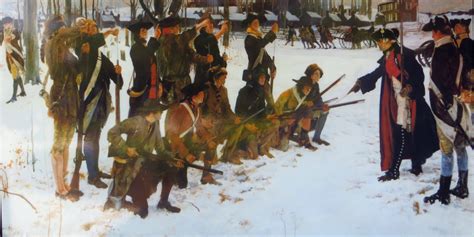
Steuben used 120 men of the Commander in Chief's Guard, and used them to demonstrate military training to the rest of the troops. These men, whom Steuben called the "Model Company" in turn trained other personnel at regimental and brigade levels. Steuben's eccentric personality greatly enhanced his mystique. As he could only speak and write a small amount of English, Steuben originally wrote the drills in French, the military language of Europe at the time. His secretary, Du Ponceau, then translated the drills from French into English, with the help of John Laurens and Alexander Hamilton, two of Washington's aides-de-camp. They did this every single night so the soldiers could practice the next day.
Colonel Alexander Hamilton and General Nathanael Greene were of great help in assisting Steuben in drafting a training program for the Army. The Baron's willingness and ability to work with the men, as well as his use of profanity (in several languages), made him popular among the soldiers. It is here he met his close friend and future adopted heir, Captain Benjamin Walker. Steuben introduced a system of progressive training, beginning with the school of the soldier, with and without arms, and going through the school of the regiment. This corrected the previous policy of simply assigning personnel to regiments.
Read also: Drive Belt and Snowmobile Performance
Upon Steuben's initial inspection of the camp and soldiers, he remarked that “the American soldier, never having used this arm, had no faith in it, and never used it but to roast his beefsteak." Steuben's introduction of effective bayonet charges became crucial. The first results of Steuben's training were in evidence at the Battle of Barren Hill, May 20, 1778, and then again at the Battle of Monmouth in June 1778.
On May 2, 1779, during the second Middlebrook encampment, a review of the army was held to honor the French minister Conrad Alexandre Gérard de Rayneval and the Spanish diplomat Juan de Miralles. supplies and soldiers would be provided to the army from there. Steuben would help in the defense of Virginia with approximately 1,000 militia fighting a delaying action in the Battle of Blandford. He was forced to take sick leave, rejoining the army for the final campaign at Yorktown, where his role was as commander of one of the three divisions of Washington's troops.
Steuben gave assistance to Washington in demobilizing the army in 1783 as well as aiding in the defense plan of the new nation.
The Lie That Saved the Continental Army: Von Steuben at Valley Forge
Post-War Life and Legacy
With the war over, Steuben resigned from service and first settled with his longtime companion, William North, for whom he created a special room on Manhattan Island, where he became a prominent figure and elder in the German Reformed Church. On December 23, 1783, the state of New Jersey presented him with the use of an estate in Bergen County now known as Steuben House, which had been confiscated from Loyalist Jan Zabriskie in 1781. Located in the formerly strategic New Bridge Landing, the estate included a gristmill and about 40 acres (16 ha) of land.
On September 5, 1788, the New Jersey Legislature gave Baron von Steuben full title to the former Zabriskie estate. A month later, recognizing his financial embarrassment, Steuben wrote another former aide-de-camp and companion, William North, recognizing: "The Jersey Estate must and is to be sold. On November 6, 1788, Steuben again wrote North (at his new home in Duanesburg, New York), noting "My Jersey Estate is Advertised but not yet Sold, from this Walker Shall immediately pay to you the money, you so generously lend me and all my debts in New-York will be payed. [sic] I support my present poverty with more heroism than I Expected. All Clubs and parties are renounced, I seldom leave the House."
Steuben eventually sold the New Jersey property to a son of the previous owner, and it remained in the Zabriskie family until 1909.
Von Steuben moved upstate and settled in Oneida County on a small estate in the vicinity of Rome, New York, on land granted to him for his military service and where he had spent summers. He was later appointed a regent for what evolved into the University of the State of New York. Von Steuben died on November 28, 1794, at his estate in Oneida County, and was buried in a grove at what became the Steuben Memorial State Historic Site.
At Valley Forge, he began close relationships with Walker and William North, then both military officers in their 20s. Von Steuben formally adopted Walker and North and made them his heirs. He never married and had no children, and he did not care much for his European relatives. Thus, he left his estate to his companions and aides-de-camp, Walker and North, with whom he had had an "extraordinarily intense emotional relationship ... treating them as surrogate sons." A third young man, John W. Mulligan (1774-1862), the son of Hercules Mulligan, who also considered himself one of von Steuben's "sons", inherited his vast library, collection of maps and $2,500 in cash.
In his 1781 will, he left the majority of his estate to his nephew, as long as he would move permanently to the United States and reject the title of baron or any other title of nobility.
Honoring Steuben's Legacy
Generally, Von Steuben Day takes place in September in many cities throughout the United States. It is often considered the German American event of the year. Participants march, dance, wear German costumes and play German music, and the event is attended by millions of people. The German-American Steuben Parade is held annually in September in New York City. It is one of the largest parades in the city and is traditionally followed by an Oktoberfest in Central Park as well as celebrations in Yorkville, Manhattan, a historically German section of New York City.
The Steuben Society was founded in 1919 as "an educational, fraternal, and patriotic organization of American citizens of German background". In the difficult post-World War I years the Society helped the German-American community to reorganize.
A warship, a submarine, and an ocean liner (later pressed into military service) were named in von Steuben's honor. Several locations in the United States are named Steuben, most of them in his honor. Examples include Steuben County, New York, Steuben County, Indiana, and the city of Steubenville, Ohio. Steuben Hill is named after him.
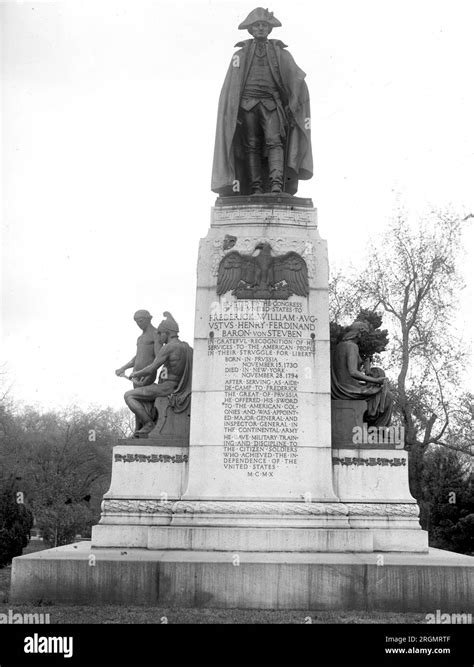
cause during the Revolution and was honored with a statue in Lafayette Square, just north of the White House, in Washington, D.C. The statue by Albert Jaegers was dedicated in 1910. A copy was dedicated in Potsdam, Germany, in 1911, and destroyed during World War II. A new cast was given in honor of German-American friendship in 1987, and to celebrate the 750th anniversary of the founding of Berlin. A cast is in Steuben's home town of Magdeburg.
The Steuben House, presented to Steuben as a gift for his services in the Continental Army, is located at New Bridge Landing in River Edge, New Jersey. The house and surrounding farmland were seized in 1781 from a Loyalist family. The house looks much as it did after Steuben renovated it. The State of New Jersey took possession of the historic mansion and one acre of ground for $9,000 in June 1928. It was opened as a public museum in September 1939. The Bergen County Historical Society opens the building for special events.
In 2007, a popular documentary DVD was released by LionHeart FilmWorks and director Kevin Hershberger titled Von Steuben's Continentals: The First American Army.
Examples of Memorials:
- Baron von Steuben (1914), J.
- Steubendenkmal (1911), Steubenplatz, Potsdam, Germany. A replica of the 1910 Washington, D.C.