Vasaloppet (Swedish for 'the Vasa race') is an annual long distance cross-country ski race held on the first Sunday of March.
The 90 km (56 mi) course starts in the village of Berga, just south of Sälen in western Dalarna, Sweden, and ends in the town of Mora in the central part of the province. The race was inspired by a notable journey King Gustav Vasa made from Mora to Sälen when he was fleeing from Christian II's soldiers during the winter of 1520-1521.
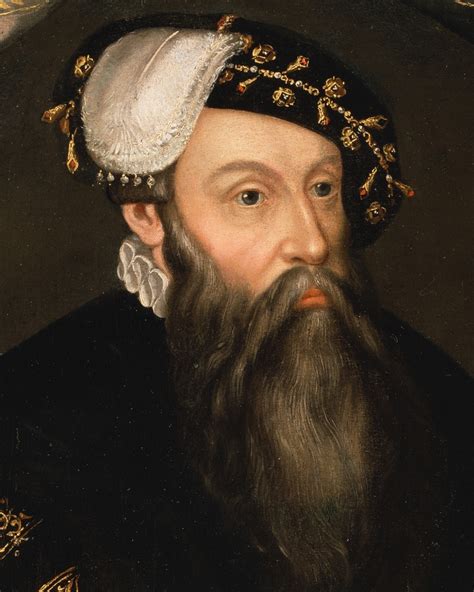
Gustav Vasa addressing the people of Dalarna. Painting by Johan Gustaf Sandberg (1830)
The Historical Context
In 1520, the young nobleman Gustav Ericsson Vasa was fleeing from the troops of Christian II, king of Denmark, Sweden and Norway (the Kalmar Union). Much of the Swedish nobility was in opposition to the king, and had nicknamed him Christian the Tyrant. Gustav fled through Dalarna, fearing for his life if he were discovered by the king's troops.
He spoke to the men of Mora at a gathering and tried to convince them to raise a levy and start a rebellion against King Christian. The men refused to join the rebellion, and Gustav started out west, toward Norway to seek refuge. However, the men in Mora changed their minds after hearing that the rulers had decided to raise taxes, and now they wanted to join the rebellion with Gustav as their leader.
Read also: Maine ski conditions
They sent out the two best skiers in the county, two brothers from Mora, Lars and Engelbrekt, to search for him and they caught up with him at Sälen.
The Birth of a Race
The idea for the race was published in Westmanlands Läns Tidning on 10 February 1922 by Anders Pers from Mora. On 5 March 1922, the board of IFK Mora decided to organize a trial race. Newspaper Dagens Nyheter sponsored the race with SEK 1,000 and with finances secured the first race was held on 19 March 1922.
136 participants registered for the race and 119 started. On 19 March 1922, the vision of journalist Anders Pers came true when the first “Vasaloppet” from Sälen to Mora celebrated its premiere.
The race - which sees competitors battle it out over 90 kilometres in classic cross-country technique - was conceived to commemorate the escape of Gustav Eriksson Vasa, later King Gustav I. Vasa, from Danish soldiers in 1520.
Alm fought his way up the first climb and on through the Swedish pine forests, over hills and past frozen lakes and farms until he arrived in the now legendary finish lane in Mora after 7 hours, 32 minutes and 49 seconds.
Read also: Buying Fischer Skis
A classic was born, with one small ‘flaw’: Gustav Vasa fled from Mora to Sälen, but for organisational reasons the organisers reversed the start and finish; to this day, the race is still run like this on the first Sunday in March.
Growth and Evolution
In the 80th race, held on 7 March 2004, about 15,500 skiers competed in the main event. More than 40,000 participated in one of the seven different races held during the first week of March.
The number of participants has grown to 15,000 cross-country skiers, while the winning time has dropped to just over 3 hours.
Traditions and Customs
The motto of Vasaloppet I fäders spår för framtids segrar ('In [our] fathers' tracks for future victories') is written on a portal erected over the finish line in Mora. At the first race, the finish line was simply marked with white board between two flag poles with the word Mål ('Finish') on it. The second year a more stately portal with the motto was fashioned.
A tradition connected to the race is the custom to choose a kranskulla. This is a woman who is given the honor of hanging a laurel victory wreath around the neck of the winner of the race as he crosses the finish line. She is dressed in the traditional folk costume of Dalarna. With the introduction of the women's race, Tjejvasan in 1988, a male kransmas is also appointed.
Read also: Versatile Cross-Country Skis: Alpina Discovery
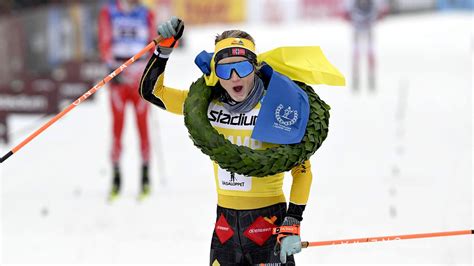
Kranskulla and Kransmas at Vasaloppet
Traditionally since 1958, blåbärssoppa ('bilberry-soup') made by Ekströms food company, is served at the stations along the course. The Swedish word for bilberry, blåbär, literally means 'blueberry'. About 50,000 liters are served during the Vasaloppet week. In addition, sports drinks and "Vasaloppet buns" are also served.
For a number of years, Ekströms had the logo for their blåbärssoppa printed on the number tags worn by the participants in the race.
Vasaloppet as a Global Event
Since 1978, Vasaloppet is included in the Worldloppet Ski Federation, a series of long-distance cross-country skiing races. There are four Vasaloppet races in the world: Sweden, USA, Japan and China.
- Vasaloppet Sweden: There is no other cross country ski race like the Swedish Vasaloppet held the first Sunday in March. Its 90 kilometers (56 miles) length is an ultimate challenge for skiers.
- Vasaloppet Japan: The City of Asahikawa, located on the Island of Hokkaido, is the home to this race, which is held in mid-March.
- Vasaloppet China: Vasaloppet China, is in the city of Changchun in northeastern China and is held in early January.
In 2006, the Vasaloppet was included in the FIS Cross-Country World Cup; a large complement of World Cup racers joined the men's field for the full 90 km (56 mi) distance.
Owing to the distance-40 km (25 mi) longer than the longest race usually skied in the World Cup-as well as the proximity to the just-concluded Olympic Games in Turin, the race was again dominated by long-distance specialists rather than World Cup racers.
Daniel Tynell won the race, just ahead of Jerry Ahrlin, while Anders Aukland - who has skied on both the Norwegian national World Cup team and in marathons like the Vasaloppet - finished third.
The women's World Cup Vasaloppet was held over 45 km (28 mi) the previous day, rather than being integrated with the full Vasaloppet.
Notable Winners and Records
Nils 'Mora-Nisse' Karlsson has the most titles, with 9. Janne Stefansson (7), Jan Ottosson (4), Arthur Häggblad (4), Bengt Hassis (3), Oskar Svärd (3), Daniel Tynell, Jörgen Brink (3) and John Kristian Dahl (3) are the only other racers with more than two titles.
Sofia Lind has the most titles, with 4.
The average winning time is 5:11:38 (a per-kilometer average of 3:28). The record winning time is 3:28:18 (2:19 per kilometer), set by Tord Asle Gjerdalen of Norway in 2021.
The ten fastest times include six Swedes and four Norwegians. In 2021 course records were set for both men and women.
Average times per decade have declined in each ten-year span, with the sharpest drop between decade averages occurring in the 1960s, for which the average winning time was 31:45 faster than the average winning time of the 1950s.
The average winning time in the 1970s was 16:07 faster than the 1960s, the 1980s average was 24:09 faster than the 1970s, and the 1990s average was 13:06 faster than the 1980s. The average winning time in the 2000s is only 2:18 faster than the 1990s, however.
Sweden is the most prolific producer of winners, with 74 titles (including two all-Sweden ties, in 1928 and 1988), or 90% of the 82 contested races. (The race was canceled in 1932, 1934, and 1990).
Norway has produced seven winners: Ole Ellefsæter, 1971; Anders Aukland, 2004; Jørgen Aukland, 2008 and 2013; John Kristian Dahl, 2014, 2016 and 2017, Petter Eliassen, 2015, Andreas Nygaard, 2018,Tore Björseth Berdal, 2019.
Two countries have produced two winners: Finland (Pekka Kuvaja, 1954; Pauli Siitonen, 1973) and Austria (Walter Mayer, 1980; Mikhail Botvinov, 1997).
Sweden won every race until 1954, when Pekka Kuvaja of Finland won the race. The next non-Swede to win was Ole Ellefsæter of Norway (1971), who kicked off a decade in which Sweden won just five titles and racers from five other countries won the five other titles.
Sweden won 8 of the titles in the 1980s (Austria [Mayer, 1980] and Switzerland [Hallenbarter, 1983] each won one title in that decade), and 8 more in the 1990s (Austria won one more title in that decade [Botvinov, 1997], and the race was canceled once [1990]).
The Week Preceding Vasaloppet
The week preceding Vasaloppet is known as Vasaloppet week.
Vasaloppet USA
In 1973, a small group of Mora volunteers and 96 skiers gathered in a farm field in northern Kanabec County for the first Vasaloppet cross-country ski race. Today, Vasaloppet USA's races start and finish in downtown Mora, with the cooperation of city street crews who perform the remarkable task of dumping snow back onto the town's main street.
However, it's the race's unique atmosphere and Mora community's ability to transform volunteer spirit and hospitality into a tangible presence that keeps skiers coming back year after year. In 2022 Vasaloppet USA celebrated its 50th Anniversary as a cross-country ski race.
The heart of the Vasaloppet success lies in the community’s volunteer spirit.
The History of Cross-Country Skiing
The history of cross-country skiing goes back thousands of years. Cross-country skiing is a form of skiing in which skiers move through snowy terrain, either on prepared tracks or through untouched snow, without the use of lifts or other aids.
While the above description might seem obvious to skiers, the history of the sport traces back to ancient times. The word ski comes from the Old Norse term skíð, meaning a wooden stick.
Skiing initially served as a means of travel in snowy terrain. Skiing has existed for nearly 5,000 years in Scandinavia, and it appears to have been practiced in China as early as 600 BCE. Early skiers used one long pole or spear along with their skis.
The first depiction of a skier dates back to 1741. At that time, traditional skis consisted of one short ski with a fur grip, called andor, and another long, gliding ski known as langski.
Over centuries, skiing evolved from a mode of transportation to an international sport. In Norwegian, the word langrenn refers to competitive skiing, where the objective is to cover a set distance on a track or trail in the shortest time possible.
Following this ideology, skiing developed into its current form. The first FIS World Championships were held for men in 1925 and for women in 1954. The first Winter Olympics were held in Chamonix, France, in 1924.
One of the biggest shifts in cross-country skiing was the introduction of skating. Although known and partially used as early as the 1900s, it became widespread only by the mid-1980s. In the 1960s, skating gained traction in ski orienteering, where competitors used it on roads and hard surfaces.
Skating’s breakthrough came at the 1985 World Championships in Seefeld, Austria, when Kari Härkönen won the 15 km race. A year earlier, skiers had introduced single-skate techniques at the Sarajevo Olympics.
Today, skating dominates competitive and recreational skiing, especially in Central Europe, and is the standard in biathlon and Nordic combined.
Long-Distance Skiing
Long-distance skiing, or marathon skiing, has existed in various forms since the late 1800s. Vasaloppet in Sweden, founded in 1922, and Tervahiihto in Oulu, Finland, which began in 1889, are the world’s oldest public skiing events.
These races have inspired many other organizers, and mass skiing has become a popular, competitive, and recreational sport. Ski Classics, which began in 2011, has brought international recognition and a well-structured annual competition series.
| Race | Location | Distance |
|---|---|---|
| Vasaloppet Sweden | Sälen to Mora, Sweden | 90 km |
| Vasaloppet Japan | Asahikawa, Hokkaido, Japan | Varies |
| Vasaloppet China | Changchun, China | 50 km |
| Vasaloppet USA | Mora, Minnesota, USA | Varies |