An ice rink (or ice skating rink) is a frozen body of water or an artificial sheet of ice where people can ice skate or play winter sports. Ice rinks are also used for exhibitions, contests and ice shows.
There are two types of ice rinks in prevalent use today:
- Natural ice rinks, where freezing occurs from cold ambient temperatures.
- Artificial ice rinks (or mechanically frozen), where a coolant produces cold temperatures underneath the water body, causing the water body to freeze and then stay frozen.
Besides recreational ice skating, some of its uses include: ice hockey, sledge hockey, spongee, bandy, rink bandy, rinkball, ringette, broomball, Moscow broomball, speed skating, figure skating, ice stock sport, curling, and crokicurl. However, Moscow broomball is typically played on a tarmac tennis court that has been flooded with water and allowed to freeze.
Rink, a Scottish word meaning 'course', was used as the name of a place where curling was played.
Building An Ice Rink | How Do They Do It?
Read also: Adventure Park Fun
Early Attempts and the First Mechanically Frozen Rink
Early attempts in the construction of artificial ice rinks were first made in the 'rink mania' of 1841-44. The technology for the maintenance of natural ice did not exist, therefore these early rinks used a substitute consisting of a mixture of hog's lard and various salts.
An item in the May 8, 1844 issue of Eliakim Littell's Living Age headed "The Glaciarium" reported that, "This establishment, which has been removed to Grafton street East' Tottenham Court Road, was opened on Monday afternoon." By 1844, these venues fell out of fashion as customers grew tired of the 'smelly' ice substitute.
It wasn't until thirty years later that refrigeration technology developed to the point where natural ice could finally be feasibly used in the rink.
The world's first mechanically frozen ice rink was the Glaciarium, opened by John Gamgee, a British veterinarian and inventor, in a tent in a small building just off the Kings Road in Chelsea, London, on 7 January 1876. Gamgee had become fascinated by the refrigeration technology he encountered during a study trip to America to look at Texas fever in cattle.
The rink was based on a concrete surface, with layers of earth, cow hair and timber planks. Atop these were laid oval copper pipes carrying a solution of glycerine with ether, nitrogen peroxide and water. The pipes were covered by water and the solution was pumped through, freezing the water into ice. Gamgee operated the rink on a membership-only basis and attempted to attract a wealthy clientele, experienced in open-air ice skating during winters in the Alps.
Read also: Learn to Ski: A Comprehensive Guide
The rink initially proved a success, and Gamgee opened two further rinks later in the year: at Rusholme in Manchester and the "Floating Glaciarium" at Charing Cross in London, this last significantly larger at 35.1 by 7.6 metres (115 by 25 ft).
In the marshlands of The Fens, skating was developed early as a pastime during winter where there were plenty of natural ice surfaces. This is the origin of the Fen skating and is said to be the birthplace of bandy.
In Germany, the first ice skating rink opened in 1882 in Frankfurt during a patent exhibition. It covered 520 m2 (5,600 ft2) and operated for two months; the refrigeration system was designed by Jahre Linde, and was probably the first skating rink where ammonia was used as a refrigerant.
The St. Nicholas Rink, (a.k.a. "St. Nicholas Arena"), was an indoor ice rink in New York City which existed from 1896 until its demolition in the 1980s.
The oldest indoor artificial ice rink still in use in the United States is Boston, Massachusetts's, Matthews Arena (formerly Boston Arena) which was built between 1909 and 1910. This American rink is the original home of the National Hockey League (NHL) Boston Bruins.
Read also: High-Tech Winter Gloves
The Guidant John Rose Minnesota Oval is an outdoor ice rink in Roseville, Minnesota, that is large enough to allow ice skaters to play the sport of bandy. Its perimeter is used as an oval speed skating track. The facility was constructed between June and December 1993. It is the only regulation-sized bandy field in North America and serves as the home of USA Bandy and its national bandy teams.
The oval measures at 400 meters long and 200 meters wide, which makes it the largest artificial outdoor refrigerated sheet of ice in North America. It is a world-class facility that is primarily used for ice sports such as ice skating, ice hockey, speed skating, and bandy.
The first building in Canada to be electrified was the Victoria Skating Rink which opened in 1862 in Montreal. The rink was created using natural ice. At the start of the twentieth century, it had been described as "one of the finest covered rinks in the world" and was used during winter for pleasure skating, ice hockey, and skating sports.
The Denman Arena (1911) was the first indoor ice rink in Canada to use artificial ice. Located in Vancouver, it was the primary site for the Pacific Coast Hockey Association professional ice hockey league. It was destroyed by fire in 1936.
The National Hockey Association (NHA) got its first artificial ice rink arena in 1912 with the opening of the Mutual Street Arena in Toronto.
Two of the oldest buildings formerly used for indoor ice rinks are still standing: the Stannus Street Rink (1897) in Windsor, Nova Scotia, and the Aberdeen Pavilion (1898) in Ottawa.
Construction and Maintenance
Many ice rinks consist of, or are found on, open bodies of water such as lakes, ponds, canals, and sometimes rivers; these can be used only in the winter in climates where the surface freezes thickly enough to support human weight. Rinks can also be made in cold climates by enclosing a level area of ground, filling it with water, and letting it freeze.
In any climate, an arena ice surface can be installed in a properly built space. This consists of a bed of sand or occasionally a slab of concrete, through (or on top of) which pipes run. The pipes carry a chilled fluid (usually either a salt brine or water with antifreeze, or in the case of smaller rinks, refrigerant) which can lower the temperature of the slab so that water placed atop will freeze.
This method is known as 'artificial ice' to differentiate from ice rinks made by simply freezing water in a cold climate, indoors or outdoors, although both types are of frozen water.
Modern rinks have a specific procedure for preparing the surface. With the pipes cold, a thin layer of water is sprayed on the sand or concrete to seal and level it (or in the case of concrete, to keep it from being marked). This thin layer is painted white or pale blue for better contrast; markings necessary for hockey or curling are also placed, along with logos or other decorations. Another thin layer of water is sprayed on top of this.
Synthetic rinks are constructed from a solid polymer material designed for skating using normal metal-bladed ice skates. High density polyethelene (HDPE) and ultra-high molecular weight polyethylene (UHMW) are the only materials that offer reasonable skating characteristics, with UHMW synthetic rinks offering the most ice-like skating but also being the most expensive.
Periodically after the ice has been used, it is resurfaced using a machine called an ice resurfacer (sometimes colloquially referred to as a Zamboni - referring to a major manufacturer of such machinery).
Those skilled at preparing arena ice are often in demand for major events where ice quality is critical. The popularity of the sport of hockey in Canada has led its icemakers to be particularly sought after.
A highly specialized form of rink is used for speed skating; this is a large oval (or ring) much like an athletic track.
Here's a table summarizing some key ice rink dimensions for various sports:
| Sport | Dimensions |
|---|---|
| Ice Hockey (NHL) | 26 m × 61 m (85 ft × 200 ft) |
| Bandy | 90-110 m × 45-65 m (300-360 ft × 148-213 ft) |
| Figure Skating (Olympic) | 60 m × 30 m (197 ft × 98 ft) |
| Curling Sheet | 45-46 m × 4.4-5.0 m (146-150 ft × 14.5-16.5 ft) |
Ice Rinks for Specific Sports
Bandy
In bandy, the size of the playing field is 90-110 m (300-360 ft) x 45-65 m (148-213 ft). For internationals, the size must not be smaller than 100 m × 60 m (330 ft × 200 ft).
Figure Skating
The size of figure skating rinks can be quite variable, but the International Skating Union prefers Olympic-sized rinks for figure skating competitions, particularly for major events. These are 60 by 30 m (197 by 98 ft).
Ice Hockey
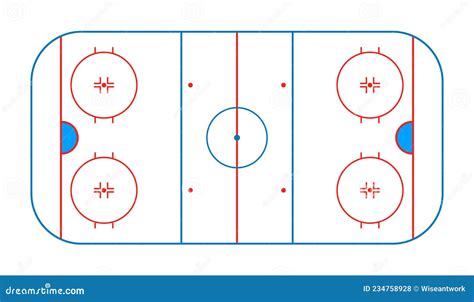
Although there is a great deal of variation in the dimensions of actual ice rinks, there are basically two rink sizes in use at the highest levels of ice hockey. Official National Hockey League rinks are 26 m × 61 m (85 ft × 200 ft).
Ringette
Sledge hockey (a.k.a. Ringette utilizes most of the standard ice hockey markings used by Hockey Canada, but the ringette rink uses additional free-pass dots in each of the attacking zones and centre zone areas as well as a larger goal crease area.
A ringette rink is an ice rink designed for ice hockey which has been modified to enable ringette to be played. Though some ice surfaces are designed strictly for ringette, these ice rinks with exclusive lines and markings for ringette are usually created only at venues hosting major ringette competitions and events.
Spongee
The sport of spongee, a.k.a. "sponge hockey", does not use ice skates. A skateless outdoor winter variant of ice hockey, spongee has its own rules codes and is played strictly within the Canadian city of Winnipeg as a cult sport.
Ice Skating Tracks and Trails
Ice skating tracks and ice skating trails are used for recreational exercise and sporting activities during the winter season including distance ice skating. To date, speed skating and ice cross downhill are the only winter activities or sports whereby ice skaters use tracks and lanes designed to include bends rather than using a simple straightway.
Speed skating tracks or "rinks" can either be created naturally or artificially and are made either outdoors or inside indoor facilities.
An ice skating marathon is a long distance speed skating race which may be held on natural ice on canals and bodies of water such as lakes and rivers.
Ice cross downhill, (formerly known as "Red Bull Crashed Ice" or "Crashed Ice"), is a winter extreme sporting event involving direct competitive downhill skating.
The rink is prepared by lowering the canal's water level and letting the canal water freeze. The rink is then resurfaced nightly by cleaning the ice of snow and flooding it with water from below the ice.
The longest ice skating trail is in Invermere, British Columbia, Canada, on Lake Windermere Whiteway.
The sport and recreational activity, Tour skating (a.k.a. "Nordic skating" in North America), is strictly an outdoor activity for ice skaters. Ice skaters traverse naturally frozen bodies of water, which sometimes, but not always, includes interconnected ice trails as well as frozen ponds, lakes, and even marsh areas.
The event leads past all eleven historical cities of the province and is held at most once a year, only when the natural ice along the entire course is at least 15 centimetres (6 in) thick. It is sometimes held on consecutive years, while at other times, gaps between the touring years have exceeded 20 years. When the ice is suitable, the tour is announced and starts within 48 hours.
Curling
The sport of curling uses an ice rink known as a "curling rink" or curling sheet. Curling does not involve ice skating.
The curling sheet is a carefully prepared rectangular area of ice created to be as flat and level as possible. The ice surface dimensions are 146 to 150 feet (45 to 46 m) in length by 14.5 to 16.5 feet (4.4 to 5.0 m) in width.
The dimensions of an official curling sheet is defined by the World Curling Federation Rules of Curling.
At major events, ice preparation and maintenance is extremely important.
Ice stock sport (sometimes spelt "Icestocksport" or "Bavarian curling") is a winter sport comparable to curling. It's called Eisstockschießen in German.
Crokicurl
Crokicurl is a Canadian winter sport and is a large scale hybrid of curling and the board game Crokinole. It is played outdoors by teams consisting of two players who take turns trying to score points on a quadrant shaped area with the playing area marked off on a sheet of ice.
The quadrant includes posts, starting line, wooden edge side-rail, and a 20-point "button".