Ice skating has a rich and varied history, evolving from simple outdoor ponds to sophisticated indoor rinks. This article explores the evolution of ice skating rinks, highlighting key moments and locations that have shaped the sport and recreational activity we know today.
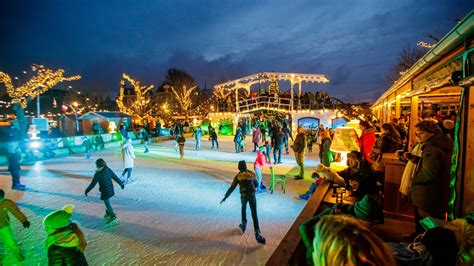
Ice Skating in Amsterdam, a historical depiction of outdoor skating.
The Golden Days of Truckee's Winter Carnivals
Truckee has a long-standing tradition of winter carnivals, with local history indicating some form of these events occurring every year since 1909. C.F. McGlashan, a prominent figure in the community, conceptualized the idea of a major tourist attraction for the town.
In the winter of 1893-1894, McGlashan oversaw the construction of the first ice palace in the center of town. Chicken wire was repeatedly sprayed with water, freezing to create a solid wall of ice. The earliest ice palace had walls 50 feet high and an oval ice skating course inside. A tower at one end allowed tobogganers to slide down to street level. This creation covered more than half the main street, but its success led to similar structures in later years, drawing thousands of visitors by train.
In 1913, plans were made for the largest winter carnival ever held in Truckee. The chamber of commerce decided that a permanent ice palace was needed. The plans called for a massive structure made of expanded metal that could be sprayed with water to form ice. A corporation was formed to acquire land at the west end of today’s southwest river street, below Hilltop. A new footbridge was built across the river for easy access.
Read also: Winter Fun at Hamilton Ice Arena
On December 11, 1913, the new ice palace was completed. Water was diverted from a natural stream to flood the ice skating rink, and the exterior walls were lit up in brilliant colors. The interior was decorated with hundreds of fresh roses. A large “Ice Palace” sign was placed on top of the building, and another sign over an arched entry greeted visitors with the words, “Glad-U-Kum.” The chamber of commerce hired a special orchestra featuring six Hawaiian musicians dressed in colorful winter costumes and featuring a beautiful Hawaiian princess who sang in her native language.
Opening day was held on December 27th. Members of the San Francisco Chamber of Commerce were invited and arrived on special trains. Every hotel in town was full while local merchants enjoyed record profits. By nightfall, a huge lighted outdoor Christmas tree illuminated the landscape along with the ice palace. Horse-drawn sleighs took visitors on moonlight excursions from Truckee to Donner Lake and back. The Festivals Association of the Pacific Coast praised Truckee for its tremendous efforts. The new ice palace and winter carnival of 1913 was such a success that an even larger event occurred in 1914-1915. This event featured sled dog racing and a memorable visit by writer Jack London. Winter sports had become a major event in Truckee.
Truckee’s last great winter ice palace burned to the ground in 1916. The pond that remained continued to be used for ice-skating but was difficult to keep cleared of snow. In 1958, N.F. Dolley, president of the Truckee Chamber of Commerce, explored the possibility of erecting some sort of icy creation for the tourists expected to arrive for the 1960 Olympic Games, however his dream was never realized. Again, in 1994, much excitement arose when a marketing firm considered building a modern ice palace on land across from the C.B. White House, however, due to concerns over costs and liability, the idea never became a reality. Today, only a mountain meadow remains where the grand old ice palace once stood.
Central Park's Skating Pond: A Victorian-Era Delight
The sport of ice skating in Victorian-era New York was so popular that all submissions to the 1857 design competition for Central Park were required to include a winter skating area. As one of the few socially acceptable activities that could be enjoyed in mixed company (along with tennis and bicycling), the Department of Parks’ Board of Commissioners recognized that a public skating rink would be a great source of healthful recreation for city dwellers.
Called the Skating Pond on Calvert Vaux and Frederick Law Olmsted’s winning Greensward plan, the Lake was one of the first areas of the park to be open to the public for the 1858-59 skating season, well before construction of many other park areas had started. In the early days of the park, ice skating on the Lake drew huge crowds-some thirty thousand people daily.
Read also: Ice Skating in Great Neck
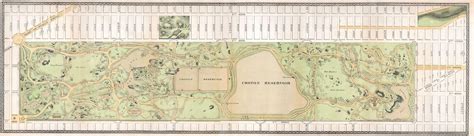
Detail of Calvert Vaux and Frederick Law Olmsted’s 1857 Greensward plan submission drawing showing the skating pond.
Beginning in 1868, a three-story chalet-style “skate tent,” as it was called, was put up and taken down at the south end of the lake during the winter season. The 1870 report of the Board of Commissioners described the tent amenity: on the first floor it had concessions, changing areas, a place to warm up, a refreshment stand, and a cloak room. In addition to the main skating area, Vaux and Olmsted also provided a more secluded space reserved for women who preferred to skate away from the mixed-gender, social atmosphere on the Lake. Located on a small inlet just beyond Balcony Bridge, the Ladies Skating Pond provided a “ladies only” option for the more modest skaters of the day.
As construction in the park continued, other bodies of water such as the Conservatory Water and the Pond also became popular skating venues. In an effort to make the man-made Lake safe throughout the year, it was equipped with waste weirs (to lower water levels) and sluice gates (to raise water levels). During summer, sluice gates kept the water level at seven feet deep to accommodate boaters. In winter, the waste weirs lowered the level to just four feet to lessen the possibility of an accidental drowning if a skater fell through too-thin ice and each night, a series of eighteen hydrants, or valves, spread water to create a fresh sheet of ice.
With large crowds arriving daily, Olmsted instituted many park rules for wintertime users of the Lake. He stipulated, for example, that visitors should “not drop any tobacco, segar-stumps, paper, nutshells, or other articles on the ice” and that, “a ball will be hoisted to the top of the pole, near the bell tower whenever the ice is in full condition for skating.” However, Olmsted did relax one rule during the ice-skating season-park closing time-extending it from eight o’clock to midnight.
While the popularity of ice skating waned in the later part of the century, it never completely fell out of fashion and remained a wintertime draw for the park, albeit one contingent on the fickle nature of New York weather. In 1949, philanthropist Kate Wollman donated $600,000 toward construction of a new kind of "artificial rink" to be built in Central Park. The Parks Department publicity materials stated that the rink guaranteed access to safe skating for New Yorkers "who have been deprived of the pleasure of regular, uninterrupted outdoor ice skating throughout the winter half year because of vagaries of our climate." Created as a memorial to her parents and four brothers, Wollman Rink opened at the south end of the park in 1950. More than 300,000 visitors arrived in the first year and by 1953 the rink had welcomed its one millionth skater.
Read also: Ice Skating at AZ Ice Gilbert
In addition to Wollman Rink, Central Park is also home to the Lasker Rink and Pool located at the northern end of the park near the Harlem Meer. Named for its major benefactor Loula Davis Lasker, a philanthropist and social worker, who donated $600,000 to help build the rink in 1961, the skating rink opened in 1966 and is converted into a public swimming pool during the summer months.
The Skating Club of Boston: A Century of Skating Excellence
The Skating Club of Boston has a rich history and heritage. The Club was founded by an enthusiastic group of Boston skaters, informally known as the “Back Bay Skating Club,” who had shared skating out of doors at various sites in the Boston area, including especially Hammond’s Pond in Chestnut Hill.
With good ice available regardless of weather, Boston skaters under the leadership of George Atkinson, Jr., formed The Skating Club of Boston in 1911 and incorporated it in April 1912. Charter members of the founding group included Mr. Atkinson, who was the first President, and A. Winsor Weld, the second President, whose daughter Theresa and her partner Nathaniel W. Niles were the leading local exponents of the New Style.
The Club founders from the “Back Bay Skating Club” had skated chiefly on Hammond’s Pond in Chestnut Hill (outdoors, of course). The Club happily skated on a regular basis at the Arena from its beginning up to World War I, when supplies of fuel (coal) became limited. But it was the destruction by fire of the first Boston Arena in 1918 which caused the first hiatus in the activities of the Club. In an effort to bridge the gap and the loss of the Arena ice, the Club obtained ice at a small rink in Cambridge near MIT on Massachusetts Avenue.
In 1938, the Club moved from the second Boston Arena to its own building on Soldiers Field Road in Brighton. This happy event was the result of careful planning during the 1930s, including the marshaling of the proceeds from the very successful carnivals held in that era at the Boston Garden. The building at 1240 Soldiers Field Rd, with its design of structural steel arches and curving roof, sometimes referred to after World War II as a “Quonset Hut”, was recognized today among architects and engineers as unique, as it was the first building of its kind in which the load on the arches was directed straight downward onto spread footings, with no tie rods being required for obvious reasons.
In 2012, after many years of effort led by President Joseph Blount, a formal plan for the building of a new facility was initiated. Not to be deterred from their vision of a state-of-the-art facility, the Club management, spearheaded by President Joe Blount and Executive Director Doug Zeghibe, continued the search for a suitable lot on which to build. After exhausting all resources, including support from the Mayor’s Office, it was determined that finding suitable land within the city limits of Boston would not be practical nor possible.
The Club found its providence twenty miles south of Boston in the town of Norwood, Massachusetts. It also undertook to find land and to plan for a new multi-rink facility. In October 2017, the Club purchased 32 acres of land at 750 University Avenue in Norwood, which was being used at that time by the Lost Brook Golf Course. In April of 2019, the Club began clearing the University Avenue property for its development, and on May 13, 2019, officially celebrated the long-awaited groundbreaking to begin construction. Construction resumed in early June, and the project was near to completion when the Club partially opened for skating with two sheets of ice on September 8, 2020. The full operation of all three sheets of ice in the new facility began on September 28, 2020.
The Norwood facility includes the 2,500-seat Tenley E. Albright Performance Center and celebrates the character of an extraordinary athlete and scholar who has had a bond with the Club since her first strokes on home ice as an eight-year-old. The Tenley E. Figure Skating and International Skating Union sanctioned events. It will be a venue that celebrates the joy and thrill of figure skating, as it also widens and amplifies the Club’s outreach to audiences from across the nation, and indeed, from around the world.
The Skating Club of Boston’s iconic current logo was designed by longtime Club member, Clara Rotch Frothingham, in 1940. The etchings represent the tracings left in the ice when skating the required figures in the 8th and final compulsory figure test.
Fiesta Rancho: A Southwestern-Themed Casino with an Ice Rink
Fiesta Rancho was a hotel and casino located on 25.46 acres (10.30 ha) of land at 2400 North Rancho Drive in North Las Vegas, Nevada, across the street from the Texas Station hotel and casino. The Maloof family opened the Fiesta on December 14, 1994, with 100 rooms and a 25,000 sq ft (2,300 m2) casino. The resort was popular among local residents, prompting a 50,000 sq ft (4,600 m2) expansion that began in 1995.
George J. Maloof Jr. had wanted to own a casino in Las Vegas, and he convinced his family to build one there. The Maloof family chose to build in a location off of the Las Vegas Strip, where real estate prices were significantly higher. The property for the eventual hotel-casino - at the northeast corner of North Rancho Drive and West Lake Mead Boulevard in North Las Vegas, Nevada - was purchased by the family in 1989.
The Fiesta opened to the public on the night of December 14, 1994, eight hours after a formal ribbon-cutting ceremony. The Fiesta was the first hotel-casino to open in North Las Vegas, Nevada, and only the second hotel-casino in the northwest Las Vegas area, after the nearby Santa Fe, also on North Rancho Drive. George Maloof, speaking about the casino's success, said, "We figured out quickly that it was too small when we opened." In response to the Fiesta's success with residents, a $10 million, 20,000 sq ft (1,900 m2) expansion was announced in March 1995.
In February 1999, Maloof announced plans for a $22 million expansion, to be completed by mid-December 1999 for the celebration of the New Millennium. According to Maloof, "The thrust of our expansion is entertainment, things we didn't have before. It's going to be highly themed and entertainment-oriented. It'll appeal to different markets, some younger crowds. You build these things for different times of the day." The $26 million expansion was constructed on the east side of the property, and featured the addition of a food court with six restaurants. Also added was Roxy's Pipe Organ Pizzeria, which featured a large 70-year-old pipe organ that was once part of the Roxy Theater in New York.
The 50,000 sq ft (4,600 m2) expansion also increased the casino by 20,000 sq ft (1,900 m2), for a total of 70,000 sq ft (6,500 m2). The number of slot machines was raised 500, to nearly 2,000 machines. A four-story, 1,000-space parking garage was also added, which allowed direct access to the food court. In March 2001, the hotel-casino was renamed Fiesta Rancho.
Nevada casinos were closed on March 17, 2020, due to the COVID-19 pandemic. Prior to that point, Fiesta Rancho had been one of Station's worst-performing properties. It remained closed while other casinos began reopening, with most of its customer base relocating to the company's nearby Santa Fe Station.
In July 2023, plans were announced by Agora Realty & Management to redevelop the two properties as a mixed-use project, known as Hylo Park. The former Fiesta land would include a 150-room hotel, retail space, and two new ice rinks, while the existing rink would be converted into a field house.
Iceland Ice Skating Rink: A Sacramento Landmark
Iceland Ice Skating Rink has been a fixture in Sacramento since 1940 and was a well-loved venue for countless numbers of shows and fun for all who have skated here. The fire destroyed almost all of Iceland, but not our spirit. Fortunately, the rink foundation was built of metal pipes and not the plastic pipes that are used in modern rinks. The metal pipes survived the fire and were a starting point to build upon once again.
As Iceland begins her 6th season of outdoor skating, and her 76th year of existence, she continues to be able to bring the joy of skating to future generations.