Ski boots are one of the most important parts of your equipment, not only are they very functional, they also affect your comfort more than any other part of your ski equipment. Ski boots are designed to transfer your movements into your skis, while supporting and protecting your feet, ankles, and lower legs. In order for the boots to transfer forces well, they have to be stiff and restrict the movement in your ankles.
This stiffness and lack of movement makes it a lot harder to walk in ski boots than normal shoes. Also, because ski boots are stiff, tight, and restricting, this can make badly fitted ski boots very uncomfortable. It is important to find the right boot for you and to have the ski boots fitted properly. The soles on ski boots are designed to attach to ski bindings so that the boots can be held firmly onto your skis.
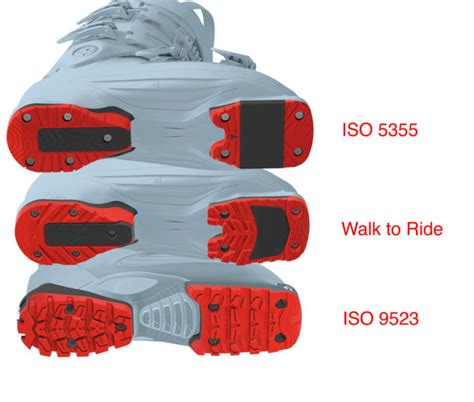
To ensure any alpine ski boot can be used with any alpine ski binding, ski boot soles adhere to the ISO 5355 design standard. This ensures the shape of the lips and overall dimensions of the ski boot sole are within set limits and will work in any alpine ski binding.
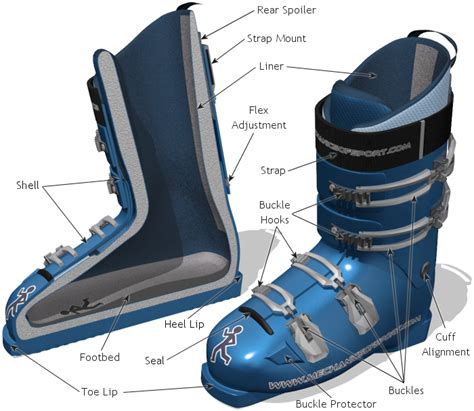
Key Components of a Ski Boot
The Shell
The shell is the solid outer layer of the ski boot, and is made of two parts, the lower shell and the cuff. The lower shell is the part where your foot is contained, and the cuff is the part that goes around your shin and lower leg. Shells are made of polymer plastics, often Polyurethane or Polyether.
It's common for the shell to be made of 2 or 3 different types or densities of plastic, so that different areas of the shell can be optimised to affect strength, stiffness, flex, comfort and ease of putting the boot on and off.
Read also: Types of Ski Boots Explained
What ski boot flex is best, how it works, and misconceptions explained.
Flex
The flex of a ski boot is a measurement of how stiff the ski boot is, and how hard it will be to flex your ankle while in the boots. Manufacturers usually assign each boot a value for flex on a scale between about 50 and 140, where 50 is very soft, and 140 is extremely stiff. There is no set scale that manufacturers use though, so a 100 flex boot from one manufacturer is not necessarily the same as a 100 flex boot from a different manufacturer.
Beginner and lower intermediate skiers usually go for softer flex boots, that are more comfortable and more forgiving, whereas expert skiers and racers go for very stiff boots, which are very responsive and efficient, but lack the same comfort and warmth. As women are generally smaller than men, they often require a boot with a flex up to 20 less than the values shown on the chart above. Also men or women who are lighter or heavier than average, may want to go for a slightly softer or harder flex.
Some boots also offer the ability to adjust the flex of the boot slightly, so that you can better tune the boot to what you want to do.
Shell Customization
The shape of the shell can have a large effect on how comfortable a ski boot is. Because of this most shells can have their shape changed in several ways to customise the ski boot to a person's foot. This is where areas of heat moldable plastic are built into the shell, normally along the sides of the foot.
The boot shells are heated up in a special oven, until they are at the right temperature (normally about 80°C), then they are taken out of the oven and the liners are put back in them. The skier then puts the boots on, and with just the pressure of the skier's foot inside the boot, the heat moldable areas expand to fit the skier's foot shape. The shell is then cooled down to set the plastic, so that the shape will not change any further.
Read also: Guide to Snowboard Boot Inserts
A more recent development is to mold the entire shell to a skier's foot, instead of just a few key areas. Boots that can do this have shells that are made entirely from a moldable plastic, so that the whole shell can change shape. The process currently used to do this is roughly the same as with moldable areas, except instead of using the skier's foot to push the shell outwards into the right shape, the boot is put into an inflatable cast that pushes the boot onto the foot and leg.
Forward Lean and Walk Mode
All ski boots tilt the lower leg forward, so that your ankles and knees are bent when you stand in ski boots. Forward lean is normally set at about 14° but can often be adjusted as far as 17°. The forward lean and stiffness of ski boots makes walking in them more difficult than in normal shoes.
Because of this, some ski boots, generally boots aimed at lower intermediate skiers, have a mode that makes it easier to walk in the boots. Exactly what these modes do changes between different boots, but they normally free up the cuff to rotate forwards more easily, and often let the cuff come further backwards than normal.
Entry Type
There used to be a few different types of ski boot around, but these days almost all ski boots you can buy in the shops are "front entry", where the shell wraps over itself in front of the shin and over the top of the foot. To get your feet in and out of the boots, the buckles are undone and the overlapping areas are pulled apart to create the extra space needed.
The Liner
The liner is the soft boot layer that sits inside the shell, and lies next to your foot. Like shells, liners can also vary a lot, below are some of the features and properties to look for in liners. How thick the liner is can effect how responsive, comfortable and warm a ski boot is.
Read also: Acceptable Boot Overhang Explained
Thicker liners are better for comfort, and keeping your feet warm, whereas thinner liners are better for power transmission, and are generally not as warm or comfortable. Thicker liners are normally found on boots aimed at beginners and intermediates, with thinner liners found in boots aimed at racers, or expert skiers.
Most liners these days contain heat activated materials that will mold to the contours and bumps of your foot. The amount, thickness and placement of this material can vary a lot between liners, depending on what the liner is intended for. To mold the liners, hot air is normally blown into the liners to heat them up, and then the ski boots are put on for 5 to 10 minutes for the liner to adjust to the shape of your feet and ankles.
Another method that some aftermarket liners use to create a custom fit, is to inject foam into the liner walls while your foot is inside. A lot of liners have smooth slide areas along the back of the leg and heel.
Insoles (Footbeds)
The insole, or footbed, is the platform that sits under and supports your foot. One recommendation often made when buying ski boots is to replace the insoles they come with, with either a custom insole, or higher quality aftermarket insole.
Custom insoles are insoles that are specially shaped for your feet. There are a few ways this can be done, some methods take a mold of your feet, and use this to mold the footbed, whereas others take a 3D scan of your foot and carve the footbed from a solid piece of EVA plastic.
Heated insoles contain heating elements inside them, which can be connected to a battery and used to help keep your feet warm while you are on the mountain. For people who easily suffer from cold feet, this can be an important extra to have, as it can increase their comfort through the day immensely.
Buckles and Straps
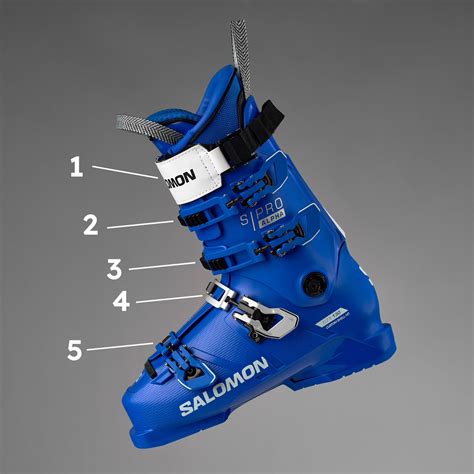
Buckles are the latches that hold your ski boots closed, and determine how tight your boots are. Traditionally ski boots have 4 buckles, 2 over the foot, and 2 around the shin, which many of today's ski boots still have.
Although the style of buckle can change between boots and manufacturers, the systems used normally involve an arm that reaches over and catches onto one of several hooks, which is then pulled tight and latched into position. The length of the buckles on most boots can be fine tuned by rotating the buckle arms. Turning the arms clockwise or anticlockwise will normally make the arm about 1mm shorter or longer for each revolution.
It's becoming common for boots that are not aimed at racers or expert skiers to use less than the normal 4 buckles. On some boots the position where the instep buckle attaches to the shell can be moved. Around the top of the boot there is normally a velcro strap that helps tighten the top of the boot around your leg.
Additional Components
- Rear Spoiler: A plate that goes between the liner and the shell at the back of the boot where the calf muscle starts.
- Seal: A strip of rubber that sits above the toes in front of where the overlap in the shell starts.
Cuff Alignment (Canting)
Cuff alignment (sometimes refered to as canting) allows the sideways angle of the cuff to be adjusted to suit the skier's lower leg shape. For people with a knock kneed stance the cuff needs to be tilted inwards, and for people with a bow legged stance the cuff needs to be tilted outwards.
Most boots offer about 1 degree of movement in each direction. Adjusting this allows the boot sole (and therefore the skis) to sit completely flat on the ground in your neutral stance, as it should be.
Boots can be tilted-or “canted”-inward or outward in relation to the ski to accommodate the biomechanics of the skier. Cant is often confused with shaft-alignment, which merely refers to the inward or outward angling of the cuff.
Other Considerations
Walking on hard surfaces can wear down the toe and heel sections of ski boots. Women's legs are shaped differently to men's legs. Their calve muscles are shorter and lower, with a greater variation in size, and their ankles are thinner. It's also more common for women to have a knock kneed stance. Women specific ski boots take these differences into consideration with shapes, moldable areas, and adjustments suited to women.
Ski Boot Fitting and Customization
Below is an overview of some of the things to be aware of when having ski boots fitted, and if required, customised. Ski boots use their own sizing system called Mondopoint. Your mondopoint size is quite simply the length of your foot in centimetres (cm), most shops have a foot measuring device which will measure your mondopoint size.
Mondopoint sizes go up in half sizes, i.e. 26.0, 26.5, 27.0, 27.5, etc. The difference between a whole size and a half size is not the length of the foot however, it is the width of the foot. Whole sizes are for narrower feet, and half sizes are for wider feet, but they are both the same length. Measuring devices will normally measure your foot width as well, to advise you to whether you need a narrow or wide boot for your mondo size.
Using a device to measure your foot does not guarantee that is the size boot you will want, it is just a guide. Last is the skiing term used to describe foot shape. It used to be that each manufacturer made boots that suited a different shape of foot, e.g. narrow, wide, high volume, low volume, etc. This is generally not true any more, with most manufacturers now having several different boot models that suit different foot shapes.
Your ski boot sole length does not affect the fit of your ski boot, but it does affect your ski bindings. The toe and heel sections of the boot are made to set dimensions, but the distance between them can change. The overall length of the ski boot sole is what your ski binding needs to be set for, so that your boot will be held correctly by the binding. The length of the sole is normally written on the boot, somewhere on the side of the sole, with a measurement in millimetres (mm).
For boots to fit really well, many of the boot features mentioned above need to be looked at and added or adjusted where necessary, including: custom insoles, liner molding, molding shell areas, cuff alignment, rear spoiler position, and buckle adjustments.
Canting is where the angle that the whole ski boot sits on the ski is changed. This can be done by putting wedges under the ski binding, or by planing and rebuilding the sole of the ski boot. Canting should not be played with though, and should be left to the ski boot experts.
Rubber grips can be put over the soles of ski boots when you are not skiing.
Ski Boot Maintenance
Ski boots require relatively little maintenance other than making sure they dry out after being used. It is important to let boots dry out after a days skiing, as a wet or damp ski boot will be less comfortable and will let your feet get cold a lot more quickly than a dry ski boot. If a boot is left damp for too long or too often, areas of the boot can become mouldy.
Important Note: The information here is for alpine ski boots, there are other types of ski boot for different types of skiing which can be quite different.
Key Terminology
- Last: The shape of the interior cavity of a boot.
- Lugs (toe and heel): The portions of the shell’s sole that interface with a ski binding.
- Liner: The removable inner boot, usually made of foams, leather, textiles and injected plastic components.
- Footbed: The removable platform inside the liner, on which the foot rests.
- Bootboard: The removable floor of the boot shell-the platform on which the liner rests.
Boot Types
Boots basically come in three varieties, defined mostly by their widths. The three categories are race, all-mountain high-performance, and sport/recreation. Last widths range from about 95 mm in the tightest race boots to 105 mm in the sloppiest sport/rec boots.
Race boots are not only the narrowest, but have the thinnest, firmest liners (often using only cork for padding), since racers are willing to sacrifice comfort for ultimate performance. All-mountain boots are medium-snug, with moderately padded liners, in order to combine all-day comfort with sufficient performance. Sport/recreation boots are excessively wide and are designed to feel good, even at the expense of performance.
Be aware that what feels good in the shop might turn out to be too loose on the hill. In a too-loose boot, the skier doesn’t have the fit-tension necessary to control a ski. Furthermore, a sloppy fit allows the foot to slide around inside the boot, often leading to greater discomfort in the long run. Remember also that thickly padded liners will pack out extensively, with a resulting loss of both performance and comfort. A general rule: snug is good. If you have problems with tight spots, a bootfitter can always help.
Flex Ratings
Flex ratings, or indexes, indicate how stiff a boot is. There is no quantitatively standardized scale for indexing flex. Manufacturers have informally developed one, but the ratings of one company can differ from those of another.
Flex ratings may at one time have been tied to measurements of plastic hardness (durometer), but there’s much more than that to the stiffness of a boot: wall thicknesses, hinge points, spine rivets, height of cuff attachment, etc. European engineers are said to be at work on a standardized rating system. Meanwhile, the flex ratings that exist today do give a skier an idea of how soft or stiff a boot’s flex is, especially in relation to other models in a line.
Additional Boot Designs
- Cabrio/mid-entry/shell-tongue: In a cabrio design, the shell has a tongue, which opens forward like a convertible (hence “cabrio”).
- Alpine/AT Hybrids: The hottest new category in boots blends the tourability of an alpine touring (AT) boot with the power and quickness of a traditional alpine boot.
Cuff Alignment Details
Ski Team athlete and 2015 national super-G champion Drew Duffy says in reference to cuff alignment, “My boots have never been so dialed in. Each boot brand offers some form of cuff bolt and associated asymmetrical washer/housing system to hold the upper and lower shells together at the ankle pivot. Each brand has its own mechanical hardware, but essentially they all function quite similarly.
Basically, you can adjust the lateral angle of the upper cuff, or “tip” it in or out, independent of the lower boot shell and sole. In the best case, this range is equal to 0.5-1 degree, +/-, of the lower. Over time, this pivoting mechanism has evolved to offer multi-directional or “compound angle” range of movements, whereby the upper cuff is not only tipped single dimensionally to one side or another but can be pivoted to the side AND towards the big or little toe direction of the boot.
Our legs come in a variety shapes and sizes. Boots come out of the box with a stock angle, and more importantly, upper cuffs are set up consistently in line with the same angle as the lower shell. The soles of modern race boots can be 90-, 90.5-, or 91-degrees - essentially straight up or tipped just barely out.
A simple visual observation of an athlete standing barefoot on a footbed out of boots with legs and feet hip-width apart can yield a picture of the legs coming up from the ankle at a certain angle. Sometimes the lower leg looks “neutral” or parallel, but other times the lower leg looks different than the angle inherently built into the boot.
I believe this is important for two reasons. First, the legs of developed athletes are strong and disciplined in their stance. Depending on the space around the leg in the upper cuff, once the leg is strapped inside the cuff with a liner between shell and leg, you may have an issue where the leg interacts with that cuff in one spot sooner or with more pressure than the rest of the leg. The result will push a boot cuff away from the spot that has the most contact while tipping the whole boot sole with it.
Second, as the leg travels fore and aft through flexion and extension movements, it guides the pressure along an axis in line with the ski tip. Before any lower boot sole canting should be considered, this critical five-minute step should be taken. Remove the footbed from the liner, and drop it into the empty boot shell. Have the athlete step into the shells and lightly close the upper buckles to approximately the same settings used when liners are in. No need to do up the power or Booster strap.
Adjust the width of the athlete’s stance using the same method as when performing a traditional alignment analysis or drill. With ankles slightly bent and the leg shaft floating inside cuff, visually inspect for consistent spacing around the leg as it corresponds to the cuff. Hopefully, there are equal gaps in all areas. You may see a bias to the outsides on both boot cuffs or a clear lean to the insides. It may be both legs consistently or it may be one leg, just a bit more than the other, due to anatomy differences, injuries, etc.
Make note as to which direction you need to move the cuff, in or out, to match the same spacing around the leg. Next, have the athlete slowly drive leg shafts as if pressuring the boot during a turn, and note where the shins intersect the front of the boot overlap. There is never an ideal, but try for contact at the center or a hair inside of center as you can imagine that will translate to the inside tip of the ski.
I made mention of “compound angles” above. The direction a leg travels during flexion and extension movements can be inconsistent or multi-axis. Legs can start inside and drive out, or come from the outside and fall in. Take the manufacturer’s tool supplied with the boots, and loosen all side hardware and spine bolts. Note the ranges on the ankle hardware. Most brands have these limits stamped on the cuff or parts, showing a “+ or -“.