The snowmobiling world is undergoing a massive transformation. Once ruled by the thunder of gas engines and clouds of exhaust, winter trails are now opening up to something cleaner, quieter, and just as thrilling - the electric snowmobile. Taiga Motors, a Canadian company, has embarked on a mission to revolutionize the powersports industry with electric vehicles.
Electric cars-at least to me, a person who’s enthusiastic about cars-make sense. Cars roll across the surface of the Earth and can operate in warm places where charging infrastructure can readily exist.
Electrified powersports machines of all types are finally hitting the mass market, and we’re stoked. Taiga’s staff is made up of industry outsiders not tied to combustion engine legacy designs. In short: The Nomad delivered.
The Taiga Nomad: A Closer Look
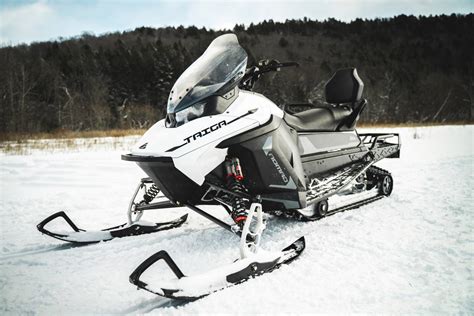
The Taiga Nomad is a true workhorse. Dubbed the Nomad, the utility workhorse model we rode features a 90-hp permanent-magnet electric motor fed by the standard lithium-ion battery pack with a gross rating of 23.0 kilowatt-hours (Taiga would not tell us the usable capacity) under the seat. It’s a two-seat, wide-wheelbase utility snowmobile that’s perfect for work or exploring the trails.
Looking at the Nomad, it’s not that different from a conventional snowmobile-which was perhaps the entire point. You can eventually expect three different snowmobiles from Taiga: the Atlas for trail performance, the Ekko for mountains, and this, the Nomad, for more all-around tasks like trail-running and towing stuff.
Read also: G-Force One: First Impressions
Key Specifications of the Taiga Nomad
Here’s a detailed look at the specifications of the Taiga Nomad:
- Base price (as tested): $17,490 ($19,490 without destination fees)
- Powertrain: 23-kWh battery | permanent-magnet synchronous motor | direct drive (no transmission)
- Horsepower: 90 (120 performance version)
- Torque: 125 lb-ft
- Seating capacity: 1 or 2
- Towing capacity: 1,125 pounds
- Curb weight: 654 to 755 pounds
- Length: 128.9 inches
- Height: 61 inches
- Front track: 42.3 inches
- Suspension travel: 8.8 inches front, 11.8 inches rear
- Range: 62 miles (83 miles performance version)
- Charge time: 4 hours on Level 2 charging, 30 minutes for 80 percent on Level 3 charging
The Nomad does offer regenerative braking in low and high modes-here controlled via some toggles on the left-hand handle-which is cool. Just like in a car, however, you cannot swap out the battery for a fresh one if you deplete it.
Taiga will offer a standard and performance version of the Nomad, both running on a 23-kWh battery. The standard Nomad produces a claimed 90 horsepower, 125 pound-feet of torque, and up to 62 miles of range. The Performance Nomad produces a claimed 120 hp, 125 lb-ft of torque, and up to 83 miles of range.
Driving Experience
The biggest adjustment you have to make while riding the Nomad is there really isn’t any obvious indication that it’s on (just like an EV). There’s no idling engine to hear or vibration to feel. You have to check that the LED driver information cluster is glowing blue to know when it’s go time.
Like all vehicles powered by batteries, the Nomad benefits from instant torque but is still very friendly to a novice rider like myself. The less-insane range mode-designed to conserve the battery-still delivers a fair thrill as you punch the accelerator. Sport mode is the one you want when you’re really trying to fly, though.
Read also: Register Your Snowmobile in IL
But at speed and on the forested trails of Stowe, Vermont, the Nomad felt extremely stable, no doubt owing to its wide track and length. And despite it having no engine, the Nomad isn’t silent either.
Innovative Technology
Among other things, the Nomad is powered by a direct belt on the drive shaft, so no CVT transmission. Taiga anticipates that this belt will last the life of the snowmobile quite impressively. Taiga’s powertrain is specifically designed for winter activities and is designed to operate reliably at extreme temperatures and withstand the worst conditions.
The snowmobile features automotive-grade lithium-ion batteries, an inverter motor combined with the Taiga Power Unit. All of this gives the snowmobile a powerful forward propulsion impulse. By consolidating the motor and inverter into a single element, it saves space and reduces the weight of the snowmobile.
Interestingly enough, when we travel, there is even an energy regenerator that recharges the battery by going down a slope. What we perceive as an engine brake is actually the recovery of this energy to send it to the battery.
State-of-the-art technology is present on the Nomad and controlled at all times using the smartphone. You will also be able to control the different driving modes, check the battery status, locate the exact location of your location. You’ll also be able to control all three driving modes via the Taiga app and much more.
Read also: Snowmobile Tunnel Bag Comparison
Charging and Range
According to Taiga, the Nomad gets around 62 miles per charge. The Nomad’s range is likely to be the major limiting factor for riders who love long-distance adventures. For now, you need to charge the machine by plugging it in at home or at an EV charging station.
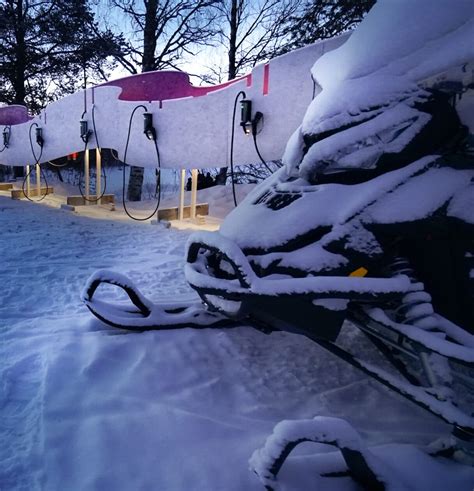
Equipped with standard J1772 connectors, the Nomad can be easily charged in any outdoor conditions. With standard level one and two charging and optional level three, it will integrate seamlessly with the existing EV network.
Every Taiga snowmobile features a 6.6-kW onboard charger with a J1772 port compatible with any charger that works with regular electric vehicles such as, say, a Ford Mustang Mach-E. Sorry, Tesla fans, it doesn't work with Superchargers.
Taiga says fully replenishing the standard battery with Level 2 charging takes about four hours. With the Level 3 onboard charger and rates between 30 and 40 kilowatts, charging the battery from zero to 80 percent is said to take about 30 minutes.
Here’s a breakdown of charging times:
- Level 1 (110V home outlet): 12 hours for a 100% charge
- Level 2 (220V residential and commercial): 3.5 hours
- Level 3 (DC Fast Charge): 40 minutes for 80%, 70 minutes for 100%
Pros and Cons
Seeing as no one else makes an electric snowmobile, the Nomad is kind of in a class of its own. But I know those of you out there reading these stats will have rightfully noticed that the Nomad’s estimated range, even in ideal conditions, is on the low side. And seeing as the Nomad is meant for trail-running, the range is pretty important.
When it goes on sale, the Nomad will start at $17,490, which is a lot more expensive than most gasoline-powered snowmobiles on sale today. This, by the way, does not include the 2,000 performance suspension with Elka dampers.
The all-electric and zero emissions aspects are cool, but are they worth ponying up an extra few thousand for? Especially when the Nomad’s reliability and ability to handle unmanicured trails are still unknown factors?
But don’t let those compromises from how fun the Nomad is to ride. The power is extremely smooth when accelerating and decelerating, it looks cool as hell, and you can do a motorized outdoor recreational activity without emitting smelly fumes.
The Future of Electric Snowmobiling
Electric Snowmobiles: Revolutionizing the Sport or Ruining It?
The shift toward electric power is only beginning. Manufacturers are developing longer-lasting batteries, faster charging systems, and more powerful motors each year. As more trails, resorts, and national parks promote eco-friendly recreation, electric sleds will play a leading role in shaping the future of winter sports.
The electric snowmobile is more than a machine-it’s a glimpse into the future of sustainable winter adventure. The future of snowmobiling is here.
tags: #taiga #electric #snowmobile